Operations · 13 min read
When a client leaves and wants to take the account
You have a thorough onboarding process and nothing at all for the other end. So the first real client exit becomes improvisation, and improvisation under pressure is where you give away work you owned or hold onto data you did not.
Priya Nandan
Delivery Lead
Published
The email is always shorter than the relationship was. Two lines, usually polite. They are moving on, or bringing it in-house, or a new agency is taking over, and could you please send over their account. The word "their" is doing a lot of work in that sentence, and how you answer it in the next hour decides whether this costs you a weekend or a quarter.
Most agencies have a careful onboarding process and nothing at all for the other end. So the first real client exit becomes improvisation, and improvisation under pressure is where you either give away work you owned or hold onto data you did not, and both are expensive in different ways. This is the offboarding you should have written down before you needed it. It is the exact mirror of the intake process, and it protects the same thing intake does: your margin, your reputation, and the promise that your client never found out who actually built the work.
What "the account" actually is, and what leaves with them
Before anything else, separate two things that a departing client, and half the agencies serving them, treat as one. There is the sub-account, and there is the system inside it.
The sub-account is a container. Inside it lives data that is genuinely the client’s: their contacts, the conversation history with their own customers, their calendars and booked appointments, their form submissions, the media they uploaded. There is also the system you installed: the workflows, the pipelines, the funnels, the email and SMS builds, the reporting. On this site that system arrives as a rebrandable white-label GoHighLevel snapshot, and the line between the client’s data and your build is the whole game at exit.
A client is entitled to their data. Whether they are entitled to your build is a licence question, and it is one you should have answered in writing long before this email arrived. The resale and licensing rights on a snapshot work the same way one layer down: what you may pass on is defined by what you were licensed to use, not by whatever happens to be sitting in the account today.
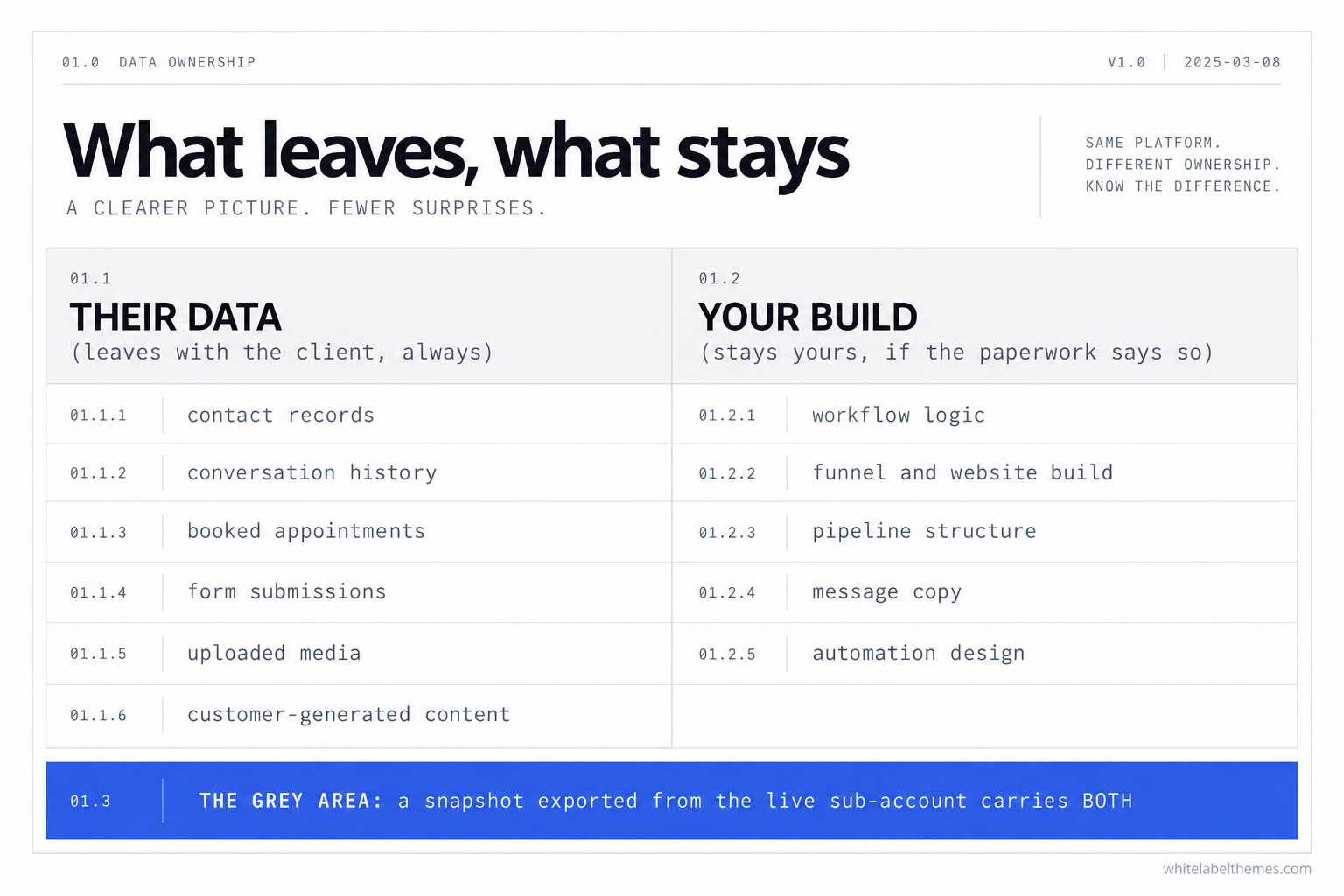
- Leaves with them, always: contact records, conversation history, booked appointments, form submissions, uploaded media, and anything their own customers generated. This is their business data. Withholding it is both wrong and, in most jurisdictions, unenforceable.
- Stays yours, if your paperwork says so: the workflow logic, the funnel and website build, the pipeline structure, the message copy and the automation design. This is the intellectual property you licensed in and rebranded, not something the client bought outright.
- The grey area: a snapshot you export from their live sub-account carries both at once. That single technical fact is what turns a clean exit into a supplier leak, and it is the failure mode that catches the most people.
Three ways a client leaves, and only one is a fire drill
The email reads the same every time, but there are three exits behind it and they carry very different exposure.
- They are going fully self-serve on their own GoHighLevel account. They want their data moved into an account they control and pay for. This is the cleanest of the three, because you are handing over data and competing with nobody.
- They are moving to another agency. Now a competitor will read whatever you send. Every place your name, or the name of whoever built the snapshot, is still buried in the account is about to be examined by somebody who does this for a living.
- They are cancelling and walking, with no destination yet. This feels like the easy one and is usually the messiest, because there is no receiving account, no deadline, and a strong temptation on both sides to leave it half done.
The middle case is the one that keeps agency owners awake, because it is where the promise this whole business runs on, that your client never sees who built the work, finally gets tested by somebody actively looking for the seam. The other two you can handle calmly. This one you handle carefully.
What a departing client actually costs you
Offboarding decisions get made emotionally, because in the moment the cost is invisible. Put a number on it and the decisions get easier, and the case for an ounce of prevention at signing gets impossible to argue with.
Take a mid-book client on a retainer, and keep every assumption visible so you can substitute your own. Say they pay you $1,200 a month, they have been with you fourteen months, and your gross margin on the retainer is 60 per cent once the platform cost and the delivery hours are out. Here is what walks out with the two-line email.
| Line | The assumption | What it costs |
|---|---|---|
| Retainer lost | Gone at the notice date | $1,200 a month, indefinitely |
| Acquisition, re-spent | You now pay again to win a replacement | Your blended cost to acquire, as a one-off |
| Offboarding hours | 6 to 10 hours to export, document and hand over | Unbilled by default, at your loaded rate |
| Empty-seat margin gap | The seat sits empty 1 to 3 months while you replace | 60% of $1,200, times the months empty |
The line people forget is the second one. Losing a client does not just stop a revenue stream. It forces you to spend, a second time, the most expensive money in the agency, which is the money it takes to win a client in the first place. The retainer is the visible loss. The re-acquisition is the one that quietly doubles the bill.
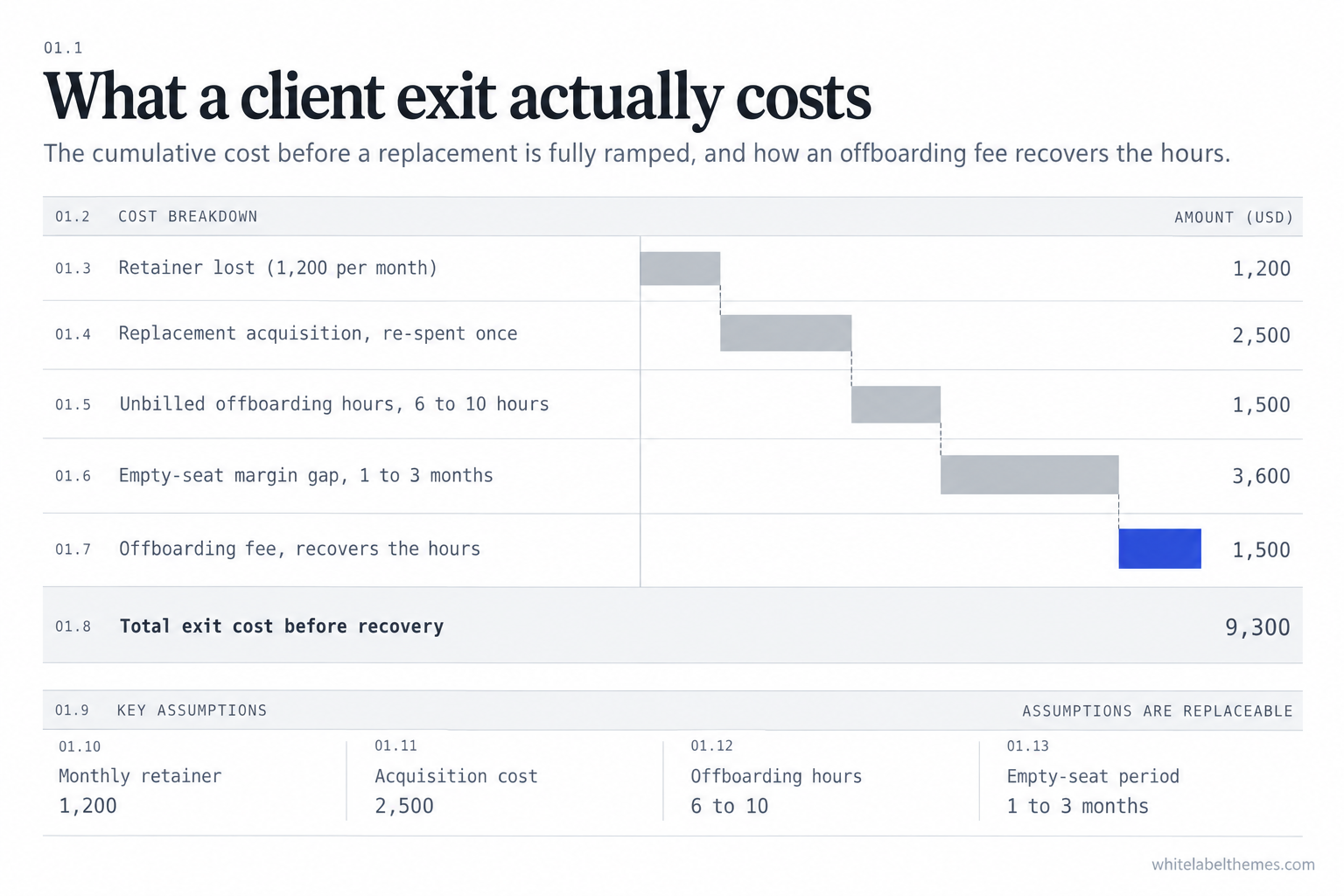
None of these numbers is ours to give you, and that is deliberate. Drop your own retainer, your own margin and your own acquisition cost into them. If you have never worked out that margin figure honestly, start with the true cost to deliver a GoHighLevel client, because the offboarding maths is meaningless until the delivery maths is real.
The five clauses that decide this before it happens
Every painful exit traces back to a conversation that never happened at signing. Five clauses turn the exit from a negotiation into an administrative step, and all five belong in the agreement, not in an email you write in a panic.
- Ownership. State plainly who owns the sub-account and who owns the build. The client owns their data. You own, or license, the system. Say nothing, and the default assumption sitting in the client’s head is that they bought all of it, which is the argument you least want to have on the way out.
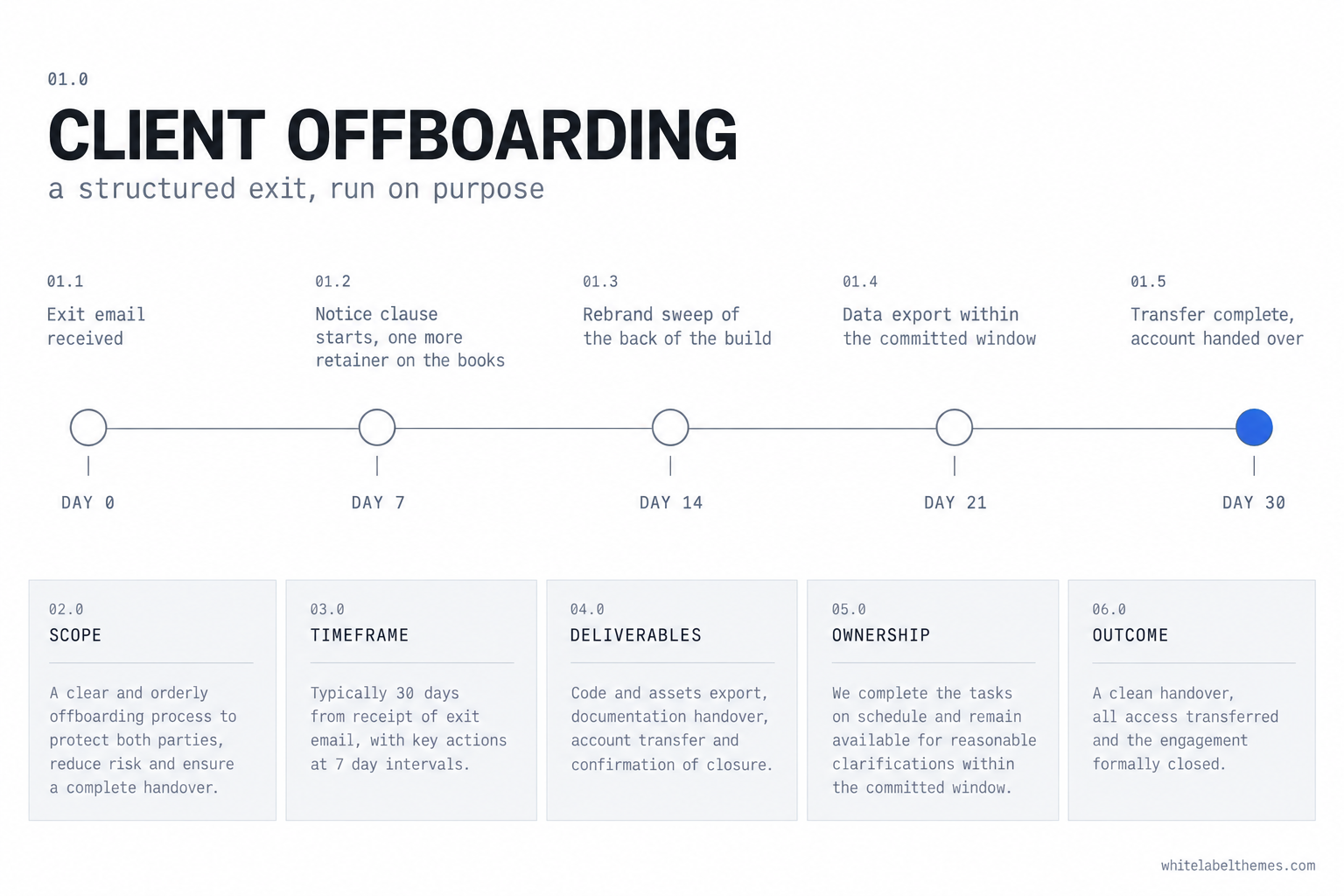
- Notice period. Thirty days minimum, in writing, tied to the billing date. This one line is the whole difference between an orderly handover and a Friday-night scramble, and it keeps one more retainer payment on the books during the fortnight you spend doing the work.
- Data export. Commit to exporting their data within a set window on request. Making this a promise you keep, rather than a lever you hold, is exactly what stops an exit turning into a chargeback or a one-star review that outlives the client.
- The offboarding fee. A defined, disclosed fee for the work of exporting, documenting and transferring. It is not a penalty. It is the price of hours you would otherwise eat, and it quietly tells a client who is about to undervalue the account that the account has a value.
- The build boundary. What the client may take of the system, and what stays your licensed property. This is where the snapshot licence you bought and the client agreement you wrote have to line up, because you can never grant a client more than you were granted yourself.
The notice period is also a pricing decision, not only an admin one, so if your retainers do not already carry one, fix it the next time you touch your retainer structure and rate card. And write the build boundary the same week you read your own supplier licence, so the two documents cannot contradict each other later.
Four ways offboarding goes wrong, and how to fix each
The clauses stop the commercial fights. These four are the operational ones, and every agency that has offboarded more than a handful of clients has been bitten by at least two of them.
The supplier leak on the way out
The symptom is a message from the receiving agency, or worse from the client, asking who a name in the account belongs to, because a workflow title, an email footer, a calendar confirmation or a sending domain still carries a brand that is not yours. The cause is that you rebranded the front of the build and never swept the back, and an exit is precisely the moment the back gets read by someone who cares.
The fix is to make a rebrand sweep a standing offboarding step, running the same list you use at install: sending domains, email footers, SMS sender IDs, calendar confirmation copy, workflow and folder names, funnel metadata and favicons, and the terms and privacy links. If you do not have that list written down, the guide to rebranding a GHL snapshot is where it lives, and it is worth running end to end before a single asset leaves the building.
You built it on your own domain and email
The symptom is that the client’s sending reputation, their calendar booking links and their form URLs all point at infrastructure you own, so a clean handover is impossible without breaking the touchpoints their customers use every day. The cause is that at onboarding you used your own domain to move fast, which works right up until the exit.
The fix is a client-owned domain and sending identity from day one. It is slower to set up, and it is the single decision that turns offboarding from a migration into a data export. If you take one operational lesson from this piece, take that one, because it is the difference between an afternoon and a fortnight.
No notice, so you eat the exit
The symptom is that the retainer stops the day the email lands, and you then spend a week doing unbilled export work for a client who has already left in every sense that matters. The cause is the absence of the two clauses above: no notice period, no offboarding fee. The fix is to add them, which converts the exit from unpaid emergency work into paid, scheduled work with a deadline everyone agreed to in advance.
You hold the data hostage
The symptom is that you withhold the export to force a conversation or to recover a disputed invoice, and it escalates into a chargeback, a public review, or a letter with a solicitor’s name on it. The cause is treating the client’s customer data as a bargaining chip. The fix is to separate the two disputes cleanly. Their data goes back on request, every time. An unpaid invoice is a debt you pursue on its own terms, never by holding customer records. The only lock-in that works is a system worth staying for, not a hostage worth fighting over.
Hand it over, or hold the line: the decision
When the email lands, the real decision is narrow. You are choosing how much of the build travels with the data, and on what terms. Score it on what you actually know, not on how the email made you feel, and the call almost makes itself.
| If this is true | Then |
|---|---|
| The client owns their domain and sending identity | Clean data export, no migration. Offboard, do not rebuild their world for them. |
| You own the domain and email | Plan a migration window before the notice period ends, or the handover breaks their live customer touchpoints. |
| They are moving to a competitor agency | Full rebrand sweep before anything leaves. Assume every field will be read by a professional. |
| They are going self-serve on their own account | Lower exposure. Put the effort into a documented, genuinely working handover. |
| Your agreement grants the build ownership to you | Export the data, keep the system. Offer a licensed or rebuilt version only if it suits you commercially. |
| No ownership clause exists at all | You are negotiating from zero. Give the data, protect the relationship, and write the clause before the next client signs. |
| An invoice is outstanding | Pursue the debt separately. Never couple it to the data request. |
| You would take them back in twelve months | Make the exit the best-run part of the relationship. It is the cheapest marketing you will do all year. |
The through-line under every row is the same. Give back what is theirs quickly and completely, keep what is yours if your paperwork earned it, and never once let a billing dispute contaminate a data request.
Three objections worth answering
These are the three arguments an agency principal makes to themselves before writing any of it down. Two of them are wrong in instructive ways, and one is right and worth saying out loud.
"The answer is just to make leaving impossible"
Lock-in through friction, their data trapped on your domain, no export path, does not retain clients. It produces angry ones who leave anyway and then tell people exactly why. The retention that compounds is a system that keeps working and a relationship that occasionally gets a call which is not a support ticket. That is a different problem from offboarding, and it is the one worth solving upstream: the third agency delivery ceiling is exactly this, the point where accounts are healthy, tickets are answered, and clients still leave because nobody spoke to them about anything but a fault in four months.
"An offboarding fee will scare people off at signing"
A disclosed, modest offboarding fee reads as professionalism, in the same way a notice period does, and for the same reason. The clients it deters are the ones already rehearsing the exit while they sign, and those are not clients whose departure you want to be subsidising later. Disclose it up front, in the agreement, next to the notice period, the way a fair final-sale term is disclosed before payment and never sprung afterwards. A term the client met at the start is a term. A term they meet only at the end is a trap, and it will cost you more than the fee ever recovers.
"I will just rebuild from my own snapshot for the next client"
This one is true, and it is the honest place to admit what a product on this site does and does not do for you. A snapshot catalogue genuinely makes the replacement client cheap: the second install of a system costs a fraction of the first, so re-acquisition on the delivery side barely registers. But that is an acquisition-side saving, and the client you just lost was a retention-side problem, and the two are not interchangeable. A snapshot makes replacing a client cheap. It does nothing whatsoever to stop the client leaving. If your net client count is flat while your delivery is genuinely excellent, no product we sell will fix it, because the problem is the relationship, not the build, and buying another tool is the most common way agencies avoid noticing that.
The cheapest exit is the one that never happens
Everything above assumes the client is already leaving. The larger money is upstream, in the exits you prevent, and the arithmetic there is lopsided enough to be worth stating with a real source behind it.
In their 1990 Harvard Business Review study "Zero Defections: Quality Comes to Services", Frederick Reichheld and W. Earl Sasser found that cutting customer defections by just five per cent lifted profit substantially across every service business they measured: by around 85 per cent for a bank branch network, about 50 per cent for an insurance brokerage, and roughly 30 per cent for an auto-service chain (hbr.org/1990/09/zero-defections-quality-comes-to-services). The exact figure moves by industry, but the direction never does. Retention is not a defensive activity you do to avoid a bad month. It is, mathematically, one of the highest-return things an agency can work on.
That reframes the whole offboarding conversation. The five clauses and the four fixes make a departure survivable. The account touch that is not a support ticket, the quarterly conversation about what the client wants next, is what makes the departure rarer. A good offboarding process is insurance. A retention habit is the return.
What none of this changes for the end customer
Through the entire exit, the thing the client’s own customers experience must not flicker. The call still gets answered at nine at night, the appointment still gets confirmed and reminded, the review request still goes out after the job, right up to the moment the account is genuinely in someone else’s hands. A botched offboarding that breaks a live customer touchpoint is the single fastest way to turn a quiet, professional departure into a loud and public one, because now the client has a story about the day their bookings stopped and your name is in it. Keep the end customer whole until the handover is complete. It is the last impression you get to leave, and it is the one that decides whether the twelve-months-later call ever comes.
The short version
A client leaving is not the emergency it feels like. Separate their data, which always goes back, from your build, which stays yours if the agreement says so. Know which of the three exits you are in, because moving to a competitor is the only one that needs a full rebrand sweep first. Settle ownership, notice, export, an offboarding fee and the build boundary at signing, and the exit becomes an administrative step instead of a negotiation. Never hold data hostage over an invoice. And remember the offboarding process is the cheap insurance, while the retention habit that stops the email arriving is the actual return.
Quick answers
Related questions
Keep reading
Next in the series
Checklist · 12 min
The GoHighLevel Client Onboarding Checklist
The account being ready is not the same as the client being onboarded. This is the fourteen-day sequence that happens around the build, under your brand, and it is what the client actually judges you on.
Terms · 11 min
GHL Snapshot Licensing and What You May Resell
Installing a snapshot for a client and selling that snapshot to another agency are two completely different rights. Most agencies assume they bought both. Almost none of them did.
Operations · 11 min
Scaling a GoHighLevel Agency: What Breaks and When
Agencies do not stall because they run out of leads. They stall because delivery hits a ceiling at a predictable client count, and the ceiling moves only if you fix the right thing in the right order.