Seasonal playbook · 13 min read
The January delivery backlog: planning your intake capacity
The last build went out before Christmas and the office closed for eleven days. Then four new clients, two renewal deliverables and a full existing book all wanted the first fortnight of January. Nobody oversold. Everything was promised into the same two weeks. Here is how to count that collision in hours before it lands, and which lever closes the gap.
Priya Nandan
Delivery Lead
Published
The last build went out on the twenty-third of December and the office closed for eleven days. On the sixth of January there were four new clients who had signed in the budget-season rush, two renewals that came with a new deliverable attached, and the same delivery capacity that had been merely full in November. Nobody had done anything wrong. Every one of those wins was a good win. They had just all been promised the same fortnight, and the fortnight does not stretch.
That is the January delivery backlog, and it is the most predictable capacity failure in the agency calendar. It arrives on schedule every year, it is caused by success rather than by any mistake, and it is almost always discovered in the second week of January rather than planned for in the first week of December. This is written for the principal who carries delivery, not for someone deciding whether to take on a second client, and every hours figure in it is an assumption you can and should replace with your own.
Why January is the collision, not the quiet month
The received wisdom is that January is slow. It is slow for sales, sometimes, while budgets reset. It is not slow for delivery. Delivery in January is carrying the compressed output of the two months before it, because three separate inflows all resolve to the same start date and none of them announces itself as an hours problem.
Budget season closes deals in the fourth quarter with a January start, because that is when the client’s new budget opens. The renewals you pushed through in November were sold as "from January your retainer now includes the quarterly automation review", and that review is build work, not a sentence. And the existing book does not pause for either of those, so account management, support and the quick changes that are never quick keep drawing down the same pool. Three inflows, one fixed number of hours, and a first week where half the team is still mentally on holiday.
The start dates that land in January were mostly set in the fourth quarter, which is why the Q4 retainer renewal and the January backlog are two halves of one decision. Promise a renewed book and a fresh intake the same hours and you have committed the same fortnight twice. If delivery is already what caps your growth in a normal month, read the agency delivery ceiling alongside this, because a seasonal spike sitting on top of a structural ceiling is a different problem from a spike on its own.
The mechanism: how the backlog actually forms
The backlog is not one event. It is four inflows meeting one number, and every one of them is invisible on a calendar that tracks clients rather than hours. Walk it clause by clause, because the fix depends on knowing which inflow is the one you can move.
- The December freeze. Deliveries stop for the holiday, but sign-ups and contracts do not. Every deal that closes between the twelfth and the thirty-first is real work that gets no hours until January, so January opens already behind by whatever December sold.
- The renewal deliverables. A price increase that was sold as a bigger retainer has to include the bigger thing. A quarterly review, a reporting upgrade or a new automation branch is a build, and if it was promised for January it is due in the same weeks as everything else.
- The intake wave. Budget-season deals almost all carry a January or first-of-February go-live, because the client wants to start when their new budget starts. That clusters the heaviest build work of the year into the shortest usable window of the year.
- The standing book. The existing clients are still there, still logging support tickets, still asking for the quick change. Business as usual has no deadline, so it gets counted at zero until it quietly eats the week.
The numbers: one January, counted in hours
The only way to see the backlog before it lands is to count it in hours, because everyone counts it in clients and clients hide the hours. Four new clients sounds like a good month. Four new systems built from scratch, plus two renewal builds, plus a standing book, against a holiday-shortened team, is a number you can actually compare to the hours you have. Here is one worked January. Every input is illustrative and replaceable: put your own team, your own per-build hours and your own book size in.
Assume a two-person delivery team. In a normal month each person turns roughly 120 hours into actual delivery once sales, admin and their own inbox are taken out, so about 240 delivery-hours exist. January starts a week late for at least one of them, so call it 200 hours available. Now the commitments, priced two ways: building each new client’s system from scratch at around 30 hours, or installing a bought baseline and rebranding it at around 6.
| What January committed | Hours if you build from scratch | Hours if you install a snapshot |
|---|---|---|
| 4 new-client systems | 120 | 24 |
| 2 renewal deliverables | 20 | 20 |
| 12 existing clients, business as usual | 96 | 96 |
| Total hours committed | 236 | 140 |
| Hours available in January | 200 | 200 |
| Balance | minus 36 | plus 60 |
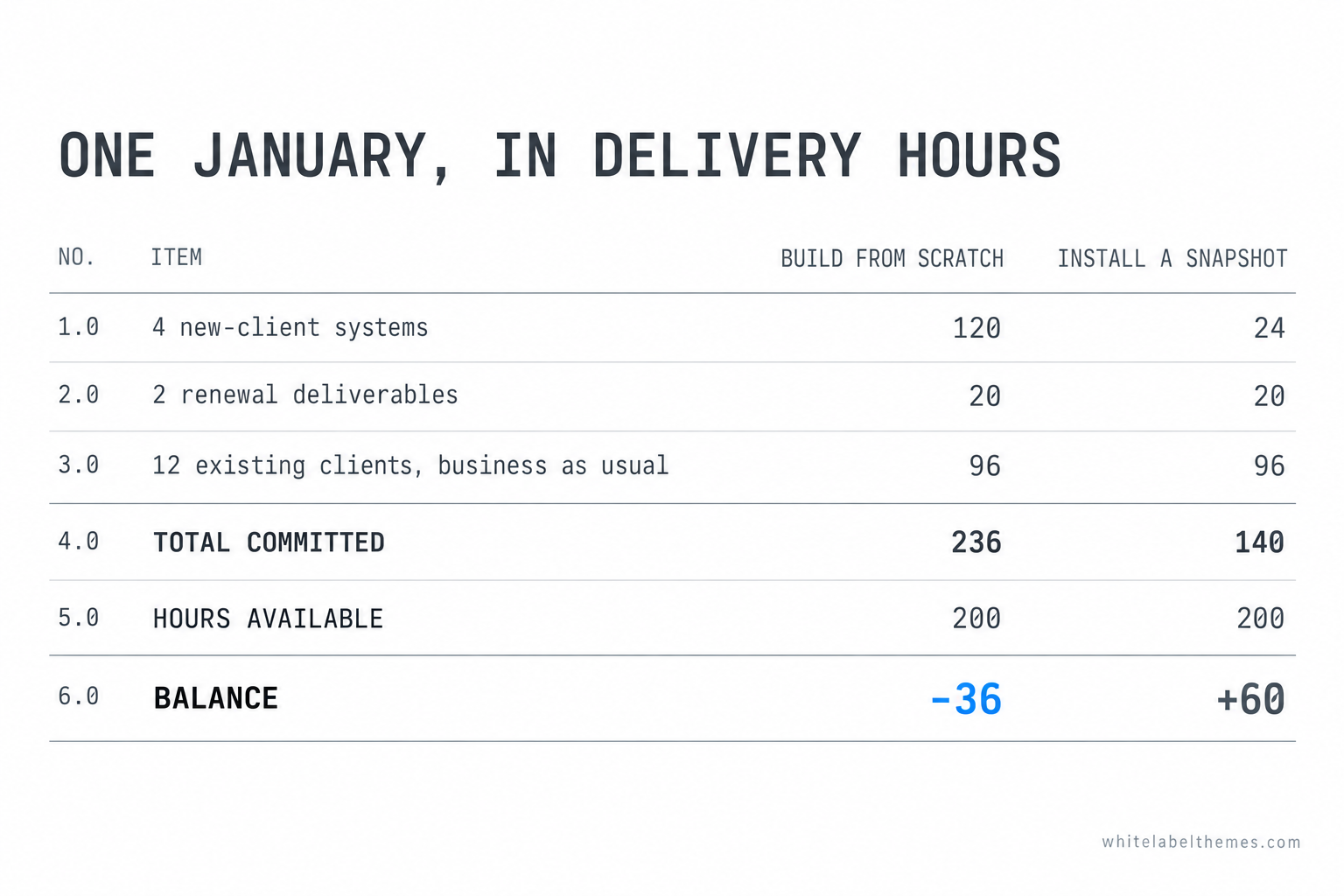
Read the balance row twice. Build everything from scratch and January is 36 hours underwater before a single job overruns, and jobs always overrun in the week you onboard them. Install the four systems from a baseline you rebrand, and the same month finishes 60 hours clear, with room for the overrun that always comes. The variable that moved the number was not how many clients you took or how good your team is. It was how each new system got built.
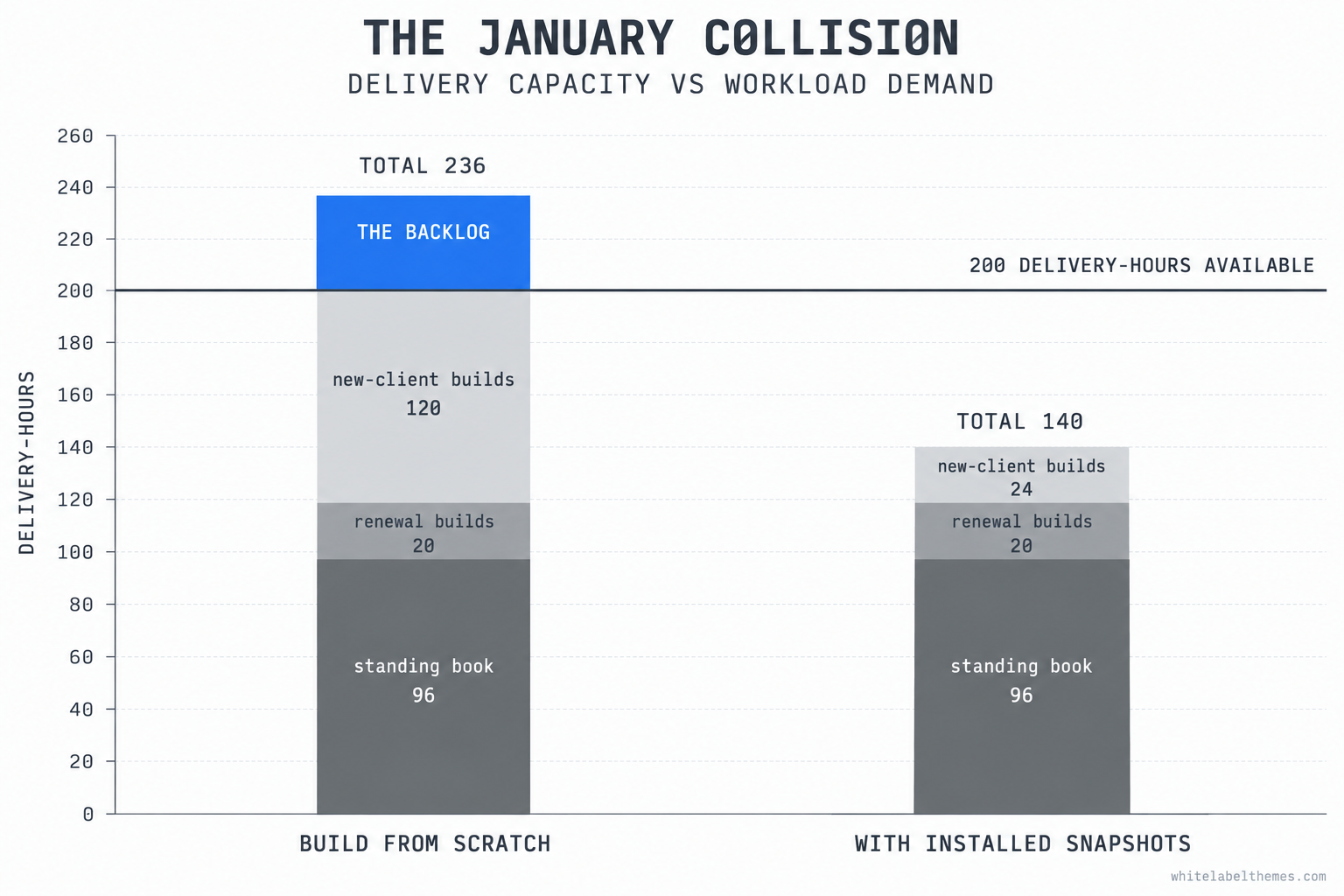
If your per-build number is a guess, that is the first thing to fix, because the whole ledger rests on it. The true cost to deliver a GoHighLevel client breaks the hours down properly, and the choice between buying a baseline and building one from scratch is what sets whether the new-client line reads 30 hours or 6. Neither is a January decision, but January is where getting them wrong finally shows up on the calendar.
Where the hours actually go
The line that surprises people in that ledger is not the new builds. Everyone expects new builds to be expensive. It is the standing book, the 96 hours of business as usual that never appears on a plan because it has no due date. Work with a deadline gets scheduled. Work without one gets done at zero on the plan and at full cost in reality, and in January it is the first thing the new builds borrow from.
The hours that hide inside a normal month, and that a strong January drains first:
- Support tickets and "quick questions", which cluster in the first fortnight because clients are also back from holiday and back in their accounts.
- The change that was quoted as ten minutes and is a workflow rebuild once you open it.
- Account reviews and check-in calls that got deferred over the holiday and now all come due at once.
- QA on your own past work, which is the first thing dropped under pressure and the thing that generates next month’s support load when it is dropped.
- The founder’s inbox, which is a delivery queue nobody has ever put an hours figure against.
Every new sub-account you light up in January also switches on a standing platform line. HighLevel publishes $97 a month for Starter, $297 for Unlimited and $497 for Agency Pro (gohighlevel.com/pricing, confirmed via search snippet this run, not independently fetched), so the cost base moves the moment the client does. But the platform bill is the smaller problem and the easy one to model. The hours are the constraint that actually caps January, and the full cost of running the agency is where the money side belongs. This piece is about the fortnight, and the fortnight is measured in hours.
Four ways the backlog goes wrong
The backlog has a small number of predictable failure modes, and each one is avoidable once you have seen it. Here are the four that do most of the damage, with the symptom that surfaces first, the cause underneath it, and the fix.
The silent slip on the existing book
The symptom is a March churn number you cannot explain, on accounts that seemed fine. The cause is January: the new clients had deadlines and the existing ones did not, so the standing book quietly lost its hours to the intake and nobody logged it as a decision. A client who gets ignored for a fortnight does not complain in the fortnight. They complain in the spring, by leaving. The fix is to ring-fence a floor of standing-book hours before you schedule a single new build, and to treat that floor as unavailable capacity, not as slack to raid. The book you already have is the one that pays the rent.
The three-week onboarding
The symptom is a new client whose go-live keeps sliding while they wait, forming their first impression of you out of delay. The cause is that onboarding which should take four days takes three weeks because delivery is saturated and the onboarding work is competing with four other builds for the same person. The fix is to make onboarding independent of build capacity: a tight, repeatable sequence that runs on a checklist rather than on your best builder’s attention. The client onboarding checklist and the snapshot import checklist exist so the fortnight’s onboarding does not depend on the one person who is also building. A system somebody can follow is capacity that does not have to be you.
Hiring into the crunch
The symptom is a builder who starts in mid-January and is not actually helping until March. The cause is a permanent decision made to solve a two-week problem: a new hire needs ramp time, your systems documented and someone to answer their questions, and all three of those cost the exact hours you are already short. You spend February teaching and carry the salary straight through the spring trough that follows the January spike. The fix is to match the duration of the lever to the duration of the gap. A recurring monthly overload is a hire. A seasonal fortnight is not, and solving a seasonal fortnight with a permanent salary is how a busy January becomes a thin, over-staffed spring.
Quoting a January start you cannot hit
The symptom is a slipped go-live date in the client’s first week, which is the single worst week to miss one. The cause is a sales conversation in December that promised a start date against an empty calendar in the seller’s head rather than the real commitments already stacked on January. The fix is to quote start dates against measured capacity and to stagger them on purpose. Not every January client has to launch on the second. Booking go-lives across six or eight weeks instead of two costs the client nothing they will notice and turns an impossible fortnight into a manageable quarter.
The decision: which lever closes the gap
Once the deficit is a number, the fix is whichever lever closes it at the lowest cost to margin and the least risk, and the right lever depends entirely on whether the gap is seasonal or structural. Here are the five, with what each does to the hours and when to reach for it.
| Lever | What it does to the hours | Pick this if |
|---|---|---|
| Install a bought snapshot instead of building | Cuts each new build from around 30 hours to around 6, so the intake stops being the heavy line | The vertical is well understood and your constraint is the calendar, which is most agencies most Januaries |
| Subcontract to a white-label fulfilment desk | Moves build hours off your team entirely for a fixed monthly line | The overload is every month, not just this fortnight, and you want variable labour turned into a fixed cost |
| Stagger the go-live dates | Spreads the same intake across six to eight weeks instead of two | The clients are flexible on start date, which they usually are once you ask |
| Move the renewal deliverable to February | Takes one build out of the collision without touching the price | You can renegotiate the date rather than the number, and the client is not waiting on it to renew |
| Hire a builder | Adds capacity permanently, but not until roughly March | The gap is structural and recurs every month, never to solve a single seasonal spike |
The first lever is the fastest and the one most agencies reach for last. Installing a well-built white-label snapshot and rebranding it is the same delivered outcome as building from scratch in a fifth of the hours, which is exactly the 96-hour swing the ledger showed. When the overload is structural rather than seasonal, a white-label fulfilment retainer converts the variable build labour into a fixed monthly line, and the pricing page’s fulfilment calculator will size it against your own client count.
Three things you are already arguing back
"I will just work the two weeks"
You will, and it will not do what you think. The hours do not vanish because you skip sleep, they move onto the accounts you stopped watching while you powered through. The January you muscle through by working weekends is the same January that produces the March churn on your neglected book, so the cost did not go away, it moved to a quarter where you cannot see it was you who caused it. Working the fortnight is not a plan, it is the absence of one, and it is the most expensive option on the list because you pay for it twice.
"Buying snapshots feels like admitting I cannot build"
You can build. That was never the question. The question is whether assembling four appointment-reminder systems from scratch in the same fortnight you also onboard them is the best use of the only hours you have. In a vertical you understand, an installed baseline plus your own rebrand is the same client outcome in a fraction of the time, and the client cannot tell the difference because there is no difference to tell. Where the value actually sits is the buy-or-build line: buy the baseline, then build the twenty per cent that reflects how you sell. That is not admitting anything. It is spending your scarce hours on the part the client is paying you for.
"I should just take fewer clients in January"
Sometimes that is the right answer, and it is the honest exception where buying anything from us is the wrong move. If your book is small and January genuinely has slack, do nothing. Take the clients, build every one yourself, keep the whole margin, and come back when capacity is actually the constraint. This playbook is for the agency whose fortnight is already full before the intake lands. Do not buy capacity you do not need, and do not turn down good clients you could serve. The skill is reading which of those two situations you are actually in, and the hours ledger is how you read it.
Run the January on purpose
The backlog arrives whether or not you plan for it. The only choice is whether you meet it with a number or with a surprise. Count the committed hours in December, not in the second week of January when the deficit is already on top of you. Ring-fence the standing book, price each new build honestly, and pick the lever whose duration matches the gap. If delivery is the thing capping what you can say yes to, start with the fulfilment calculator on the pricing page, put in your real client count and your real build hours, and see the January deficit as a figure you can act on while there is still time to act.
Quick answers
Related questions
Keep reading
Next in the series
Operations · 11 min
Scaling a GoHighLevel Agency: What Breaks and When
Agencies do not stall because they run out of leads. They stall because delivery hits a ceiling at a predictable client count, and the ceiling moves only if you fix the right thing in the right order.
Seasonal playbook · 12 min
Q4 Retainer Renewals: The Price-Increase Conversation
Holding a retainer book flat for another year is a decision, and most agencies make it by accident every December. Here is how to run the fourth-quarter renewal on purpose, with the arithmetic that shows why the raise is a retention lever rather than a churn risk.