Seasonal playbook · 12 min read
Q4 retainer renewals: the price-increase conversation
Holding a retainer book flat for another year is a decision, and most agencies make it by accident every December. Here is how to run the fourth-quarter renewal on purpose, with the arithmetic that shows why the raise is a retention lever rather than a churn risk.
Priya Nandan
Delivery Lead
Published
Last December the invoices went out on time and at exactly the same rate as the year before. Every one of them. Nobody sat down and decided that. It was the default, and the default is what runs an agency that has not planned its renewals. A book that should have moved up eight to twelve per cent held flat for another twelve months, and the gap compounded quietly into the spring.
The fourth quarter is when that gets decided, one way or the other. This is the playbook for deciding it on purpose. It is written for the principal who carries the book, not for someone learning what a retainer is, and every figure in it is an assumption you can replace with your own numbers.
Why the fourth quarter is the only clean window
Client budgets reset in January. Most annual agreements anniversary somewhere near the turn of the year. And January is exactly when new-client intake starts competing for your delivery hours, which means the rate has to be settled before intake begins, not during it. Raising prices in the first quarter means raising them while you are also onboarding, and that is the worst possible week to ask an existing client for more money.
There is also a mechanical reason. A rate change needs lead time to be fair and to be legal in most places. A notice given in October, sixty to ninety days ahead, lands a January effective date cleanly. A notice sent in the last week of December, effective on the next invoice, reads as an ambush and gets treated like one. The window that works is short, and it opens now.
The other thing the quarter forces is a capacity decision. If your delivery is already the thing that caps your growth, a rate rise alone will not fix it, and the agency delivery ceiling is worth reading alongside this before you set next year’s card. You cannot promise a January intake and a renewed book the same hours.
How a rate change actually moves through a book
A price increase is not an email. It is a sequence, and skipping a step in it is what turns a routine renewal into a dispute in month nine. Run it clause by clause.
- The anniversary date. Every retainer has one, the day it started. A blanket "everyone goes up on the first of January" ignores those dates and manufactures a cohort of clients who all receive bad news in the same week, then compare notes.
- The notice period. Read what the agreement says. If it says nothing, sixty to ninety days in writing is the fair default and the one a court in most jurisdictions will expect to see.
- The effective date. Tie it to the client’s anniversary or to a clean quarter boundary. Never tie it to "your next invoice", which gives no notice at all.
- The mechanism. Decide whether the change is a new deliverable added, an inflation pass-through, or a full re-scope. The number is easier to accept when it is attached to a reason the client can see.
- The record. Get the new rate acknowledged in writing, countersigned or confirmed by reply. An increase nobody wrote down becomes an argument the first month cash is tight.
The arithmetic of holding flat
Run the numbers before the conversation, because the numbers are what make the conversation easy. Take a book of eighteen retainers at an average of $1,400 a month. Every figure here is replaceable with your own, and you should replace them.
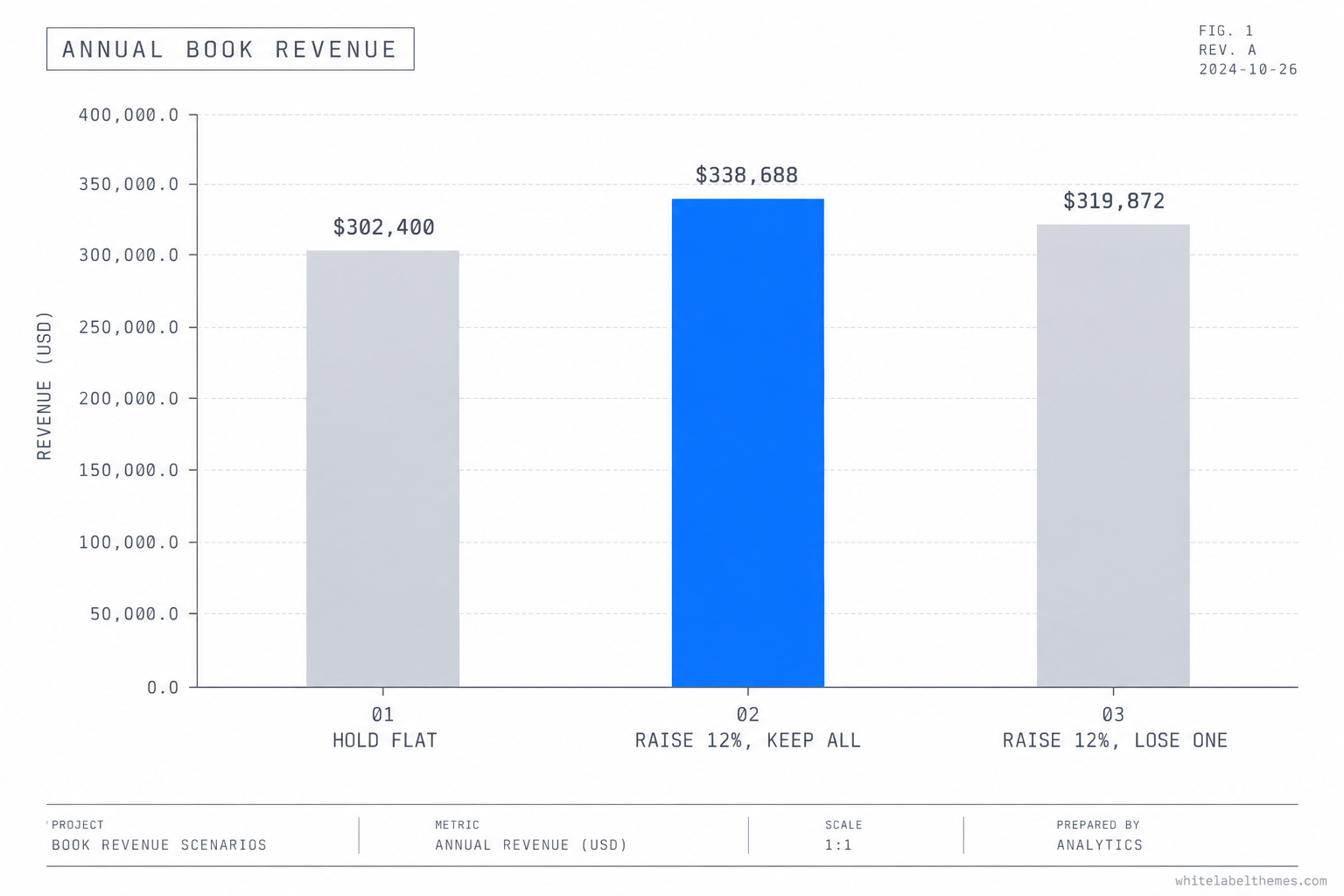
| Scenario | Clients kept | Annual book revenue | Versus holding flat |
|---|---|---|---|
| Hold the whole book flat | 18 | $302,400 | baseline |
| Raise 12%, keep every client | 18 | $338,688 | plus $36,288 |
| Raise 12%, one client leaves over it | 17 | $319,872 | plus $17,472 |
Read the bottom row twice. You raised the whole book by twelve per cent, one client walked out over it, and you still finished seventeen thousand dollars ahead of where holding flat would have left you, on one fewer account to serve. The client who leaves over a twelve per cent increase is almost always your least profitable and most price-sensitive one, and the hours they freed up absorb a replacement at the new rate.
Now compound it. A year skipped is not a year deferred, it is a year gone, and the base you failed to raise is the base every future increase is calculated from. Hold that same book flat for three years while your own costs rise, and you are not eight or twelve per cent behind, you are running a book priced for the market two years ago against a cost base priced for today. The gap does not wait for you to notice it. That is why the decision has a season: the cost of getting it wrong is small in any single quarter and large across the two or three quarters an agency typically lets slide before someone finally looks at the margin and asks what happened.
The retention economics point the same way. Harvard Business Review put the cost of winning a new customer at five to twenty-five times the cost of keeping an existing one (hbr.org, 2014, confirmed via search snippet this run, not independently fetched). Bain and Company is where the companion figure comes from: a five per cent lift in retention raises profit somewhere between twenty-five and ninety-five per cent (confirmed via search snippet this run). Both say the same thing to a book owner. The client you keep at a higher rate is worth far more than the one you have to go out and replace, so a well-run increase is a retention instrument, not a churn risk. If you want the underlying cost model, the cost to deliver a GoHighLevel client is the number the raise has to clear before any of it is margin.
The Q4 renewal calendar
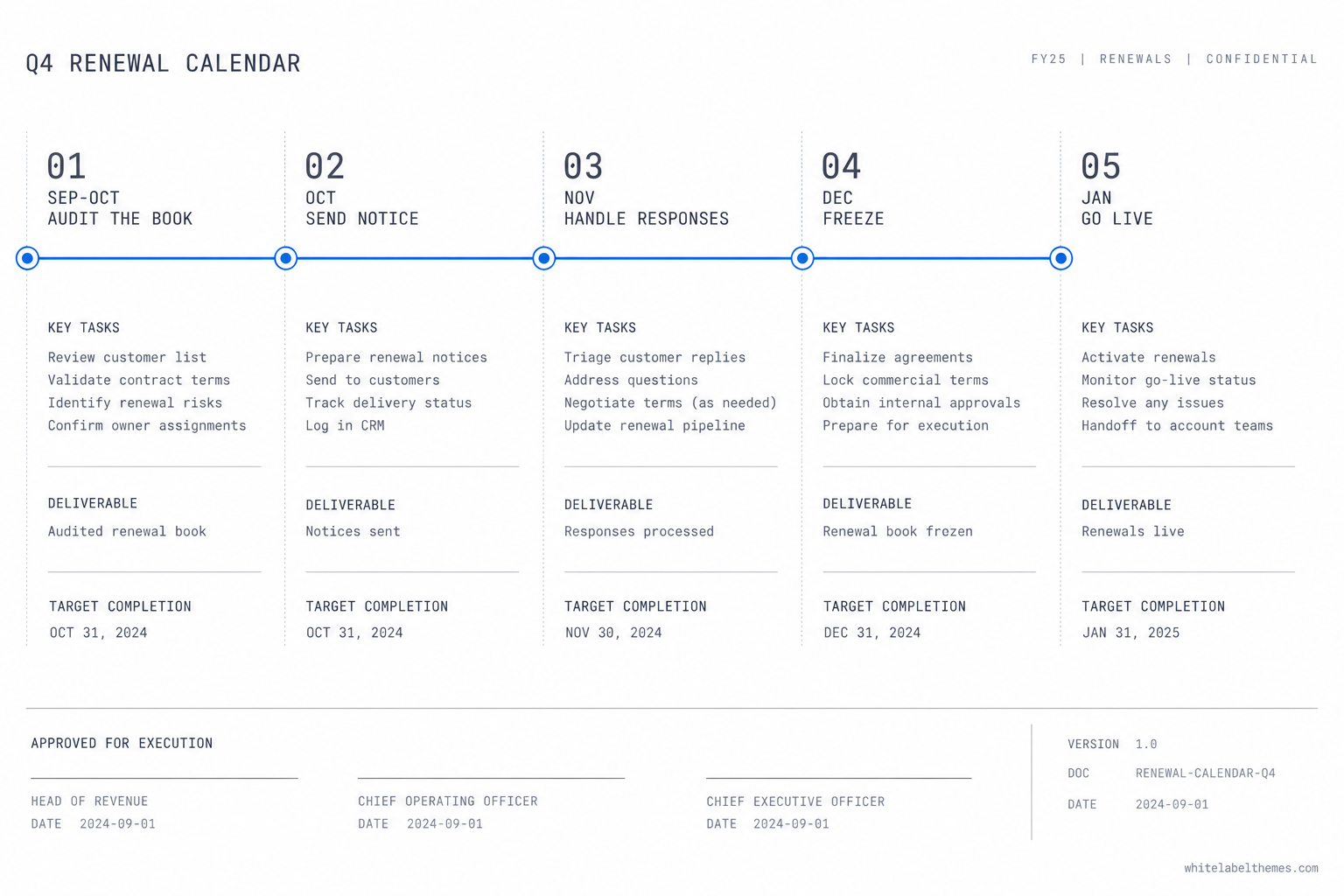
The reason renewals go badly is almost never the number. It is the timing. Everything gets left until the invoice is due, the notice is too short to be fair, and the difficult calls collide with the holiday lull when nobody is reachable. Give the quarter a spine and the whole thing gets calmer.
| Window | What you do | What you stop doing |
|---|---|---|
| Mid-September to early October | Audit the book. Rank every retainer by margin and by months since the last new deliverable. Decide who is raised, who holds, and who you let go. | Guessing which clients are profitable. |
| October | Draft each increase and attach a new deliverable to it. Send written notice, sixty to ninety days ahead of a January effective date. | Waiting for a "good moment" that never arrives. |
| November | Handle the responses. The calls happen here, not in December. Re-scope where needed, confirm every outcome in writing. | Negotiating over email threads that never close. |
| December | Freeze changes. Make no new promises during the lull. Build the January intake against the new rate card. | Reopening settled numbers under holiday pressure. |
| January | The new rate is live. New clients onboard at the new card. Intake is not fighting a renewal backlog, because the renewals closed in November. | Onboarding and renegotiating in the same week. |
What to stop doing before the quarter ends
A seasonal playbook is half about what you start and half about what you finally stop. These four habits are the ones that quietly cap a book, and Q4 is when you break them.
- Stop closing new clients with a founding-rate discount you will carry for the life of the account. A discount given to win the deal is a permanent tax on your own book, and it compounds every year you fail to step it up.
- Stop auto-renewing at the old rate by silence. Silence is a real-terms price cut in any year inflation is positive, and it is the single most expensive habit in this list.
- Stop pricing the platform line at cost. HighLevel publishes $97 a month for Starter, $297 for Unlimited and $497 for Agency Pro (gohighlevel.com/pricing, confirmed via search snippet this run). If you pass a sub-account through at exactly what the platform charges you, you are subsidising your client’s software out of your own margin.
- Stop discovering the builder’s name in the email footers during a renewal audit. A client who finds your supplier mid-renewal has just found their own negotiating position, so the rebrand sweep belongs before the conversation, not after it.
That last one is worth a full pass every renewal season. The places a builder’s identity leaks are predictable, and the rebrand and import sweep is the checklist for closing them. A snapshot built to be genuinely white label from the start, rather than found-and-replaced, is the difference between a renewal you control and one where the client holds a card you did not know was in play.
Four ways the renewal goes wrong
The renewal conversation has a small number of predictable failure modes, and every one of them is avoidable if you have seen it before. Here are the four that account for most of the damage, with the symptom that shows up first, the cause underneath it, and the fix.
The blanket email
The symptom is a bad morning: half your book replies within hours of the same message, several of them have already compared numbers with each other, and one or two escalate into calls you were not ready for. The cause is a single increase sent to everyone on one date, ignoring the fact that each retainer has its own anniversary and its own history. The fix is to stagger the notices by anniversary and send each one personally, referencing that client’s account and results. A price change is a relationship event, not a mail merge, and the moment it reads as a mail merge you have handed the client a reason to treat it as negotiable.
The naked increase
The symptom is the question you cannot answer: "what am I actually getting for the extra?" The cause is that the number went up and nothing was attached to it, so the client is being asked to pay more for exactly what they had last month. The fix is to attach something real to every increase, most often a quarterly automation review or a reporting upgrade the client will genuinely use, so the conversation is about a bigger thing at a bigger price rather than the same thing at a worse one. This is not a trick. The extra work is the justification, and if you cannot name any extra work then the honest move is a smaller increase or a hold, not a bluff.
The platform-cost audit
The symptom is a client forwarding you HighLevel’s public pricing page and asking why their platform line is three times what they can see it costs. The cause is aggressive markup on a number anyone can look up in thirty seconds. The fix is to keep the platform line modest and transparent, and to recover your margin on the managed-system and growth lines instead, where the value is your work and not a subscription the client can price themselves. A markup they can catch does not just lose you that line, it makes them wonder what else on the invoice is padded, and that suspicion is expensive in a renewal.
The retainer that is profitable on paper
The symptom is the one that hurts most: the book grew, you pushed the increases through, and the bank balance did not move. The cause is almost always a delivered cost that drifted upward through the year, as support load and account-management time crept in, while the rate you set was sized against last year’s cost. The fix is to re-measure what one client actually costs you to deliver before you set the raise, not after. A twelve per cent increase sized against a cost that has already risen fifteen per cent is a pay cut with extra steps, and you will not feel it until the quarter after you have committed the numbers.
Which clients get raised, held, or let go
Not every account gets the same move, and treating them alike is how you lose the wrong ones. Triage the book against clear signals before you draft a single notice. Score each retainer on where it sits, then apply the move the signal calls for.
| What the account looks like | The move |
|---|---|
| High margin, logs in weekly, results have landed | Raise, and attach a growth deliverable they will actually use. |
| Mid margin, quiet but stable, always pays on time | Raise modestly, anchored to the quarterly review. |
| Below your delivered cost, heavy support load | Raise hard to your real rate. Accept the risk they leave, because keeping them is the loss. |
| Still on a founding-rate discount | Step to the card rate over two cycles, in writing, starting now. |
| Never logs in, no attachment to the account | Raise and expect a decision. Either outcome improves the book. |
| Chronically late, disputes line items | Managed exit. Replace the slot with a January intake at the new rate. |
| A logo you use in your own sales | Hold one more cycle as a stated exception, documented so it is a choice and not a leak. |
| Long tenure, contract silent on increases | Raise with a full ninety days notice and a new deliverable to anchor the number. |
The line that ends the exercise: raise the accounts that respect the work, exit the ones that cost you to keep, and hold only the handful you can name a strategic reason for. If you cannot name the reason out loud, it is not an exception, it is an account you are underpricing out of habit.
Three arguments you are already having with yourself
"I will lose clients if I raise"
You will lose the least profitable one, occasionally, and the arithmetic above shows that costs you almost nothing. What you are actually afraid of is losing a good client, and good clients do not leave over a fair, well-noticed, well-framed increase attached to something new. They leave over being taken for granted, which is what holding flat for three years actually communicates.
"My market cannot bear a higher rate"
Then you are pricing against your own hourly rate instead of the client’s number. A recovered missed call or a kept appointment is worth more to them than the increase costs, and the whole point of value-based retainer pricing is to move the conversation onto their figure and off yours. In a vertical like a law firm, where a single signed retainer is worth thousands, the client’s own number dwarfs any increase you would ever put in front of them. A market that genuinely cannot bear a rate rise is a market where your delivered cost is too high, which is a different problem with a different fix.
"I should just win more clients instead of raising"
New clients cost five to twenty-five times what it costs to keep the ones you have, and each one consumes delivery hours you may not have spare. Raising the book you already serve is the cheaper growth. The honest exception, and the case where buying anything from us is the wrong move: if your book is small and your delivery has real slack, do not add a fulfilment retainer or subcontract anything. Raise your rates, keep the whole margin, and come back when capacity is the constraint. When it is, a white-label fulfilment retainer converts variable delivery labour into a fixed monthly line, which is what lets a rate rise become margin instead of overtime.
Run the quarter on purpose
The renewal happens whether or not you run it. The only question is whether the rate that ships in January is one you chose or the one your billing system defaulted to. Audit the book this month, notice the increases in October, close them in November, and go into intake with a rate card you set deliberately. If delivery is the thing stopping you from raising, fix that first: start with the fulfilment calculator on the pricing page, put your own client count and build hours into it, and see whether a fixed delivery line frees the capacity a rate rise on its own never will.
Quick answers
Related questions
Keep reading
Next in the series
Operations · 10 min
White-Label GHL Fulfilment: How to Price Agency Retainers
Cost-plus pricing caps your agency at the size of your delivery team. Here is the maths behind value-based retainers, with the four numbers that decide whether a retainer survives month four.
Margin maths · 11 min
What One GoHighLevel Client Actually Costs You to Deliver
Most agencies know their revenue per client to the dollar and their cost per client to the nearest guess. Here is the ledger that closes the gap, and the line that is almost always missing from it.