Seasonal playbook · 13 min read
Setting your agency rate card for 2027
Most agencies do not have pricing. They have a year of guesses, each one made on a sales call under mild panic and then kept forever. The fourth quarter is when you replace the guessing with a card you set on purpose, and here is how to build one from the cost up.
Marcus Feld
Head of Build
Published
A prospect asked what you charge, and you told them a number you assembled on the call. It felt about right. It was anchored to nothing except the fear of quoting too high and losing the deal, and it is now the rate that account pays for as long as it stays with you. Do that forty times across a year and you do not have pricing. You have forty separate guesses, each one a small permanent decision made under mild panic, none of them written down anywhere you could defend to yourself in January.
A rate card is the alternative, and the fourth quarter is when you build next year’s. This is the playbook for setting it on purpose, written for the principal who signs the deals rather than for someone learning what a retainer is. Every figure in it is an assumption you can and should replace with your own, and the point of the exercise is to replace them once, carefully, in October, so you are not improvising them one prospect at a time all through the year.
What a rate card actually is
A rate card is not a price list you email to prospects. It is the internal document that has already decided every number before a prospect opens their mouth. When somebody asks what you charge, the card is the reason you answer in two seconds with a figure you can stand behind, instead of stalling, guessing, and quietly discounting yourself out of a year of margin. You can publish part of it or none of it. What matters is that it exists and that you priced it deliberately, away from the pressure of a live call.
The card and the renewal are two halves of the same year. The card sets what new business pays going in; the Q4 retainer renewal moves the book you already carry up toward it. Build the card first, because you cannot run a renewal toward a number you have not set, and January intake will start competing for your delivery hours the moment the card is live.
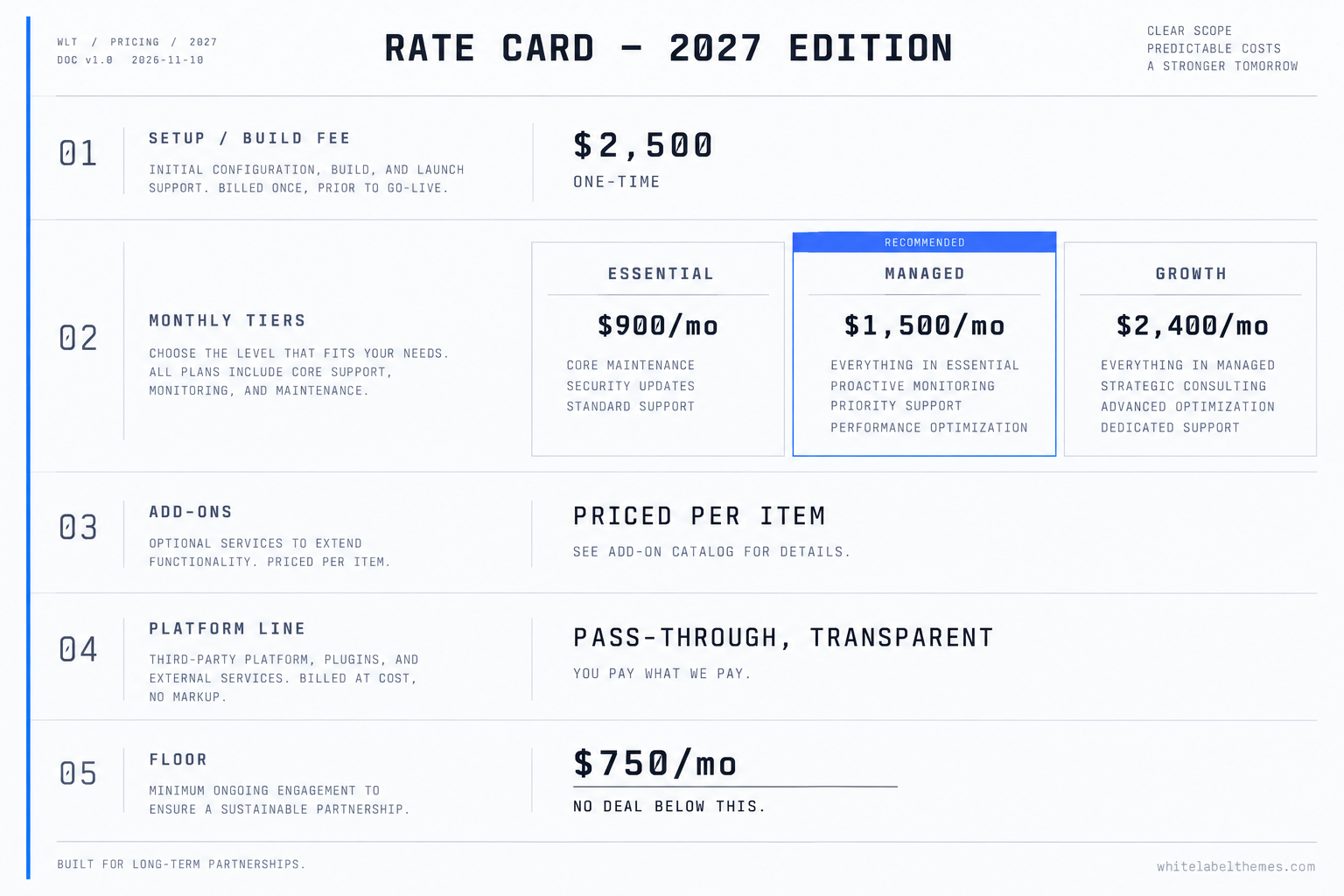
The five lines every card carries
A card that only lists monthly retainers is half a card. The whole thing has five lines, and the agencies that lose money usually lose it on the ones they forgot to price at all. Set each line separately, because each one answers a different question and gets paid for by a different thing.
| Line on the card | What it prices | Paid for by |
|---|---|---|
| Setup or build fee | The one-time work of standing the client up: the snapshot, the rebrand, the import, the onboarding fortnight | A one-time charge, taken before any work starts |
| Monthly tiers | The ongoing managed service: account management, reporting, support, the growth work | The recurring retainer, where your margin actually compounds |
| Add-ons | Anything optional and discrete: an extra automation build, a migration, a paid install | Priced per item, quoted off the card, never thrown in free |
| Platform line | The sub-account the client runs on, passed through from the platform you resell on | A modest, transparent markup, kept where a client can check it |
| The floor | The number below which no deal gets written, whatever the prospect says | Nothing. It is a hard stop, not a line item |
The floor is the line most agencies do not have, and it is the one that saves you. It is the single number you decide in October, in calm, that you refuse to cross in March, on a call, with a prospect telling you their budget is tight. Without it, every negotiation bottoms out at whatever the client first names, and a book priced off client budgets is a book priced by people who are not paying your costs.
Build the middle tier from the cost up
Most cards are built top down: you pick a monthly number that sounds like a real agency and work backwards to justify it. Build the middle tier the other way, from your cost up, because the cost is the only number on the card that is not a matter of opinion. Everything else is positioning. The cost is arithmetic, and if the tier does not clear it, no amount of positioning saves you.
Start with what one client actually costs you to serve in a month, which is almost never what agencies think it is. Work through the cost to deliver a GoHighLevel client before you price a single tier, because the number you set the tier against has to be this year’s delivered cost, not last year’s, and support load has a way of drifting upward while nobody is watching the line.
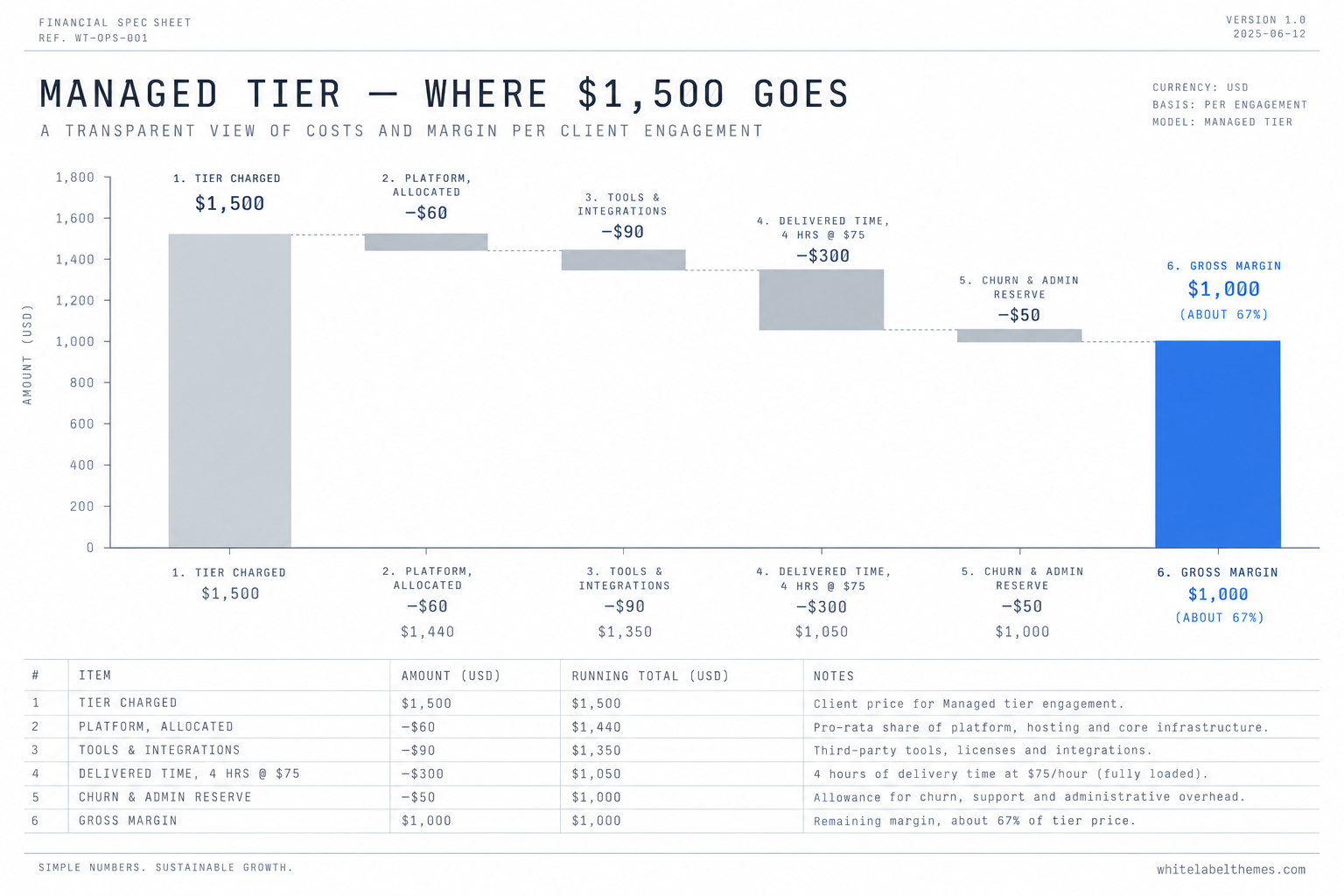
Here is the middle tier of a card built from the cost up. Call it the Managed tier, priced at $1,500 a month. Every figure is an assumption, and yours will differ; the structure is the part to copy, not the numbers.
| Line | Per month | What is left |
|---|---|---|
| Managed tier, as charged | $1,500 | $1,500 |
| Platform, one sub-account allocated from your Unlimited plan | minus $60 | $1,440 |
| Tools and integrations allocated to the account | minus $90 | $1,350 |
| Delivered time, four hours at $75 an hour | minus $300 | $1,050 |
| Reserve for churn and admin | minus $50 | $1,000 |
| Gross margin on the tier | $1,000 | about 67% |
Two things make that tier work, and both are decisions you take at the card, not on the call. The platform line is allocated, not retail: you are on an Unlimited plan that carries many sub-accounts, so each client is charged a share of it, not the sticker price of a plan they will never see. And the build is nowhere in this table, because the build is paid for separately by the setup fee. If you fund the one-time build out of the monthly, the monthly stops being margin and becomes a loan you made the client, repaid slowly, interest free, by you.
Why three tiers, and what goes in each
A single price is a yes or a no. Three prices turn the conversation from whether to buy into which to buy, and that is a far easier conversation to be in. The structure that works is the familiar one: a lean entry tier, a middle tier that is the one you actually want sold, and a top tier that exists partly to make the middle look reasonable.
| Tier | Who it is for | What it includes |
|---|---|---|
| Essential | A small client who wants the system running and little hand-holding | The managed snapshot, standard reporting, reactive support. The floor lives near here |
| Managed | The client you want most of your book to be | Everything in Essential plus a monthly review, proactive optimisation and a growth conversation |
| Growth | A client treating the account as a growth channel, not a utility | Everything in Managed plus campaign build-outs, priority delivery and a quarterly strategy session |
Behavioural pricing research calls the thing that happens next the compromise effect: offered three options, most buyers avoid the cheapest, which feels like a false economy, and the dearest, which feels like overreach, and settle in the middle. The exact share who pick the middle gets quoted all over the internet and sourced almost nowhere, so treat it as a direction rather than a number. What matters is that you design the middle tier to be the one you want sold, price the other two to frame it, and then stop apologising for the top tier. The top tier is not there to be sold often. It is there to make the middle look like the sensible choice, and occasionally to be taken by a client who was always going to spend more than you expected.
The tiers only work if the thing underneath them is genuinely repeatable. If every client gets a bespoke build, you do not have tiers, you have three different custom-project prices wearing the same labels. That is the case for pricing off a productised system in the first place, and it is the whole argument in value-based retainer pricing: the tier sells an outcome the client can price for themselves, not a bundle of hours they will try to audit.
The setup fee is not optional
The single most common hole in an agency card is a setup fee that is too small, or waived to win the deal. It feels generous. It is the most expensive generosity in this business, because the setup fee is the only thing standing between you and financing your clients’ onboarding out of your own cash.
The setup fee has to clear the one-time cost of standing the client up, with margin on top. If you buy the build in, that cost is a known number: a white-label snapshot from the catalogue, which runs from $925 for a straightforward vertical like an independent restaurant up to $2,425 for a heavier one like a SaaS company, plus the rebrand and import labour, plus the paid install if you hand that over rather than doing it yourself. Add those, add a margin, and that is your floor for the setup line.
There is a whole piece worth reading on where to pitch that number, because agencies habitually underprice it: what to charge for a snapshot install walks the setup line specifically. The short version is that a setup fee which only covers your cost is not a setup fee, it is you breaking even on the hardest, least repeatable fortnight of the whole engagement, and then hoping the monthly makes up for it before the client churns.
The platform line gets its own discipline. HighLevel publishes $97 a month for Starter, which caps you at three sub-accounts, $297 for Unlimited, which lifts the cap, and $497 for Agency Pro, which adds the SaaS resale configuration (gohighlevel.com/pricing, confirmed via search snippet this run, not independently fetched). Those are numbers your client can look up in thirty seconds. Mark the platform line up three times and the first renewal audit a client runs turns into a question about what else on the invoice is padded. Keep it modest and transparent, and recover your margin on the managed line, where the value is your work rather than a subscription anyone can price.
If you are considering resale under your own brand rather than a flat retainer, the platform line becomes the whole model, and the SaaS-mode price ladder is a different card with a different shape. It is worth setting as its own exercise, not bolted onto a retainer card, because the unit you are selling changes from your service to software access.
The Q4 calendar for setting the card
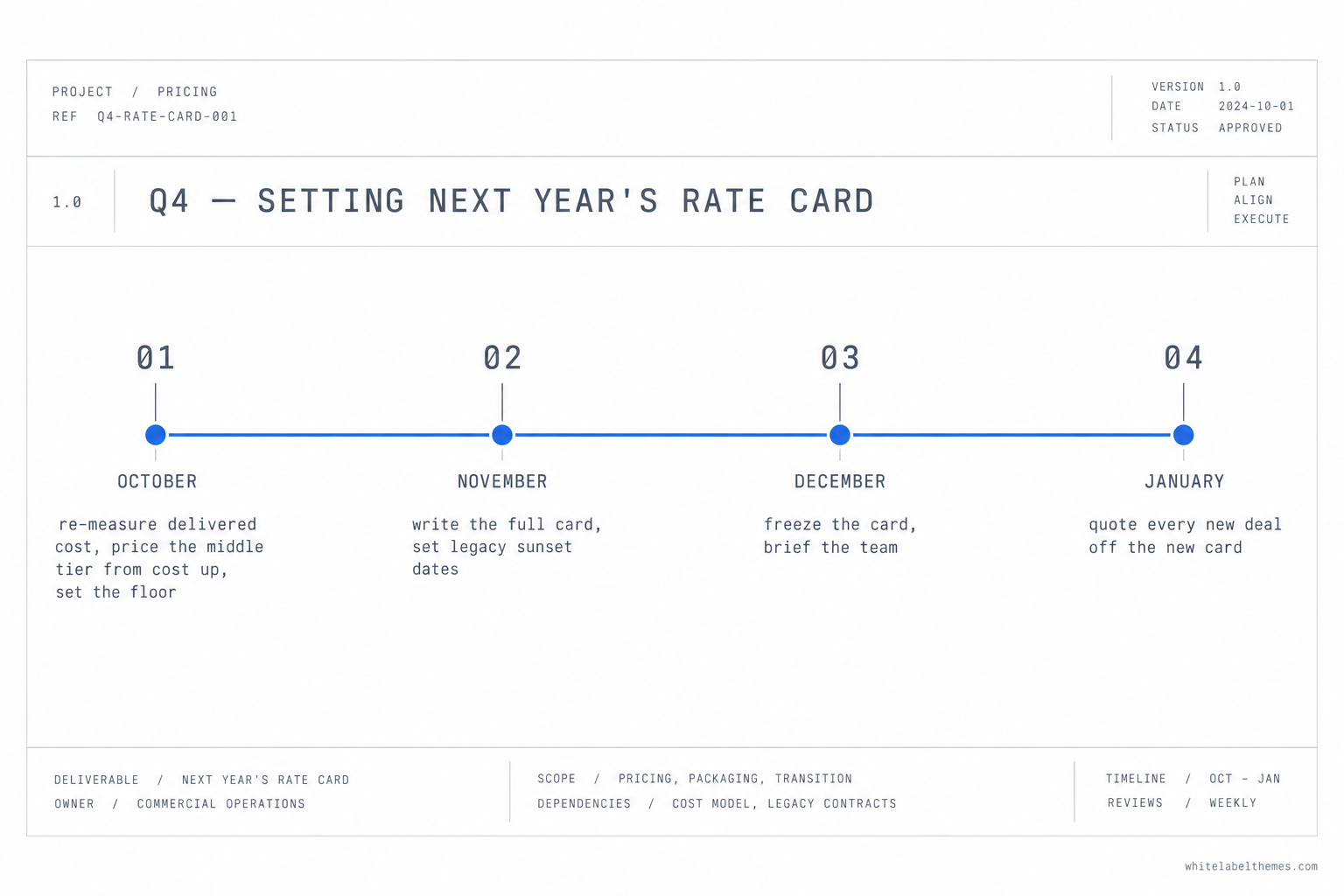
The card is a quarter of work, not an afternoon, and the reason to do it in the fourth quarter is mechanical. Client budgets reset in January. New-client intake starts the same month, and intake competes with everything else for your delivery hours, so the card has to be settled before intake begins rather than during it. Give the quarter a spine and the whole thing stops being a scramble in the last week of December.
| Window | What you do | What you stop doing |
|---|---|---|
| October | Re-measure your delivered cost for the year that is ending. Price the middle tier from that cost up, then set the entry and top tiers around it. Decide the floor. | Pricing next year against last year’s cost base. |
| November | Write the full card: setup fee, three tiers, add-ons, platform line, floor. Decide which legacy prices get a sunset date and when. | Keeping the card in your head where nobody, including you, can check it. |
| December | Freeze the card. Brief anyone who quotes on your behalf so the whole team answers with the same number. Set the legacy sunset dates in writing. | Reopening tiers under holiday pressure, or quoting off the old card out of habit. |
| January | Every new deal is quoted off the new card, at the new setup fee, at the new tiers. Intake runs against a card you set in calm, not a number you invent per call. | Improvising a price in a sales conversation because the card was never finished. |
Five ways a rate card goes wrong
A card fails in a small number of predictable ways, and every one of them is avoidable if you have watched it happen once. Here are the five that account for most of the damage, each with the symptom that shows up first, the cause underneath it, and the fix.
The card that lives in your head
The symptom is that two people in your business quote the same scope at two different numbers, and a prospect who talked to both now knows it. The cause is a card that was decided but never written down, so it drifts every time it is spoken. The fix is to write it, circulate it, and make the written card the only source anyone quotes from. A number you keep in your head is a number you will round down under pressure, every time, and never notice you did.
The waived setup fee
The symptom is a cash position that never improves no matter how many clients you sign, because each new client costs you a fortnight of your hardest work up front and returns it slowly over a year that may not finish. The cause is a setup fee you dropped to close the deal. The fix is to treat the setup fee as non-negotiable and move elsewhere if you must give something away, into a month of the monthly or a bundled add-on, so the discount is visible and finite rather than a permanent hole under the whole engagement.
The platform line a client can catch
The symptom is a client forwarding you the platform’s public pricing page and asking why their line is triple what they can see it costs. The cause is an aggressive markup on a number anyone can look up. The fix is to keep the platform line modest and transparent and recover margin on the managed line instead. A markup a client catches does not just lose you that line, it makes them audit every other line, and suspicion is expensive in a relationship you want to keep for years.
The founding-rate discount with no end
The symptom is a cohort of your oldest clients, often your favourites, paying rates you set when you were desperate for proof you could deliver at all. The cause is a discount given to win an early deal and then carried forever because raising it felt ungrateful. The fix is a sunset date set at the card: every legacy rate steps to the current card over a stated number of cycles, in writing, starting with the next renewal. A discount with no end is not loyalty, it is a tax you pay your own best clients for having believed in you early.
The card nobody built, so every deal is bespoke
The symptom is that you cannot answer "what do you charge" without a discovery call, a proposal and three days, because every price is assembled from scratch. The cause is that there is no card, only a habit of quoting per situation. The fix is the whole of this piece. A bespoke quote is the right tool for a genuinely custom engagement and the wrong one for the eightieth client who wants the same system as the last seventy-nine. The profit margin of an agency that quotes everything bespoke is almost always worse than the one that quotes off a card, because bespoke pricing hides the accounts that are quietly running below cost until the year is over and the bank balance has already told you.
Grandfathering and the sunset date
A new card creates a split the day it goes live: new clients on it, old clients on whatever they were signed at. The temptation is to leave the old book alone, because it is working and nobody is complaining. That is how a card quietly becomes two cards, one real and one historical, and the historical one is the one eating your margin. Grandfathering is a decision, not a kindness, and it has to be a dated one.
Set a sunset date at the card, in October, for every rate below the new one. Then run the increase on the old book through the fourth-quarter renewal, which is the companion exercise to this one: the card sets where the book is going, the renewal moves it there with proper notice and a new deliverable attached. A legacy rate you choose to hold, for a client whose logo you use in your own sales, is a stated exception you can defend. A legacy rate you hold because you never looked is a leak.
Three arguments you are already having with yourself
"Published prices will scare prospects off"
A card does not have to be public to do its job. The card is the internal document; what you publish from it is a separate decision. Plenty of agencies keep the card entirely internal and simply quote from it instantly and consistently, which is most of the benefit. If you do publish, published prices tend to filter rather than scare: the prospect who leaves over a visible number is usually the one who was going to grind you down on it anyway, and you found that out before you spent a discovery call on them rather than after.
"My work is too bespoke for a card"
Some of it genuinely is, and those engagements get a bespoke quote. But the honest question is how much of your delivery is actually bespoke versus how much feels bespoke because you never productised it. If you are installing a recognisably similar system for a salon or barbershop client and then a near-identical one for the next, that is not bespoke work, it is a repeatable build you are pricing as though it were custom every time. The card is for the repeatable majority; keep the bespoke quote for the genuine exception, and be honest about which is which.
"I should just win more clients instead of fixing pricing"
New clients cost more to win than existing ones cost to keep, by a wide and frequently cited margin: Harvard Business Review put acquisition at five to twenty-five times the cost of retention (hbr.org, 2014, confirmed via search snippet this run, not independently fetched), and Frederick Reichheld’s work at Bain tied a five per cent lift in retention to a profit increase somewhere between twenty-five and ninety-five per cent (confirmed via search snippet this run). A card that prices your existing book correctly is cheaper growth than chasing volume you then deliver at the wrong rate. The honest exception, and the case where buying anything from us would be the wrong move: if your book is small and your delivery has real slack, do not add a fulfilment retainer and do not subcontract. Set the card, charge it, keep the whole margin, and come back when capacity is the thing stopping you. When it is, a white-label fulfilment retainer turns variable delivery labour into a fixed monthly line, which is what lets a higher card become margin instead of overtime.
Set the card before January needs it
The card gets set whether or not you sit down to do it. The only question is whether next year’s prices are ones you chose in October, looking at your cost base, or ones you improvise in March on calls you were not ready for. One of those is a pricing strategy. The other is forty guesses, and you already ran that experiment this year.
Inflation is the quiet argument for doing it now rather than skipping another year: headline US inflation ran near 3.5 per cent in the year to the middle of 2026 (usinflationcalculator.com, citing Labor Department data, confirmed via search snippet this run; the published figures for the year varied by source), which means a card held flat is a real-terms price cut you volunteered for. Your own delivered cost almost certainly rose by more than the index did.
Start where the numbers are concrete. Re-measure what one client costs you, price the middle tier from that cost up, and build the other two around it. If delivery is the thing stopping you from charging the card you know you should, fix that constraint first: put your own client count and build hours into the fulfilment calculator on the pricing page, and see whether a fixed delivery line frees the capacity a higher card needs before a single new prospect ever sees it.
Quick answers
Related questions
Keep reading
Next in the series
Seasonal playbook · 12 min
Q4 Retainer Renewals: The Price-Increase Conversation
Holding a retainer book flat for another year is a decision, and most agencies make it by accident every December. Here is how to run the fourth-quarter renewal on purpose, with the arithmetic that shows why the raise is a retention lever rather than a churn risk.
Operations · 10 min
White-Label GHL Fulfilment: How to Price Agency Retainers
Cost-plus pricing caps your agency at the size of your delivery team. Here is the maths behind value-based retainers, with the four numbers that decide whether a retainer survives month four.
Margin maths · 11 min
What One GoHighLevel Client Actually Costs You to Deliver
Most agencies know their revenue per client to the dollar and their cost per client to the nearest guess. Here is the ledger that closes the gap, and the line that is almost always missing from it.