Pricing teardown · 14 min read
GoHighLevel agency pricing: which plan actually pays for itself
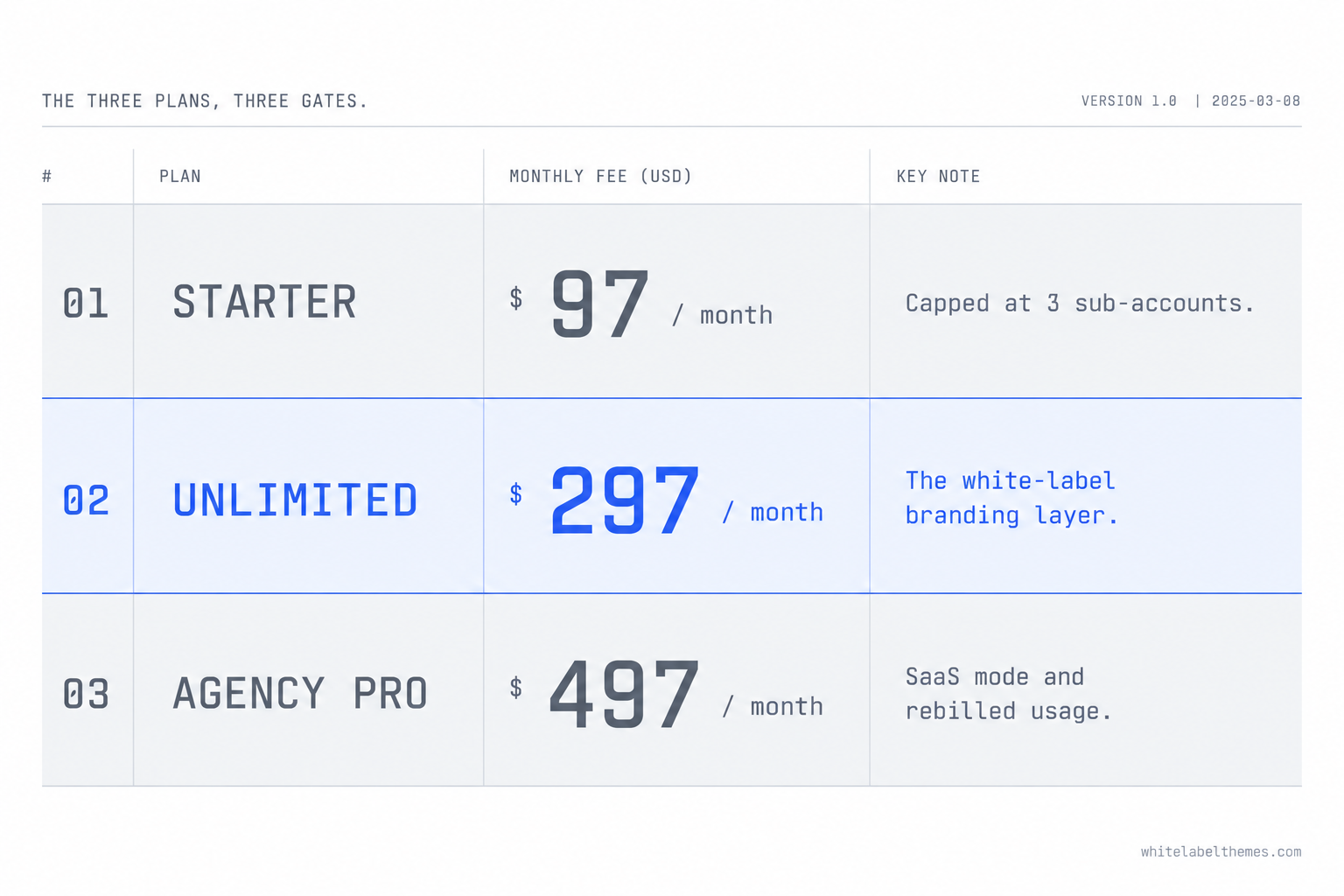
HighLevel’s three agency plans run $97, $297 and $497 a month, and the difference between them is not a longer feature list. It is three structural gates. This is the teardown of which plan a reselling agency actually needs at each stage, with the per-client arithmetic shown, the five ways agencies buy the wrong one, and the point where the $497 tier starts to pay you back.
Marcus Feld
Head of Build
Published
You signed the third client on a Tuesday. You went to spin up their sub-account the same afternoon, the way you had for the first two, and the platform told you that you had used all three. The Starter plan stops at three sub-accounts, and nobody says that in the sales video, because the sales video is selling you the ninety-seven-dollar number. So you upgraded to Unlimited that evening, mid-onboarding, with a client already waiting on you, which is the single most expensive moment to discover what a plan does not include.
GoHighLevel has three agency plans, and exactly one of them is the floor for almost everyone reading this. The prices are public and they are not complicated: ninety-seven, two hundred and ninety-seven, and four hundred and ninety-seven dollars a month, read off gohighlevel.com/pricing this week. What is complicated is which one you actually need, because the gap between them is not a longer feature list. It is three structural gates, and landing on the wrong side of one of them costs you either a capability you needed that afternoon or two hundred dollars a month you did not.
This is a teardown of those three plans from the only seat that matters to you, which is the one where you are paying HighLevel on one side and billing a client on the other. Every per-client figure below is a plain division you can redo with your own book size in about a minute, and every input is written down next to it. The aim is not to tell you which plan to buy. It is to let you work it out from your own numbers and stop guessing.
Three gates, not three feature lists
The mistake almost everyone makes when they compare the plans is to read down a feature grid looking for the thing the cheaper plan is missing. You will not find it there, because the three plans are not feature-gated in any way that matters to delivery. All three give you the CRM, the pipelines, the funnel and site builder, the calendars, the email and SMS, the workflow engine and the mobile app. A client installed on Starter and a client installed on Agency Pro get an identical system. The differences are three structural lines, and each one is a gate you either need open or you do not.
Gate one: the sub-account cap
Starter caps you at three sub-accounts. That is the whole story of the ninety-seven-dollar plan, and it is the gate that catches the most people, because three sounds like enough until you remember that one of them is your own agency account and one is the test environment you break things in. That leaves you one real client before the wall, and the wall does not warn you politely in advance. It stops you at the moment you try to create the account, which is always the moment a client is waiting.
Starter is not a plan to run clients on. It is a plan to learn the platform on, to install a snapshot, break it, and install it again without a book of live clients watching. Treated as that, ninety-seven dollars for a fortnight or two of practice is cheap. Treated as the plan you grow on, it is a trap with a three-client trigger, and the upgrade it forces always arrives on your worst day.
Gate two: the branding layer
Unlimited removes the cap and, far more importantly, opens the white-label branding layer: your own domain on the platform, your logo in place of HighLevel’s, your sender identity on the mail. This is the gate that matters to this site’s entire premise, because without it the client logs in and sees somebody else’s brand on the software, and the thing you were selling as yours is visibly not. Unlimited at two hundred and ninety-seven dollars a month is the real floor for delivering under your own name, and for most agencies it is also the ceiling for a long time.
The jump from Starter to Unlimited is two hundred dollars a month, and it buys you two things at once: the unlimited sub-accounts that let you hold a book, and the branding that lets the book be yours. There is no sensible argument for a reselling agency to sit on Starter. The only question worth having is the next one up, which is whether you also need the third gate.
Gate three: SaaS mode
Agency Pro, at four hundred and ninety-seven dollars a month, adds SaaS mode: automated sub-account provisioning, connected billing, and the client’s own usage of SMS, email, phone and AI rebilled to them with your markup on top. This is the gate that separates an agency selling delivery hours from an agency selling access to software it brands as its own. If your clients pay you a retainer for work, you may never need it. If your clients are going to pay you for a login, a plan and a monthly subscription that renews without you lifting a finger, it is the only tier that does that, and the two hundred dollars a month it costs over Unlimited is a different kind of spend entirely.
The economics of that third gate are their own subject, and this site has already pulled them apart in the teardown of GoHighLevel SaaS-mode pricing, which is the piece to read before you decide whether the jump to Agency Pro is a cost or an engine. For the purposes of choosing a plan, the thing to hold is simpler: SaaS mode is a revenue model, not a feature, and you buy the tier when you have decided to run that model, not before.
What the plan actually costs you per client
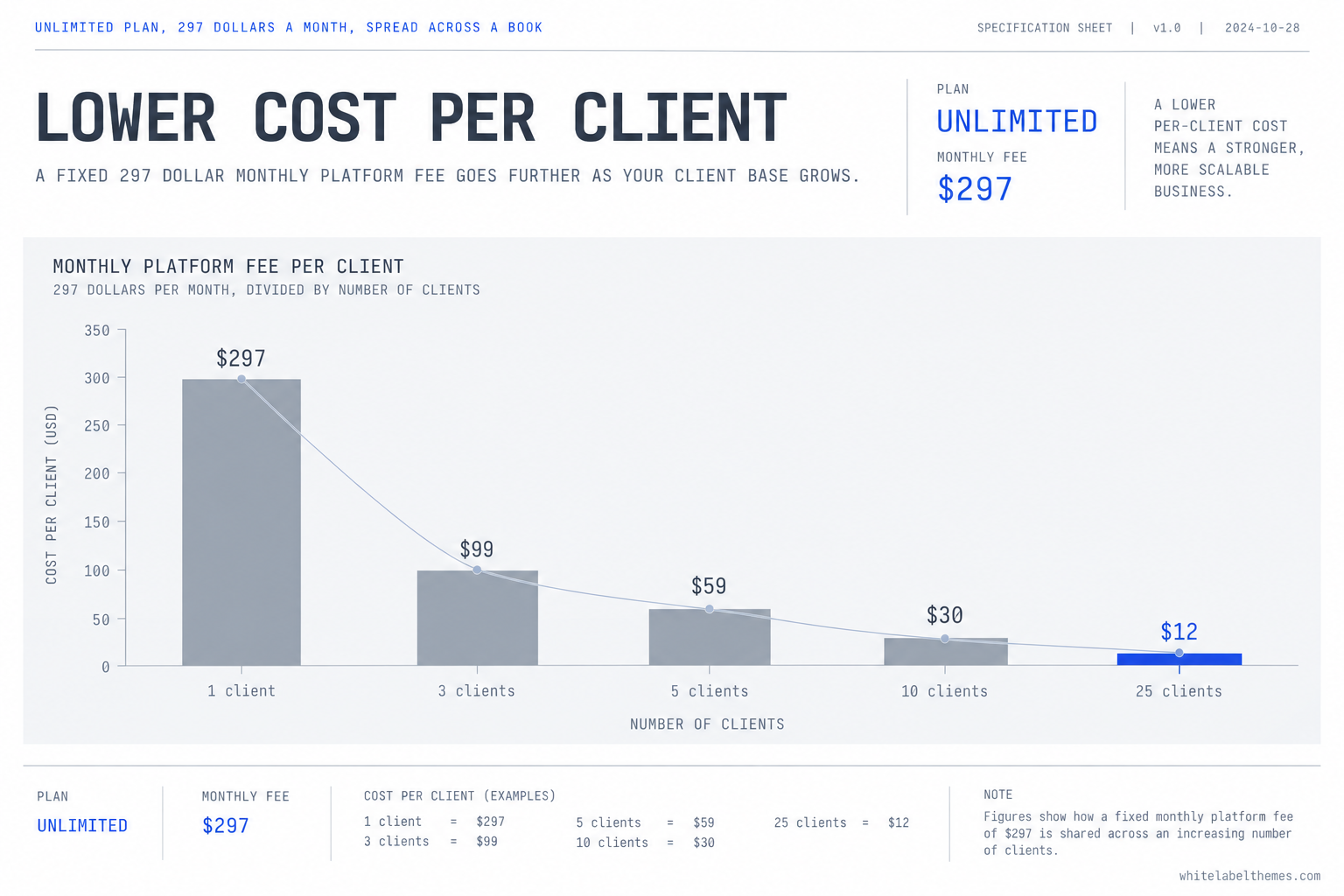
Here is the number agencies quote wrong more than any other: the cost of the platform per client. They quote the plan fee, as though two hundred and ninety-seven dollars were a per-client cost, and then they panic about it, because two hundred and ninety-seven dollars against a single client is a frightening slice of a retainer. It is also not how the bill works. Unlimited is one flat fee for the whole agency across unlimited sub-accounts, so the per-client cost is the fee divided by your book, and it falls every time you add an account.
| Clients on the book | Unlimited plan, per client, per month | How the figure is reached |
|---|---|---|
| 1 | $297 | The whole fee resting on a single account. The most expensive the platform ever is |
| 3 | $99 | $297 divided by three. Already a line you would barely notice on a retainer |
| 5 | $59.40 | $297 divided by five |
| 10 | $29.70 | $297 divided by ten. The platform is now a rounding error against the fee you charge |
| 25 | $11.88 | $297 divided by twenty-five. Effectively free per client |
Those are divisions, not forecasts. The only input is the flat Unlimited fee, which HighLevel publishes at two hundred and ninety-seven dollars a month (gohighlevel.com/pricing), and the only variable is how many clients you spread it across. The shape is the point: the platform fee is a fixed base that gets cheaper per client the more clients you carry, which makes it the smallest and least interesting lever on your whole cost sheet by the time you are past a handful of accounts.
There is a second half of the bill that the plan fee does not cover, and leaving it out is how agencies underquote. SMS, email, phone minutes and the AI features all run on usage credits on top of the plan, metered by how much the client actually sends. A quiet client barely touches it. A client running a real campaign can run a usage bill that dwarfs their share of the plan fee. If you are on Unlimited and absorbing that usage inside a flat retainer, every message the client sends comes out of your margin, and it does so precisely when the client is busiest and winning, which is the worst moment to be eating their costs.
When the $497 tier starts to pay you back
The only genuinely hard pricing decision in HighLevel’s range is Unlimited against Agency Pro, because it is the one where you are spending two hundred more dollars a month for a capability you might not use. Framed as a feature upgrade it looks expensive. Framed correctly it is a question with a clean break-even: Agency Pro pays for itself the month it either rebills more than two hundred dollars of client usage at your markup, or saves you more than two hundred dollars of your own time in automated provisioning and self-serve signup. Below that line it is a cost. Above it, it is the cheapest employee you will ever hire.
The first route is usage. In SaaS mode you meter the client’s consumption and add your margin, so their heavy campaign month becomes their line item rather than your quiet loss. A single active client sending real volume can clear the two-hundred-dollar gap on their own. The second route is time. Automated provisioning and credit-card self-signup mean a client can be live without you touching the account, which is worth real money the moment onboarding is your constraint rather than your sales pipeline.
Both of those routes assume you have already decided to sell access rather than hours, and that decision has knock-on effects on everything from your contracts to your churn. If you have not made it yet, do not buy the tier to keep the option open: Unlimited is the right plan until the SaaS model is a plan rather than a maybe. When you are weighing the model itself, the cost of running the agency as a whole is the base every one of these plan figures sits inside, and it is a bigger number than the plan by a wide margin.
Five ways agencies buy the wrong plan
None of these feels like a mistake at the time. Each is a sensible-looking decision that the plan structure quietly punishes a month or two later.
One: starting on Starter to save money
The symptom is the Tuesday in the opening: you hit the three-sub-account wall mid-onboarding and upgrade under pressure. The cause is reading ninety-seven dollars as the entry price for an agency when it is the entry price for a single operator learning the tool. The fix is to treat Starter as a training licence with a two-week life and move to Unlimited before you sign client one, so the capability is already there when the client is. The two hundred dollars you saved for a month is not worth discovering the cap with a client watching.
Two: sitting on Unlimited while absorbing usage
The symptom is a usage bill that climbs as your clients get busier while your retainers stay flat, and a margin that mysteriously thins in your best months. The cause is a flat fee sitting on top of a variable cost with nothing passing the variable part through. The fix is either to move to Agency Pro and rebill usage with a markup, or, if you are staying on Unlimited, to write a usage allowance into the retainer with a per-unit rate above it. Doing neither means your most successful clients are your least profitable ones, which is exactly backwards.
Three: jumping to Agency Pro before you have a reason
The symptom is four hundred and ninety-seven dollars a month leaving your account while SaaS mode sits switched off, because you bought the tier for a model you have not actually launched. The cause is buying capability as insurance. The fix is discipline: the extra two hundred dollars is only worth spending when you can name the usage you will rebill or the hours you will save, and until you can, Unlimited does everything you are actually doing. Capability you are not using is not a hedge. It is a subscription to a plan for the business you imagine rather than the one you run.
Four: modelling the plan fee and forgetting the wallet
The symptom is a retainer that looked profitable on the plan-fee maths and bleeds once the client starts sending. The cause is quoting the subscription as if it were the whole platform cost and ignoring the metered usage stacked on top of it. The fix is to model both lines: the flat plan fee divided across your book, and a realistic usage estimate for that specific client’s sending volume. A dental practice confirming appointments and a credit-repair firm running long nurture sequences do not cost the same to run, and a single blended assumption underprices one of them.
Five: paying annual for the discount your cashflow cannot carry
The symptom is a lump annual charge that saves you a couple of months of fee on paper and leaves the operating account short the week it lands. HighLevel prices the plans annually as well as monthly, and the annual rate is genuinely cheaper per month, but a discount you fund by starving your own cashflow is not a saving. The cause is treating a prepay as free money rather than as capital you have tied up. The fix is to take the annual rate only once the plan is a certainty and the cash is spare, and to stay monthly while either of those is still in question.
The plan for each stage of an agency
Strip out the edge cases and the decision collapses to your stage, not your ambition. Buy for the agency you are running this quarter, and upgrade when the quarter changes, because every plan jump is reversible and none of them is a one-way door.
| Where you are | The plan | Pick it if |
|---|---|---|
| Learning the platform, no live clients | Starter, $97 | You are practising installs and want a cheap environment to break. Not a plan to grow on |
| Reselling to one to ten clients for a retainer | Unlimited, $297 | You deliver work for a fee, need your own branding, and want the platform cost to fall per client as you grow. The floor and, for most, the ceiling |
| Selling software access, not hours | Agency Pro, $497 | You can name the usage you will rebill or the provisioning time you will save, and the extra $200 a month clears that bar |
| Unsure between Unlimited and Agency Pro | Unlimited, $297 | The SaaS model is still a maybe. Buy the capability when the model is a decision, not insurance |
The through-line is that the plan is the cheap part of this business, and the agencies that get into trouble are the ones that spend their attention on it while the expensive lines go unexamined. The platform fee falls to a rounding error by ten clients. What does not fall is the cost of actually delivering the work, which is why where the retainer margin really leaks and what a single GoHighLevel client costs you to deliver are the two teardowns that move more money than any plan decision ever will.
Three things you are already arguing back
I will start on Starter and upgrade when I need to
You can, and the platform makes the upgrade painless, which is exactly the problem: the upgrade is painless and the timing is not yours. You will not upgrade on a calm Monday with a plan in hand. You will upgrade the afternoon a client is waiting on a sub-account you cannot create, under the pressure of a promise you have already made. Moving to Unlimited before client one costs you two hundred dollars for one quiet month and removes the one moment in this whole decision that is genuinely expensive, which is discovering a limit with a client watching.
Agency Pro is too dear, I will just rebill usage by hand
You can rebill by hand, and for a very small book it is a reasonable call. The honest version of this argument has a shelf life, though. Hand-rebilling means reading each client’s usage, working out your markup, raising the line and chasing it, every month, per client, and the admin of it scales with the book in exactly the way your time cannot. The two hundred dollars Agency Pro costs over Unlimited buys the metering and the billing done automatically, so the question is not whether you can do it by hand, it is at what client count the hand version costs you more than two hundred dollars of your time a month. For most agencies that number arrives sooner than they expect.
The platform bill is my biggest expense, so it is where I should save
It is almost certainly not your biggest expense, and believing it is will send you optimising the smallest line on your sheet. By the time you are running ten clients the platform costs you under thirty dollars a head, while the hours you spend delivering to each of them cost many times that. The place to save is the cost of delivery, not the cost of the platform, and the fastest lever on delivery is not a cheaper subscription. It is a build you do not have to make yourself.
That is the honest end of this: once your book is past a handful of clients, the plan you are on barely moves your margin, and the thing that does is what you load onto it. A rebrandable white-label snapshot turns a per-client build into a one-off cost you spread across every account it serves, and when it is your own delivery hours rather than the build that have become the ceiling, white-label fulfilment converts those variable hours into a fixed line. Both are priced in full, with the installation add-on and the all-sales-final terms stated, on the pricing page, so you can see the whole number before you commit to any of it. Sort the plan in five minutes with the table above, then spend your real attention on the cost of the work.
Quick answers
Related questions
Keep reading
Next in the series
Margin maths · 12 min
Pricing a GoHighLevel SaaS Mode Plan That Survives Usage
Most SaaS-mode plans are priced against the platform bill and then eaten alive by the usage bill. Here is the tier structure that does not, with the arithmetic laid out so you can put your own numbers in.
Pricing teardown · 13 min
What It Costs to Run a GoHighLevel Agency Each Month
The platform invoice is the number every agency knows. It is also the small one. This is the fixed monthly cost base torn down line by line, the usage wallet nobody budgets for, the build spend spread across the months it serves, and the reason the fixed nut is almost never what actually caps your growth.
Pricing teardown · 13 min
Profitable on Paper, Broke in the Bank
Your model says the retainer clears fifty-something per cent. The operating account says otherwise. This is the teardown of the gap between the margin you quote yourself and the margin you actually bank, with the arithmetic, the five leaks in the order they cost you, and the fix for each.