Pricing teardown · 13 min read
What it costs to run a GoHighLevel agency each month
The platform invoice is the number every agency knows. It is also the small one. This is the fixed monthly cost base torn down line by line, the usage wallet nobody budgets for, the build spend spread across the months it serves, and the reason the fixed nut is almost never what actually caps your growth.
Marcus Feld
Head of Build
Published
The HighLevel invoice arrived on the first, the amount you expected, and you barely looked at it. Then on the ninth a second charge hit the same card, smaller, unlabelled, and you had to log in to work out what it was. It was the usage wallet topping itself up. Nobody had budgeted for it, because when someone asks what a GoHighLevel agency costs to run, they answer with the plan price and stop there.
The plan price is the number you know. It is also the one that matters least. This is a teardown of the whole fixed monthly cost base, written for the principal deciding whether the numbers actually work before they add the next client or the next vertical. Every figure here is an assumption you should replace with your own, with one exception: HighLevel publishes its plan prices, and those are quoted as read this run rather than estimated.
The three things you are actually paying for
An agency running on GoHighLevel carries three separate kinds of monthly cost, and confusing them is where most cost models go wrong. Keep them apart on the page and the whole thing gets legible.
- The platform line. A flat monthly subscription that does not move with how many clients you serve or how hard they use the system. This is the number everyone quotes.
- The usage wallet. A pay-as-you-go balance for the messages, calls, emails and AI the accounts actually send. It moves with volume, so it is variable, and it is the line that surprises the card.
- The build and tools base. What it cost you to have a system worth reselling in the first place, spread across the months it serves, plus whatever you pay for the software sitting alongside HighLevel.
Two of those three are what this piece is about: the fixed base you carry whether you have three clients or thirty. The third, the variable cost of actually delivering to each client once they are live, is a separate number with its own method, and the true cost to deliver one GoHighLevel client is where you measure it. Read them together and you have your whole P&L. Read only one and you will price against half of it.
The platform line, and what HighLevel actually charges
HighLevel sells three plans, and the difference between them is not features so much as how many sub-accounts you can run and whether you can mark up usage. As read on the public pricing page this run, the prices are these.
| Plan | Monthly | Annual | Sub-accounts | Usage rebilling |
|---|---|---|---|---|
| Starter | $97 | $970 | Three | Not available |
| Unlimited | $297 | $2,970 | Unlimited | At cost |
| Agency Pro | $497 | $4,970 | Unlimited | With markup |
Those figures are from gohighlevel.com/pricing, confirmed via search snippet this run rather than independently fetched, and annual billing runs roughly seventeen per cent below twelve monthly payments. The trial is fourteen days on every tier. Contacts and users are uncapped on all three, so the real decision is the sub-account ceiling and the rebilling right, not a feature list.
Most agencies that resell to clients live on Unlimited at $297. Starter caps you at three sub-accounts, which is a client or two plus your own, so you outgrow it almost immediately once you are actually selling. Agency Pro at $497 exists for one reason that pays for itself and several that do not: it is the plan that lets you rebill usage at a markup instead of passing it through at cost. If you are not marking up usage, the extra two hundred dollars a month buys you features you may not touch yet.
The usage wallet nobody budgets for
The wallet is the line that turns a tidy $297 into a monthly number you cannot predict to the dollar. When you switch on the phone system, email sending or the AI features, HighLevel opens a wallet on your agency and charges your card automatically whenever the balance drops below a threshold you set. That auto-recharge is the unlabelled charge on the ninth. It is not a surprise fee, it is usage you asked for, but it lands outside the subscription and so it lands outside most people budgets.
The per-unit rates are small, which is exactly why they get ignored until they add up. As read this run from HighLevel LC billing guide, confirmed via search snippet rather than fetched:
- Email runs about $0.675 per thousand sends.
- Outbound SMS runs about $0.0079 per segment, where a segment is roughly a hundred and sixty characters, so a long message is several segments.
- Each phone number costs about $1.15 a month to keep, before a single call or text goes through it.
None of that matters for one client sending a handful of reminders. It matters a great deal for a book of clients running review-request sequences, appointment reminders and a reactivation campaign at the same time, because the sends multiply by contacts and the segments multiply by message length. The honest way to budget it is per client per month, from that client actual sending volume, and then to rebill it so the client carries their own usage rather than your margin carrying it.
This is also the trap that sinks a SaaS-mode plan priced without it. If you resell HighLevel under your own brand on a flat monthly fee, the usage still flows through your wallet, and a heavy client can consume the margin on a light one. Pricing that survives real usage is its own exercise, and pricing a GoHighLevel SaaS mode plan that survives usage walks through the arithmetic of setting a fee that does not go underwater the month a client sends in earnest.
The build spend, spread across the months it serves
The third piece of the fixed base is the one people forget entirely, because it is not a monthly cash charge. It is what it cost you to have something worth reselling. Whether you built your system yourself over a fortnight of evenings or bought a rebrandable snapshot, that cost belongs in your monthly number, spread across the months the build actually serves your book. Leave it out and every margin figure you calculate is flattering and wrong.
The buy side is easy to amortise because the number is known. A niche build like the HVAC contractor snapshot is $1,275 once, installable into unlimited sub-accounts inside your own agency, which spread across the eighteen months it will realistically serve your book before the platform moves under it comes to about seventy-one dollars a month. The build side is harder, because the honest cost of building your own is rarely the week you remember and almost always the copy pass and the year of maintenance you forgot. That gap is exactly what the buy or build decision is about, and it is the single input most likely to be understated in your model.
The reason a bought build amortises so cheaply is the licence, not the price. One purchase installs into every sub-account you run, so the second client the snapshot serves halves its per-client cost, the fourth quarters it, and by the time it is under a dozen accounts the build line is a rounding error. That is the leverage a reusable asset gives you that a bespoke build for a single client never can, and it is why the fixed base of a reselling agency stays small even as the book grows.
The whole base, on one worked example
Put the three together and you have your fixed monthly base. Here is a worked example for an agency on Unlimited, serving a small book, with the usage rebilled to clients so the wallet line is only the agency own overhead rather than the whole book traffic. Every figure below except the platform price is an assumption, and the point is the shape of the sum, not the numbers in it.
| Line | Monthly | What it is |
|---|---|---|
| Platform plan | $297 | HighLevel Unlimited, published price, unlimited sub-accounts. |
| Usage wallet, agency overhead | $40 | Your own numbers and internal sends, before any client usage you rebill. |
| Tools alongside HighLevel | $80 | Scheduling, design, a form or survey tool, storage. Your stack, your figure. |
| Amortised build | $71 | A $1,275 snapshot spread across eighteen months of service. |
| Fixed base | $488 | The nut you carry before a single client invoice clears. |
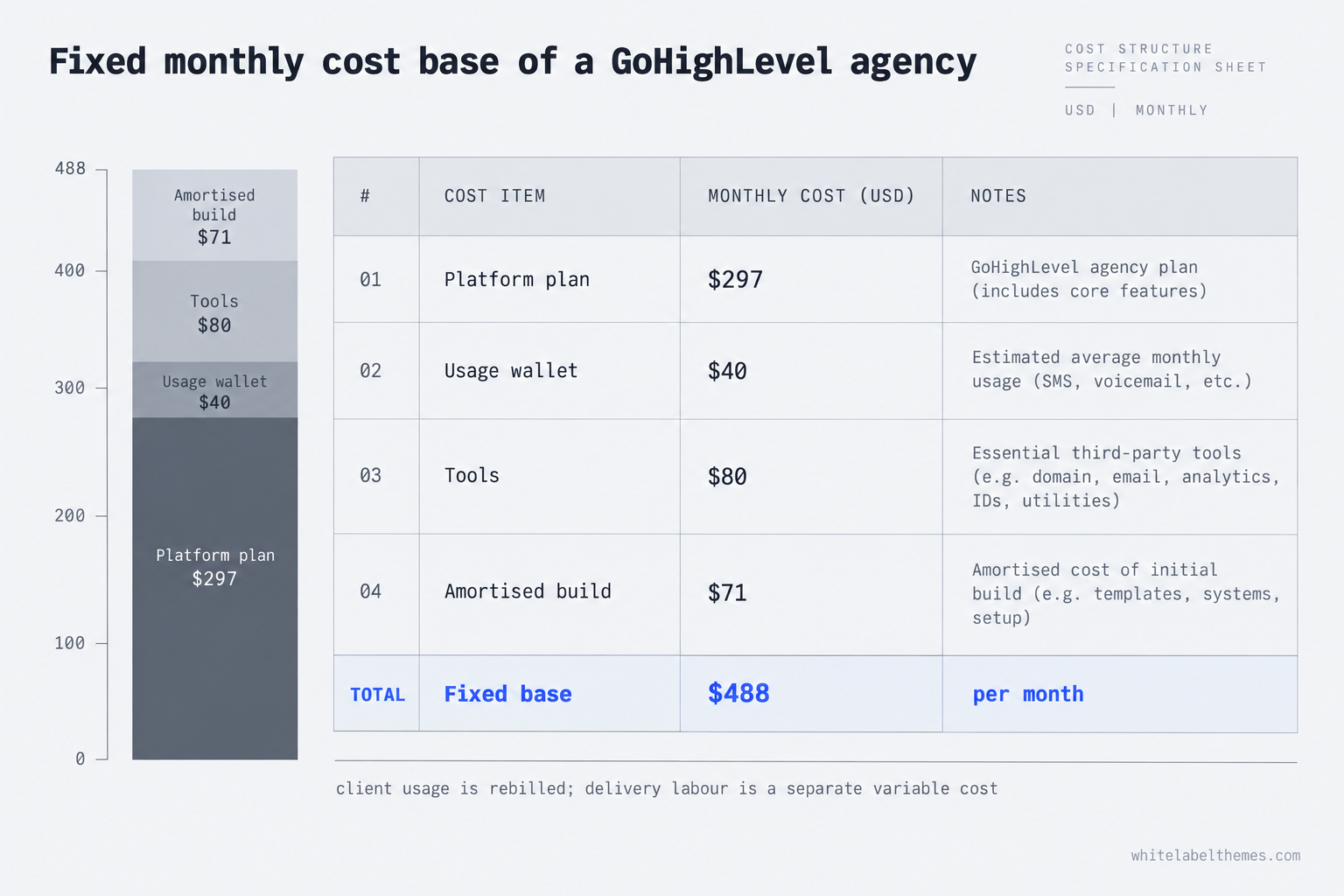
Under five hundred dollars a month, fixed, whether you serve three clients or thirteen. Now put a single retained client against it. If one managed client leaves you, say, nine hundred dollars a month after the variable cost of actually serving them, then the first client clears the entire fixed base before their invoice has finished processing, and every client after that is contribution. The fixed nut is not what stops you growing. It is covered by client one.
Where the money actually goes
The teardown so far tells a story that surprises people who assumed the platform bill was the enemy. The fixed base is cheap and it is flat. The cost that scales with your book, the one that genuinely decides whether you make money, is the variable cost of delivering to each client: the hours, the account management, the support messages, the small interruptions that never make it onto an invoice. That is not on the cost-base chart at all, and it dwarfs everything that is.
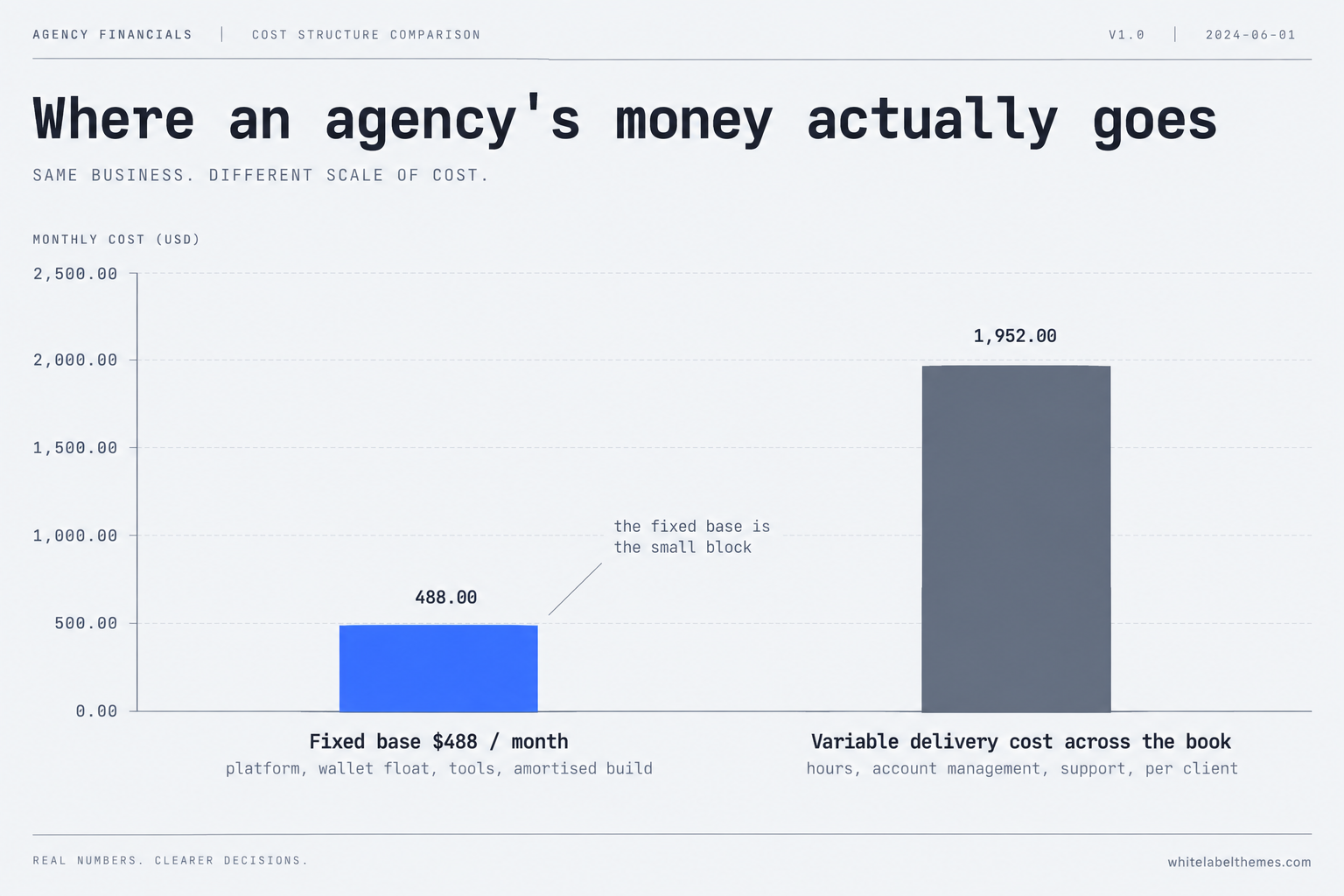
This is why an agency can be busy, fully subscribed and still not paying its principal. The platform bill was never the problem. Delivery hours were, and once delivery becomes the thing you cannot add more of, the agency delivery ceiling is the wall you hit. Reading a cost base and concluding the platform is expensive is the classic misdiagnosis. The platform is the cheapest reliable part of the whole operation.
Five ways the number comes out wrong
A cost base is easy to get wrong in predictable ways, and each mistake has the same shape: a line understated or left off, discovered a quarter later when the bank balance disagrees with the spreadsheet. Here are the five that account for most of the damage, each with the symptom that shows first, the cause underneath, and the fix.
The platform line billed to clients at cost
The symptom is a client forwarding you HighLevel public pricing and asking why their platform line is triple what they can see it costs. The cause is aggressive markup on a number anyone can look up in thirty seconds. The fix is to keep the visible platform line modest and honest, and to recover your margin on the managed-system and growth work instead, where the value is your labour and not a subscription the client can price themselves. A markup they can catch does not just lose you that line, it makes them audit the whole invoice.
The wallet that surprises the card
The symptom is the second charge on the ninth, unbudgeted, and a scramble to work out what it was. The cause is treating usage as free because each unit is fractions of a cent, and never setting it against a client. The fix is to switch on rebilling the day your plan allows it, so client usage is carried by the client, and to hold a small wallet float as agency overhead rather than letting it auto-recharge into a number you never see. Usage you rebill is neutral. Usage you absorb is a leak that widens with every client you add.
The build treated as sunk
The symptom is a margin that looks wonderful on paper and thin in the account. The cause is leaving the build cost out of the monthly number because it was paid once, months ago, and feels like history. The fix is to amortise it honestly across the months it serves, whether you bought it or built it, and to be especially honest about a self-build, where the maintenance and the copy pass usually cost more than the week you actually counted. A cost you paid once is still a cost the book has to carry.
The plan you outgrew, or jumped to early
The symptom comes in two forms: an agency wedged onto Starter, juggling three sub-accounts and deleting old clients to make room for new ones, or an agency on Agency Pro at $497 with rebilling switched off, paying the top plan for none of the reason it exists. The cause is treating the plan as a set-and-forget decision rather than one tied to client count and to whether you mark up usage. The fix is to move to Unlimited the moment you have a third client, and to Agency Pro only when the markup you would earn on rebilled usage clears the two hundred dollar difference. The plan should follow the book, not lead it.
The hours nobody put in the model
The symptom is the one that hurts: every cash line is covered and there is still nothing left for you. The cause is a cost base built entirely from invoices, with your own time and your team hours left off because they never generate a charge. The fix is to price your delivery labour into the model as a real cost, the way you would price a contractor, because an agency that cannot pay its principal a wage after covering its cash costs is not profitable, it is subsidised by the founder. The cash base is the easy half. The labour is the half that decides it.
Which plan, at which client count
The single most common question underneath all of this is which HighLevel plan to run, and the honest answer is that it is a function of two things only: how many sub-accounts you need, and whether you are marking up usage. Score your own situation against the rows below and the plan picks itself.
| Where you are | The plan | Why |
|---|---|---|
| Testing the model, no paying clients yet | Starter, or the trial | Three sub-accounts is enough to build and demo. Do not pay for capacity you are not selling. |
| Your first paying client, maybe a second | Move to Unlimited now | Starter three-account cap bites the moment you add your own account plus two clients. Unlimited removes the ceiling. |
| A growing book, usage passed through at cost | Unlimited | You have the sub-accounts and rebilling at cost. The extra two hundred for Pro buys nothing you are using yet. |
| A book where rebilled usage markup would exceed $200 a month | Agency Pro | Now the markup right pays for the plan and then some. This is the one number that justifies the upgrade. |
| Selling HighLevel itself under your own brand as software | Agency Pro | SaaS-mode resale needs the top tier. Price it against usage from the start so a heavy client cannot sink a light one. |
Notice that client results, niche and reputation do not appear in that table, because the plan decision is purely mechanical. What you charge the client, by contrast, is not mechanical at all, and anchoring it to the client own numbers rather than your costs is the whole game. Value-based retainer pricing and what to charge for a snapshot install are the two pieces that turn this cost base into a rate card.
Three things you are already telling yourself
"Starter is fine, I only have a few clients"
It is fine until the day it is not, and that day arrives fast. Three sub-accounts sounds like room until you count your own agency account as one of them, leaving space for two clients. The moment you sell a third you are either deleting a client to import another or upgrading in a hurry mid-week. The two hundred dollar step from Starter to Unlimited is the cheapest decision in this whole teardown, and postponing it past your second client costs you more in friction than it ever saves in subscription.
"Usage is pennies, I can ignore the wallet"
Each unit is pennies. A book of clients running reminders, review requests and a reactivation push at once is not pennies, it is a monthly line that grows with every client and every campaign, and if you are absorbing it rather than rebilling it, it grows straight out of your margin. The fix costs nothing: switch rebilling on, let clients carry their own sending, and the wallet stops being a leak and becomes a pass-through you never think about again. Ignoring it does not make it small. It makes it invisible, which is worse.
"Buying a build just adds a cost I do not need"
Sometimes it does, and here is the honest case where buying anything from us is the wrong move. If you have one client, real slack in your week and you genuinely enjoy the build, build it yourself. Keep the whole margin and learn the platform in your hands. You do not need a rebrandable snapshot to serve one account. The buy decision earns its keep the moment the build is repeated: the second client the asset serves is where a bought build starts paying you back, because the licence installs it into every sub-account you run and the cost per client falls with each one. When capacity, not curiosity, is the constraint, a white-label fulfilment retainer converts variable delivery labour into a fixed line, which is the one move that actually changes the shape of the cost base this piece has been tearing down.
Run the base on purpose
The platform bill is the number you already know and the one that matters least. Add the wallet, add the tools, amortise the build, and then, before you conclude anything, put your delivery hours next to all of it and watch which side of the ledger is actually large. The fixed base is cheap and flat. Delivery is where the money goes. Build your own number from your own figures, then use the fulfilment calculator on the pricing page to see what a fixed delivery line does to the half of the base that a subscription price will never show you.
Quick answers
Related questions
Keep reading
Next in the series
Margin maths · 11 min
What One GoHighLevel Client Actually Costs You to Deliver
Most agencies know their revenue per client to the dollar and their cost per client to the nearest guess. Here is the ledger that closes the gap, and the line that is almost always missing from it.
Margin maths · 12 min
Pricing a GoHighLevel SaaS Mode Plan That Survives Usage
Most SaaS-mode plans are priced against the platform bill and then eaten alive by the usage bill. Here is the tier structure that does not, with the arithmetic laid out so you can put your own numbers in.
Operations · 10 min
White-Label GHL Fulfilment: How to Price Agency Retainers
Cost-plus pricing caps your agency at the size of your delivery team. Here is the maths behind value-based retainers, with the four numbers that decide whether a retainer survives month four.