Margin and pricing · 13 min read
When the retainer doesn’t clear
You host the account, so a missed payment is not an awkward email. It is a live system costing you money every day it stays on, and a kill switch you do not want to touch. Here are the terms that mean you almost never have to.
Priya Nandan
Delivery Lead
Published
The Stripe email came in at 6:02 on the first. Card declined, retry scheduled. You read it on your phone, meant to deal with it later, and forgot. That night the account you built for that client ran its reminder sweep anyway: the nine o’clock no-show recovery call, the next morning’s appointment confirmations, the review request to everyone whose job closed that week. The machine does not know the invoice bounced. It keeps serving the client’s customers at full tilt, on your platform bill, while the client owes you money and has not noticed yet either.
This is the part of running a white-label GoHighLevel agency that nobody puts in the pitch. You are not a web designer who handed over a file and moved on. You host the account. The lead flow, the pipeline, the reminders, the reviews: all of it runs inside something you control and keep paying for. That changes what a missed payment is. For most suppliers a late invoice is an awkward email. For you it is a live system quietly costing you money every day it stays on, attached to a kill switch you really do not want to touch.
Hosting the account is the strongest hand you will ever hold over a client, and the most dangerous thing you own. This is how to set terms so you almost never have to reach for that switch, and how to use it correctly on the rare month you do.
Why a missed payment is different when you host the account
Think about what you are actually holding. The client’s customers are booked, reminded, chased and asked for reviews by a system that lives on your HighLevel sub-account, under your agency’s brand, paid for by you. The client does not have the logins to the platform-level billing. They cannot export a running workflow. For every practical purpose, their marketing operations department is a thing you switch on. That is real bargaining power, and it is the reason an agency can enforce terms a freelance designer never could.
The same fact is a trap. Flip the switch and you do not just stop invoicing the client. You stop their customers getting appointment reminders, you stop their leads getting followed up, and you do it to a business that may genuinely not have seen the failed-payment notice yet. The damage lands on their revenue first and yours second. Worse, it lands under your brand, so when the reminders stop the client does not think "my card bounced", they think "the agency broke my system". A pause done wrong turns a billing problem into a reputation problem that is now yours.
And there is a specific, expensive way it goes wrong. If you quietly switch the account off over an unpaid invoice, and your agreement never gave you the written right to, the client can dispute the last card charge they did pay. Banks tend to side with the cardholder when the merchant cannot show agreed terms and a notice. You lose the disputed amount and the account stays off. The whole point of a white-label service agreement that protects your margin is that it is the document which turns that bargaining power from a risk into a right you can actually exercise.
The mechanism: what actually happens when a payment fails
Before you can set a rule you have to know the sequence, because most of the cost hides in the gap between the card declining and you doing anything about it. Here is the chain, link by link.
The card declines and the retries start quietly
GoHighLevel’s own invoicing will hold a card on file and auto-charge a recurring invoice on its due date, and you can set a retry strategy so a soft decline is attempted again on a schedule rather than failing outright (help.gohighlevel.com documents the Auto Payments option and failed-payment retries on recurring templates; confirmed via search snippet this week). That is the feature working as designed, and it is good. The side effect is that the first decline is nearly silent. The system politely retries in the background, both you and the client get a notification that is easy to miss, and nothing visible breaks. The account keeps running. The quiet is the problem: the meter is on and nobody is looking at it.
The platform keeps billing you on its own date
Your platform bill does not pause because a client’s did. HighLevel publishes $497 a month for the Agency Pro tier that lets you resell under your own brand, and $297 for Unlimited (gohighlevel.com/pricing; confirmed via search snippet this week, not fetched directly). That subscription rebills on its date, not the client’s. On top of it the messaging is metered, so every reminder and recovery call the system fires for a non-paying client is SMS and voice usage you are billed for. The account working perfectly is the account costing you money. The gap between what you have earned and what has actually cleared is a whole subject of its own, worked through in why a profitable agency runs out of cash. A non-paying client is that gap at its sharpest: the cost is certain and the revenue may never arrive.
The chargeback is worse than the unpaid invoice
If the decline turns into a dispute rather than a retry, the arithmetic gets uglier. A chargeback in the United States hands you a dispute fee of about $15, charged the moment the customer’s bank opens the case, and reported by payment-industry sources such as chargeflow.io and hubifi.com to be at risk even when you go on to win (confirmed via search snippet this week, not fetched from Stripe directly; those sources disagree on whether a win returns it). Lose, and you forfeit the disputed amount on top. The lesson is not that $15 matters on its own. It is that a payment you let drift into a dispute costs you more than one you handled while it was still a decline, so speed is a term, not a temperament.
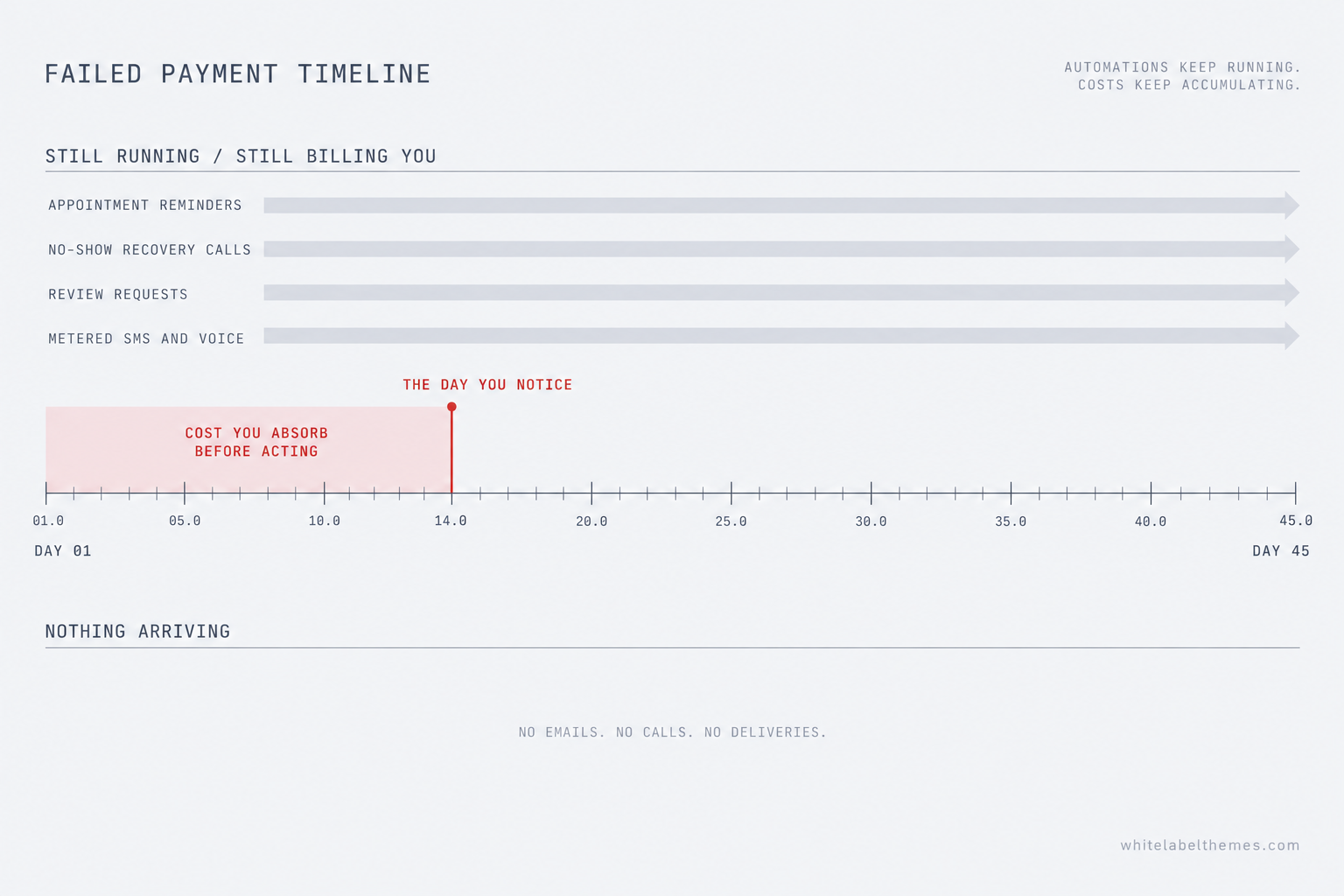
Fig. 01 is the whole problem on one axis. The top track is everything that keeps happening the instant the payment fails. The bottom track, the money arriving, stays flat. The wedge between the decline and the day you actually notice is not a loss you chose. It is one you backed into by not having a date on the calendar that forces the question.
The numbers: what a non-paying client actually costs you
Round figures persuade nobody, so here is a worked example with every input visible, and the whole point is that you swap in your own. Say one retainer client pays $1,500 a month. Your real cost to serve them is about $400 a month: roughly $350 of fulfilment or your own time, plus roughly $50 of metered SMS and voice on their sub-account. The card declines on the first, you keep the account live while you chase, and nothing is resolved for six weeks.
At day 45 you have delivered a month and a half of service. Here is the tab.
| The tab on one client, 45 days after the card declined | Amount |
|---|---|
| Retainer earned but not collected (1.5 months at $1,500) | +$2,250 owed to you |
| Fulfilment and your own time spent serving them (1.5 × $400) | −$600 real cash out |
| Metered platform usage firing for their customers | included in the $400 |
| Your Agency Pro platform bill, which rebilled twice regardless | −$497 per month, fixed |
| What you can still recover if they never pay | $0 of the $600, and the $2,250 is now a collections fight |
Read it slowly. The $2,250 is the headline, but it is the softer number, because an invoice can sometimes still be collected. The $600 is the one that should bother you: that is real cash you spent, serving a client who stopped paying on day one, that you will not get back under any outcome. You funded six weeks of someone else’s marketing operations out of your own account, and you did it by default, because no rule made you stop.
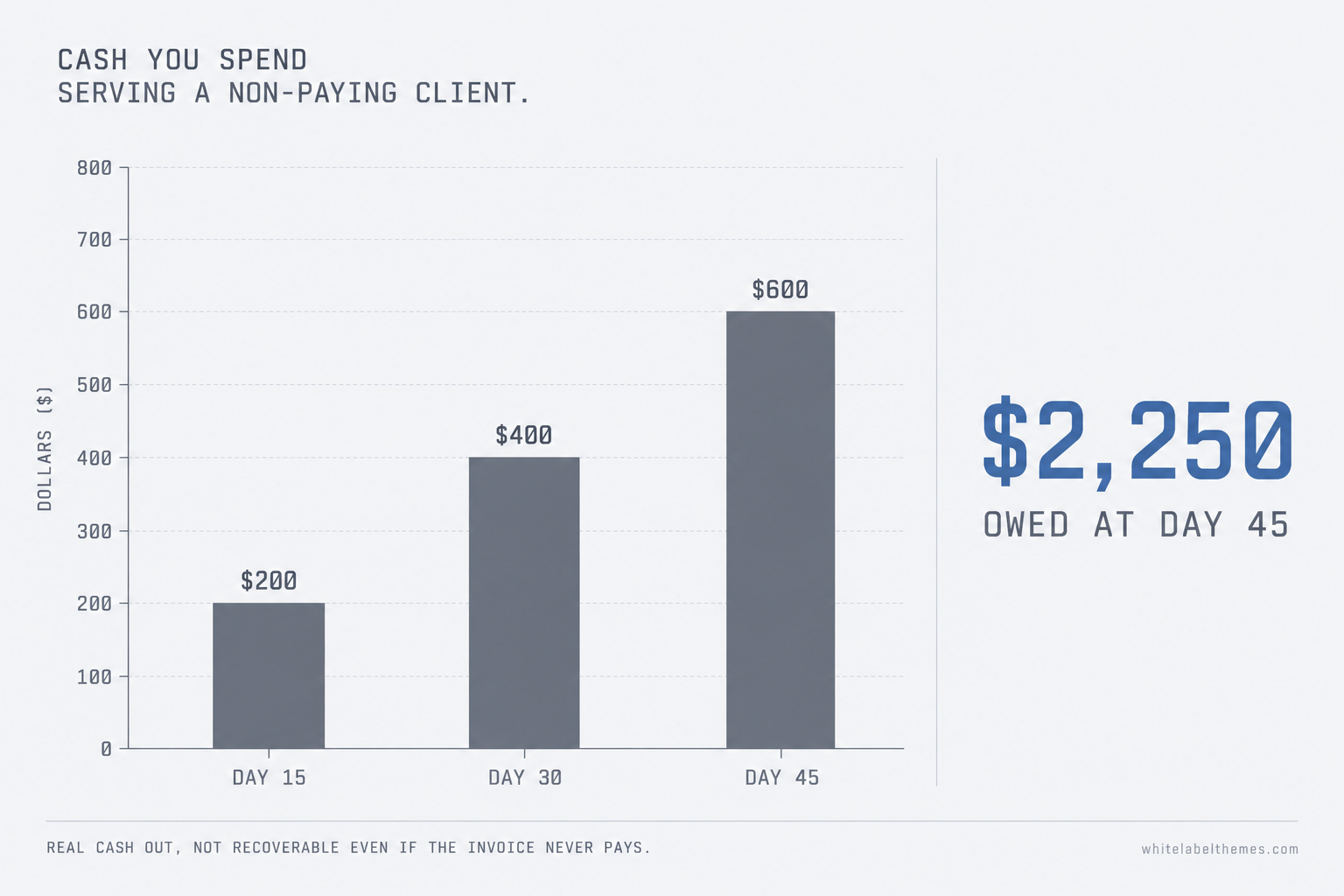
Fig. 02 shows why waiting is the expensive choice. The columns climb at day 15, day 30 and day 45, because the delivery cost keeps accruing for as long as the switch stays on. There is no version of this where patience is free. Every extra fortnight of goodwill is a fortnight of your own cash, spent on a decision you have not made.
Four ways this goes wrong, and the term that fixes each
A late payment is survivable. It turns into a real loss when one of these four patterns is in place, and each one is a missing term rather than a bad client.
1. No deposit, so you financed the build
The symptom is a client who vanishes after the expensive part, the setup, is done, but before enough retainer has cleared to cover it. The cause is a setup fee you invoiced after handover, or waived to win the deal, so the heaviest cost of the whole relationship was carried entirely by you on trust. The fix is to charge the setup fee up front, on a card, before the build starts, sized so it clears your delivery cost on its own. What to charge for a snapshot install works through the figure, but the rule here is simpler: a client who will not put down a deposit before you build has already told you how the invoices will go.
2. Net-30 you offered without being asked
The symptom is that every client is a month behind by design, so a single slow payer stalls your whole month. The cause is that you made terms the standard thing you offer rather than the exception a client has to request. The fix is to default every retainer to a card on file, auto-charged on a fixed date, and to treat net-30 as something a client asks for and justifies, backed by a deposit that covers your cost. Terms you hand out unasked are terms you will spend the rest of the relationship chasing.
3. The silent pause that became a chargeback
The symptom is that you quietly switched the account off, the client disputed the last charge they did pay, and the bank sided with them. The cause is two missing things at once: your agreement never gave you a written right to suspend for non-payment, and you gave no notice before you acted, so there was nothing to show the card network. You ate the dispute fee and still have an unpaid client. The fix lives in the contract, not the heat of the moment: a suspension-for-non-payment clause, and an absolute rule that a pause always follows written notice with a stated cure window. The service agreement is where that right is written down before you ever need it.
4. The sixty-day “I didn’t want to be the bad guy”
The symptom is a $1,500 problem that is now a $4,500 one, because you kept delivering for two months hoping it would sort itself out. The cause is that no rule forced a decision on a date, so the default action was always to wait one more fortnight. The fix is a dunning schedule where day 3, day 7, day 14 and day 30 each carry a defined action, so the question gets answered by the calendar instead of by how generous you happen to feel that week. Kindness with no deadline is just an interest-free loan with extra steps.
The decision: a graduated ladder, not a cliff
You do not want a single rule that says "pause on day 1", because a genuine card expiry and a client who has decided not to pay are not the same event and should not get the same response. You want a ladder, where each rung is a defined action on a defined day, visible to the client as a system rather than a mood. Here is a default ladder you can adjust for how long you have worked with the client and whether the decline looks like an accident or a decision.
| Day | What you do | What the client sees | What keeps running |
|---|---|---|---|
| 0 to 2 | Let the automatic retry do its job. A real card expiry usually clears here with no human involved. | A polite update-your-card message from the invoice link. | Everything, at full service. |
| 3 | A short personal message, not an automated one. "Your card didn’t go through, here’s the link, no drama." Most good clients are fixed by now. | A human being who is relaxed about it. | Everything, at full service. |
| 7 | A written notice that states the terms: the balance due, a cure window, and that service pauses if it is not cleared by a named date. This is the notice a chargeback dispute would need. | A firm, dated, professional notice. Not a threat, a term. | Everything, but the clock is now visible. |
| 14 | Pause the client-facing parts first: hold new outbound sequences, keep the account intact and the data untouched. Nothing is deleted. | Their new campaigns stop. Their existing data is safe. They feel it without losing anything permanent. | Data retained; outbound paused. |
| 30 | Full suspension under the clause, or, if the relationship is dead, start the offboarding you already have a process for. | A suspended account and a clear route to settle and resume. | Nothing outbound; account preserved for a defined retention window. |
The ladder does two jobs. It gives a decent client every chance to fix an honest mistake without you nagging, and it gives a bad one a documented, escalating paper trail that makes the eventual pause defensible rather than reckless. If the client reaches the bottom rung and it is genuinely over, you are not improvising: you follow the process for when a client leaves and wants to take the account, which decides what they get, what stays yours, and how the sub-account is wound down.
The objections you are already making
Three arguments come up every time, and all three have a straight answer, including the one where the honest advice is to buy nothing from us at all.
- "If I get heavy about money I’ll lose the client." A client who cannot clear a $1,500 retainer is not a client you are losing, it is a liability you are subsidising. Firm, upfront terms keep the clients worth keeping, because good businesses expect to pay on terms, and they surface the ones who were always going to cost you. The relationship survives a clear deposit clause. It does not survive you quietly resenting someone for six weeks.
- "I’ll just stay on top of the invoices and chase." Chasing is unpaid labour you perform every month, forever, and it scales with your client count, so the busier you get the more of your week it eats. A term is set once and enforces itself. You are choosing between an afternoon writing a clause and a permanent part-time job as your own collections department.
- "So the fix is to buy a snapshot library or your fulfilment service to make the money back." No, and this is the one to hear clearly: a non-paying client is not a product problem and buying anything from us will not solve it. It is a terms-and-contract problem you fix with a deposit, a card on file and a suspension clause, all of which cost nothing and can be in place this afternoon. If anything, do not add cost while chasing a bad debt: a five-snapshot pack is real cash out today, floored at $850 each regardless of the twenty per cent multi-buy, so spending it to recover from a client who is not paying makes your bank position worse, not better. Fix the terms first. Buy an asset later, when the repeat volume is already there, for its own reasons.
The terms that stop it happening, in order
Every durable fix is some version of collect before you deliver, hold an instrument you can charge, and keep a dated process for when it still goes wrong. In rough order of how much they move the needle for the least effort:
- Charge the setup fee up front, on a card, before the build starts, sized to clear your delivery cost on its own. This single change means a client who churns early still leaves you square rather than short.
- Make a card on file a condition of onboarding, not a favour you ask for later. Auto-charge the recurring invoice on a fixed date through GoHighLevel’s own billing, with a retry strategy set for soft declines, so the common accidental decline fixes itself before it is ever your problem.
- Offer net-30 only when a client asks and can justify it, and only against a deposit that covers your out-of-pocket, so the term applies to your margin and never to your cost.
- Write the suspension-for-non-payment clause and the written-notice rule into the service agreement before you sign a single client, so the hold you have over the account is a right you can use rather than a risk that triggers a dispute.
- Run a dunning ladder with a defined action on day 3, 7, 14 and 30, so the decision to pause happens on a calendar instead of on your conscience.
- Set a write-off and offboarding trigger, so a dead account stops costing you delivery and usage on a known date rather than drifting on because nobody switched it off.
None of that is new revenue and none of it is a purchase. It is the same clients and the same builds, priced the way you already priced the retainer, collected on a schedule that keeps your bank ahead of your delivery instead of behind it. The cost side matters too: if a single client is expensive to serve even when they do pay, the real fix may be structural, which is where what one client actually costs you to deliver decides whether the terms above are enough or whether the delivery model itself needs to change.
What the client never sees
Here is the part that keeps all of this compatible with the promise the agency is built on. None of your collections discipline is visible to the client, and none of it reaches their customers. On the month a card bounces, right up until the day your ladder says to pause, the no-show recovery still runs against its seventy per cent target, the review requests still aim at a steady five to ten reviews a month, and the appointments still get confirmed. The business you serve experiences a system that works. Their customers never feel a billing dispute happening three layers above them.
That separation is the whole model. You build it, you brand it, and your client never sees the machinery behind it, which includes how you get paid as much as how the snapshot was built. The terms are entirely yours. The client meets a professional agency with clear expectations, not a supplier who is either a soft touch or a surprise. Both of those lose clients. Clear terms, quietly enforced, keep them.
The short version
Hosting the account is the upper hand, and the upper hand used badly is a chargeback and a one-star review. A missed payment costs you real cash every day the system stays live, and the cash you spend serving a non-paying client is money you never get back even if the invoice eventually is. So collect the setup fee before you build, keep a card on file you can actually charge, treat net-30 as an exception with a deposit, write the suspension right into the agreement before you need it, and run a dated ladder so the decision to pause happens on the calendar rather than on your mood. Do that and a missed payment goes back to being what it should be: an awkward email, not a hole in your month.
Quick answers
Related questions
Keep reading
Next in the series
Margin and pricing · 13 min
Why Your GoHighLevel Agency Is Profitable and Still Broke
Profit is what you earned. Cash is what cleared. They are not the same month, and the gap between them is the thing that quietly ends agencies that were making money the whole time.
Compliance guide · 12 min
The White-Label Service Agreement That Protects Your Margin
The snapshot is half the product. The agreement is the other half, and the one almost nobody writes. Four clauses decide who pays when a text goes wrong, and whether the account is still yours when the client leaves.