Compliance guide · 12 min read
The white-label service agreement that keeps the account yours
The snapshot is half the product. The agreement is the other half, and the one almost nobody writes. Four clauses decide who pays when a text goes wrong, and whether the account is still yours when the client leaves.
Priya Nandan
Delivery Lead
Published
The letter arrived as a forwarded PDF with no message attached, which is how you can tell a client is frightened. One of their former patients had received an appointment reminder four months after they stopped being a patient, had not asked to hear from the practice again, and had found a lawyer who runs these by the dozen. The demand named a figure. It also named the agency, because the agency’s logo was on everything, including the text. The client’s own question, when it landed an hour later, was two words long: who pays?
If you resell GoHighLevel under your own brand, that question has a correct answer, and the correct answer is written down before the first message ever sends. For most agencies it is not written down anywhere. The snapshot gets delivered, an invoice gets raised, and the thing that was meant to sit between the two, the agreement, is a payment-app memo line that reads “website and automation setup”.
A white-label snapshot is only half of what you are selling. The snapshot is the build, wired together and rebranded to you. The other half is the paper that says what you promised, what the client is responsible for, and what happens when it ends. This is a field guide to that paper: the clauses that keep your margin intact, keep you out of your client’s legal problems, and keep the account yours when the relationship changes.
What the agreement is actually for
There are two agreements in every white-label delivery, and they do different jobs. The first is the licence that runs between you and your supplier, which governs your resale rights and their limits. The second is the agreement between you and your client, which is the one almost nobody writes and the only one your client ever sees. They are not the same document and they must never be stapled together, because the entire white-label promise is that the first one stays invisible to the people covered by the second. Fig. 01 draws the line that separates them.
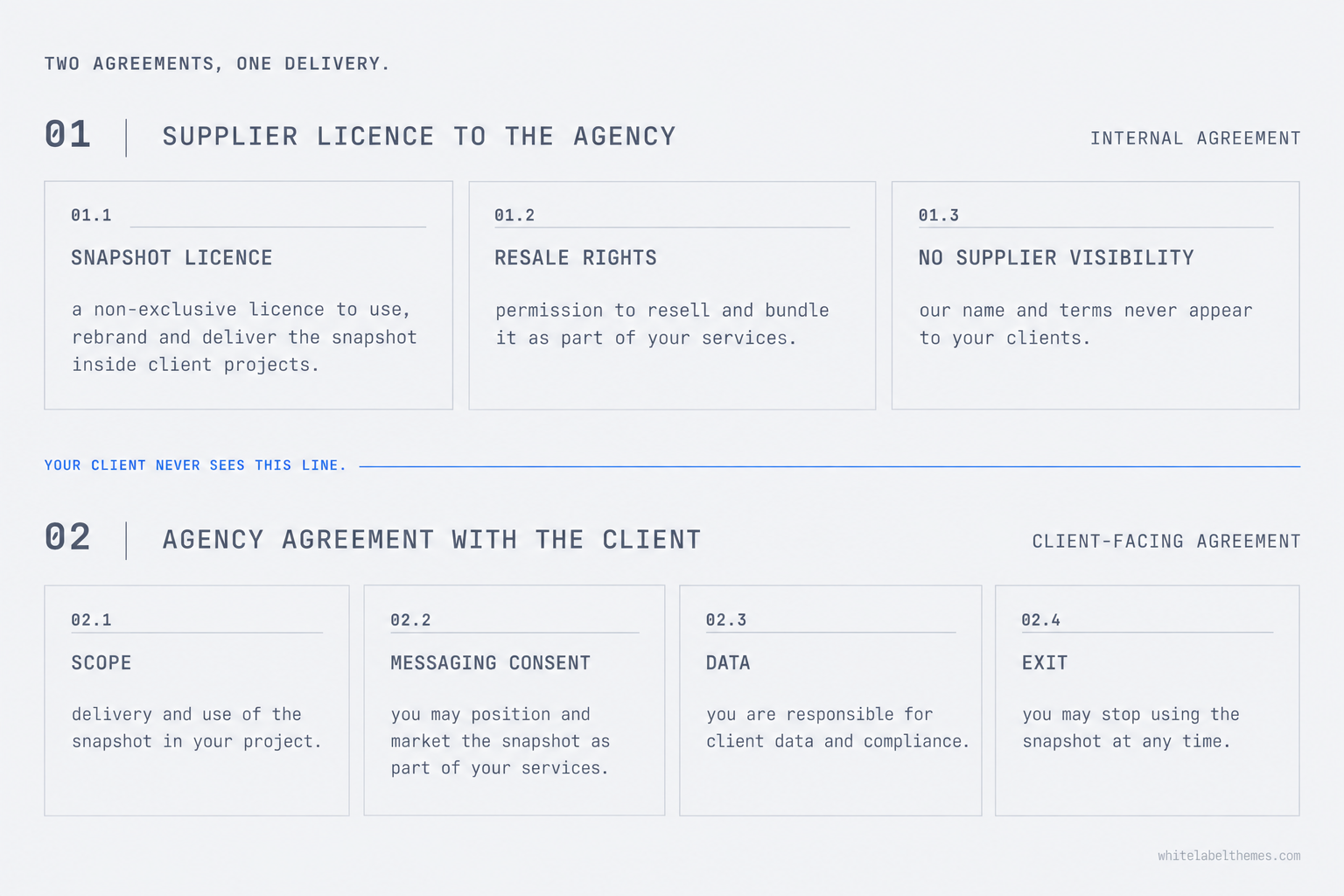
The client-facing agreement has three jobs, and a template pulled from a generic contract site does one of them by accident. It allocates liability, so the risk of the work lands on whoever controls the thing that creates the risk. It protects the resale, so the margin you built into the price survives contact with scope creep and early churn. And it controls the exit, so that when the client leaves, and a share of them always leaves, they go with what they paid for and not with your entire build and your supplier’s name attached to it.
Clause one: scope defined as an outcome, not an asset list
The first mistake is in the first clause. An agency writes a deliverables list, because a list feels concrete and reassuring, and the list becomes a hostage. “A booking funnel, a reminder sequence, a review request flow, a pipeline and a reporting view” reads like a definition of done. It is actually a definition of the floor, because the moment the client wants the booking funnel to behave differently, you are rebuilding an item on a list you agreed to deliver, for free, for as long as they ask.
Define the deliverable as the outcome the client is buying and the work you will do to stand it up, not the parts in the box. “A booking and follow-up system configured for your practice, installed and rebranded to you” is a scope. It lets you point at the rebrand and the import as the work, and it lets revisions past the agreed window become a new line rather than a standing obligation. The handover document you deliver with the build is your evidence of what “installed” meant, so the scope clause should name it and point at it.
Clause two: messaging consent, and who pays the fine
This is the clause the forwarded PDF was about. A snapshot ships with the flows that make it worth buying, and the flows that make it worth buying send texts and emails: the reminder, the no-show rescue, the review request, the reactivation of an old list. The list belongs to the client. The consent to message that list belongs to the client. Under United States law the liability for messaging that list without consent also belongs to the client, but only if your agreement says so, because the agency whose name is on the message is the obvious first defendant.
The exposure is not theoretical and it is not small. The Telephone Consumer Protection Act gives every recipient of a non-consented marketing text a private right of action worth $500 per message, rising to $1,500 per message where the violation was willful or knowing, with no cap on the total, so one careless reactivation blast to an old list is a claim measured in thousands of messages multiplied by five hundred dollars. Email runs under a separate regime: CAN-SPAM, enforced by the Federal Trade Commission, carries a civil penalty the FTC adjusts for inflation and that currently reaches up to $53,088 per offending email. (Both figures were confirmed this week via search snippet across several compliance publishers, among them messageiq.io/blogs/avoid-costly-fines-a-guide-to-tcpa-and-can-spam-for-sms-marketing, rather than independently fetched.)
| Regime | What it governs | Who must hold the consent | Exposure |
|---|---|---|---|
| TCPA | Marketing and automated SMS and calls to US numbers | The client, whose list and whose customers these are | $500 per message, or $1,500 if willful, uncapped |
| CAN-SPAM | Commercial email | The client, as the sender of record | Up to $53,088 per email (FTC, inflation-adjusted) |
| A2P 10DLC | Carrier registration before any SMS will send | The client’s own legal entity, in the client’s name | Messages filtered or blocked until it is done |
This is also where the white-label line does real work. The carrier registration and the consent records sit with the client’s own legal entity, in the client’s name, which is exactly where the law wants them and exactly where your supplier can never appear. What you white-label and what you deliberately keep in the client’s hands is not only a branding decision; the things you keep in the client’s name are also the things whose liability you do not want to own.
Clause three: the licence you grant, and the boundary you hold
Your supplier grants you a licence to resell. You, in turn, grant your client a licence to use what you deliver, and the second grant should be narrower than people assume. You are giving the client the right to use the system you built them, inside their own account. You are not giving them the right to export it, hand it to another agency, or resell it as their own, and if the agreement is silent a motivated client will assume all three. Your own resale rights came with limits; pass sensible limits down the chain.
The boundary clause is short, and it is the whole white-label promise in one sentence: nothing in the delivery identifies any third party, and the client agrees not to go looking for one. You cannot stop a determined client from finding a footer you missed, which is why the rebrand has to be clean in the first place, but you can make “I found out who really built this” a breach rather than a reason to reopen the price. The clause is cheap. The footer you missed is what makes it necessary.
Clause four: who owns the account, and what leaving looks like
GoHighLevel is built around the agency-to-client relationship, and that shapes what “ownership” can even mean. A sub-account lives under your agency. A formal transfer that moves a sub-account into the client’s own agency account is handled through HighLevel support, needs both agencies to agree, and cannot be started by a sub-account user on their own. For white-label sub-accounts the standard transfer is not available at all. (GoHighLevel’s transfer mechanics here were confirmed via search snippet from ghlscaleup.com and HighLevel support write-ups, not independently fetched.)
That is a fact your agreement has to meet honestly, because the client will eventually ask the question and “it is complicated” is not an exit clause. Decide in writing what the client gets when they leave: a copy of their data by export, an agreed handover window, and whether you will migrate the build into an account they own. A clean offboarding is a selling point, not a concession. The agencies that lose ugly are the ones who never wrote down what leaving looks like and then improvised it while the client was already angry.
The numbers: what a term clause is worth
The liability clause saves you once, on the day the demand letter arrives. The commercial clauses are the ones that pay for the agreement every single month, and the clearest example is the minimum term. Here is the arithmetic, with every input visible so you can drop in your own figures.
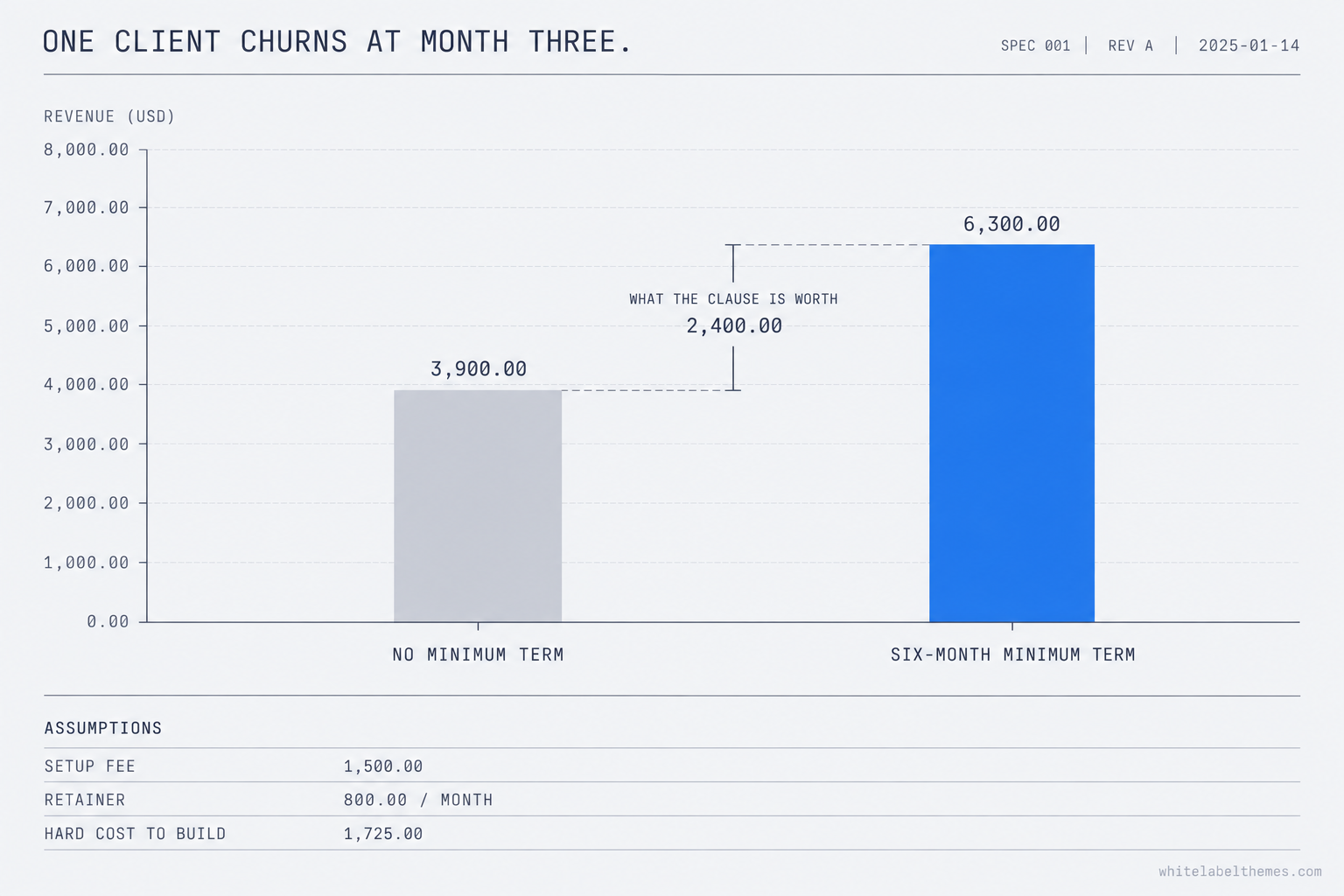
Say you resell a build on a $1,500 setup fee and an $800 monthly retainer. Your hard cost to stand it up is the snapshot plus the install: take a $1,475 snapshot such as the med spa build and the $250 installation add-on, which is $1,725 before a minute of your own time. Notice that the setup fee does not even cover the hard cost. That is deliberate and it is normal: the setup fee buys the client in, and the retainer is where the work is actually paid for.
Now the client churns at the end of month three, which is the most common moment to lose one, right after the novelty has worn off and right before the habit has set in. With no minimum term you have collected the setup fee and three retainers, which is 1,500 plus three lots of 800, or 3,900. With a six-month minimum term, or a kill fee equal to the remaining months, you bill the balance, which is 1,500 plus six lots of 800, or 6,300. The clause is worth 2,400 dollars on this one departure, which is more than the setup fee and more than the snapshot and install combined. Fig. 02 puts the two outcomes side by side.
Change the inputs and the conclusion holds. The term clause is worth the most on exactly the clients who leave early, which are the clients a weak agreement would have let leave for free. It costs you one sentence. Compare that to recovering the same loss by signing a replacement client, which costs you the whole acquisition over again, and the cheapest insurance on the page is the one most agencies never write.
Where it goes wrong
Four failures recur, and each one is a missing clause with a predictable bill attached. A fifth is the one that is quiet until it is not.
The agency named in the client’s lawsuit
Symptom: a demand letter arrives naming your agency over a message you sent on the client’s behalf. Cause: no consent warranty, so there is nothing in writing that puts the legality of the list on the client. Fix: the warranty and indemnity from clause two, plus an approval trail for every broadcast, so that “the client told us to send it to that list” is documented rather than remembered under pressure.
The retainer eaten by revisions
Symptom: a profitable retainer quietly turns into unpaid build work, because the client keeps asking for small changes to the funnel. Cause: scope defined as an asset list, which made every change to an asset your problem. Fix: outcome-based scope, a named revision window, and a rate card for anything past it, so that month four is retainer work and not a renegotiation you lose by default.
The install you never recovered
Symptom: a client leaves at month two or three and you are down on the whole engagement, because the snapshot, the install and your setup time cost more than you ever collected. Cause: no minimum term and no kill fee, so the client’s exit is free to them and expensive to you. Fix: the term clause, sized so the floor of the engagement at least clears your hard cost and your setup time.
The client who walks with the build
Symptom: a departing client demands “our account and everything in it”, assumes they own the configuration you licensed to them, and threatens a chargeback when you hesitate. Cause: no ownership or exit clause, so “everything” has no agreed meaning and you are defining it live with someone who has already decided to go. Fix: the ownership line and a defined offboarding, including what a white-label sub-account can and cannot be transferred into, written while everyone is still friendly.
The snapshot resold behind your back
Symptom: a client, or the next agency they hire, stands up your build for someone else. Cause: a client licence that never said the grant was for their use only. Fix: the narrow-grant clause from clause three, which makes reuse a breach rather than an ambiguity, and which costs nothing to include and a repeatable product to omit.
What each clause has to say
If you read one thing twice, read this. The difference between an agreement that protects you and one that decorates your invoice is usually a single sentence per clause.
| Clause | The term that protects you | The absence that sinks you |
|---|---|---|
| Scope | The outcome, the work to deliver it, a revision window and a rate past it | A flat list of assets with no revision limit |
| Messaging | Client consent warranty plus indemnity; you send only what is approved | Silence, so the name on the message is the defendant |
| Licence | A use-only grant to the client; no export, handoff or resale | No grant stated, so the client assumes all three |
| Confidentiality | No third party is named; looking for one is a breach | Nothing, so a missed footer reopens the price |
| Term | A minimum term or kill fee that clears your hard cost | Month to month from the first day |
| Exit | A defined data export, handover window and ownership split | “It is complicated”, improvised while the client is leaving |
Three objections, answered
A contract will scare off a small client
It scares off the client who was always going to be a problem, which is rather the point. A one-page plain-language agreement that a sole trader can read in two minutes does not frighten a serious buyer; it signals that you have done this before. The version that scares people is six pages of boilerplate from a template site, aimed at no one, that the client’s own lawyer flags for sport. Keep it short, keep it specific to how you actually deliver, and the agreement reads as competence rather than as a hurdle.
I will just use a template I found
A generic template allocates none of the liability you care about, because it was not written for a business that resells someone else’s build and sends messages on a client’s behalf. It will carry an indemnity that runs the wrong way, a scope clause that lists nothing, and no concept of a white-label boundary at all. Borrow its structure if you like, but the four clauses that matter here are precisely the ones a general template does not contain, because the risks they cover are specific to what you do.
If I need all this paper, maybe buying a snapshot is not worth it
Sometimes it is not, and that is worth saying plainly. If you have a single client and you intend to build everything yourself and learn the platform as you go, a full resale agreement and a bought snapshot may both be more than you need this quarter; the build-or-buy decision turns on exactly that. But the moment you have a second client and a delivery you repeat, the agreement stops being overhead and becomes the thing that lets you repeat the delivery safely at a margin. The snapshot makes the work fast. The agreement makes the work a business.
Where to start
Write the four clauses before your next delivery, not after your next problem: outcome scope, consent warranty, use-only licence, and a defined term with an exit. If you are still deciding what you are actually selling under them, the snapshots and the fixed terms they ship with are priced and described so you can quote a client this week, with the delivery window and the final-sale terms stated up front rather than discovered later. The paper is cheap. The month you need it and do not have it is not.
Quick answers
Related questions
Keep reading
Next in the series
Terms · 11 min
GHL Snapshot Licensing and What You May Resell
Installing a snapshot for a client and selling that snapshot to another agency are two completely different rights. Most agencies assume they bought both. Almost none of them did.
Operations · 13 min
When a Client Leaves and Wants to Take the Account
You have a thorough onboarding process and nothing at all for the other end. So the first real client exit becomes improvisation, and improvisation under pressure is where you give away work you owned or hold onto data you did not.
Decision · 11 min
Buy or Build a GoHighLevel Snapshot: The Decision
Building teaches you the system. Buying gets you a system this week. The right answer depends on one thing, and it is not the price of the snapshot.