Decision · 13 min read
How to deliver GoHighLevel to clients: five models, compared
Five ways to produce a client account, and the one that fits depends on your calendar, not the price of a snapshot. The arithmetic at ten clients settles it.
Marcus Feld
Head of Build
Published
The month you cross ten clients is the month delivery stops being a task and becomes the business. You notice it on a Thursday, when a new client has already paid, two existing ones want changes, and the only person who can build any of it is you. The question underneath every late night that follows is not which snapshot to use. It is which way you are going to produce accounts at all.
There are five honest ways to do it, and most agencies drift into one by accident rather than choosing it. This is the choice laid out on purpose: what each model actually is, what each one costs to run ten clients for a year, where each one leaks a supplier name into your client inbox, and the one question that picks between them. The prices here are real and dated. Your own hours are the variable that decides the answer.
The five models, in one line each
- Build every account in-house from a blank GoHighLevel sub-account.
- Buy a rebrandable white-label snapshot and install it yourself.
- Subcontract to a white-label desk that supports, and sometimes builds, under your brand.
- Hire a dedicated builder or GoHighLevel VA who does nothing else.
- Resell the platform in SaaS mode and let the client operate the account you provisioned.
They are not mutually exclusive, and pretending they are is the first mistake. Most working agencies run two: a spine that produces the account and a second model that absorbs the overflow or the support. Pick the spine first, then decide what bolts on.
Model one: build it in-house
Building means you start from an empty sub-account and assemble the whole thing yourself: the call answering and the outbound recovery for when nobody picks up, the chat replies across every channel a customer uses, the site and its forms, the booking and the reminder chain, the review capture and its follow-ups, the reactivation and the long nurture. Then you write every email, text and voice prompt in a voice that suits the trade, which is usually more work than the automation and is almost always underestimated because it does not look like building.
Then you own it forever, because the platform moves and a workflow that behaved one way in March behaves differently in September. Building buys you total control and a system nobody else has. It costs you the one resource you cannot restock, and the full hours arithmetic of a home build is worse than the estimate you are carrying in your head, because the estimate never includes the copy pass or the year of maintenance.
Model two: buy a snapshot and install it
A rebrandable snapshot is the same build, already assembled and already written, delivered as a link you import into a sub-account. You swap the brand tokens, point the domain, set the two settings that are account-specific, and it is live. The build cost is spread across every client the snapshot serves rather than paid again each time, which is the whole reason the model exists.
On this site the link installs into unlimited sub-accounts inside your own agency and comes with twelve months of updates as the platform moves, so the maintenance line that ruins a home build is somebody else’s problem. The catalogue of rebrandable snapshots delivers inside 24 business hours, and if you would rather not touch the import, installation is an optional $250 add-on rather than a requirement. You install these for a living, so the handover PDF is written for you, not for a beginner.
Model three: subcontract to a white-label desk
A white-label desk answers your clients in your name. Your client opens a chat widget wearing your logo, and a team you do not employ replies as though they were your staff, with the client never learning a third party is involved. Some desks also build and onboard. The pricing is recurring and, importantly, per-agency rather than per-client, so a desk covers your whole book for one monthly line.
The published rates spread wide. HL Pro Tools lists a Core desk at $197 a month and a VIP tier at $397 (hlprotools.com). Extendly starts around $299 a month for ten sub-accounts and prices its onboarding tiers annually (getextendly.com). Growthable opens at $549 a month plus a setup fee and runs a $2,000 tier with dedicated admin hours (growthable.io). Every one of those covers support. None of them, at the entry price, is producing the account, which is the distinction most agencies miss until the first invoice.
When you want the building done for you as well, that is a white-label fulfilment retainer, which is a different cost and a different question. Whether to rent that capacity or hire it is worked out in the break-even between fulfilment and a builder.
Model four: hire a dedicated builder
A hire is fixed capacity. You pay whether the week is full or empty, and the wage is the smallest interesting part of the cost. Published 2026 rates put a dedicated GoHighLevel VA between $449 and $1,500 a month for managed offshore work, and offshore hourly work between about $6 and $16; a domestic specialist runs $75 to $150 an hour (ddiy.co, ghlops.com). Load employment costs, recruitment and the two to three months of ramp on top, and the real hourly cost is often close to double the number on the offer letter.
A hire wins when demand is steady enough to keep the person busy, and loses badly when it is not, because a delivery hire is paid in the quiet months too. The exact break-even against renting capacity turns on your real utilisation rather than your contracted hours, and most agencies plan the hire against their best month instead of their average one.
Model five: resell SaaS mode
SaaS mode is the opposite of done-for-you. You provision a rebranded sub-account, load a baseline build once, set a plan price, and rebill the client for their own usage with your markup. The client operates the account. It needs the Agency Pro tier, which HighLevel publishes at $497 a month against $297 for Unlimited (gohighlevel.com/pricing), and it trades a high-touch build for a recurring subscription with a lower ticket and a higher churn rate if you ship it without a support layer underneath it.
It is the model with the lowest delivery labour and the thinnest margin per client, so it only works at volume and only with onboarding that stops people cancelling in month two. The SaaS-mode price ladder is where that maths lives.
What each model costs to run ten clients for a year
Here is the arithmetic, with the assumptions from the top of the page. Two columns matter, because two of these models spend cash and two of them spend your calendar, and a calendar has a price. The last column is the one that decides whether a model survives growth: what the eleventh client costs once the first ten are already running.
| Model | Cash, year one | Your hours, year one | Total at $75/hr | Each extra client |
|---|---|---|---|---|
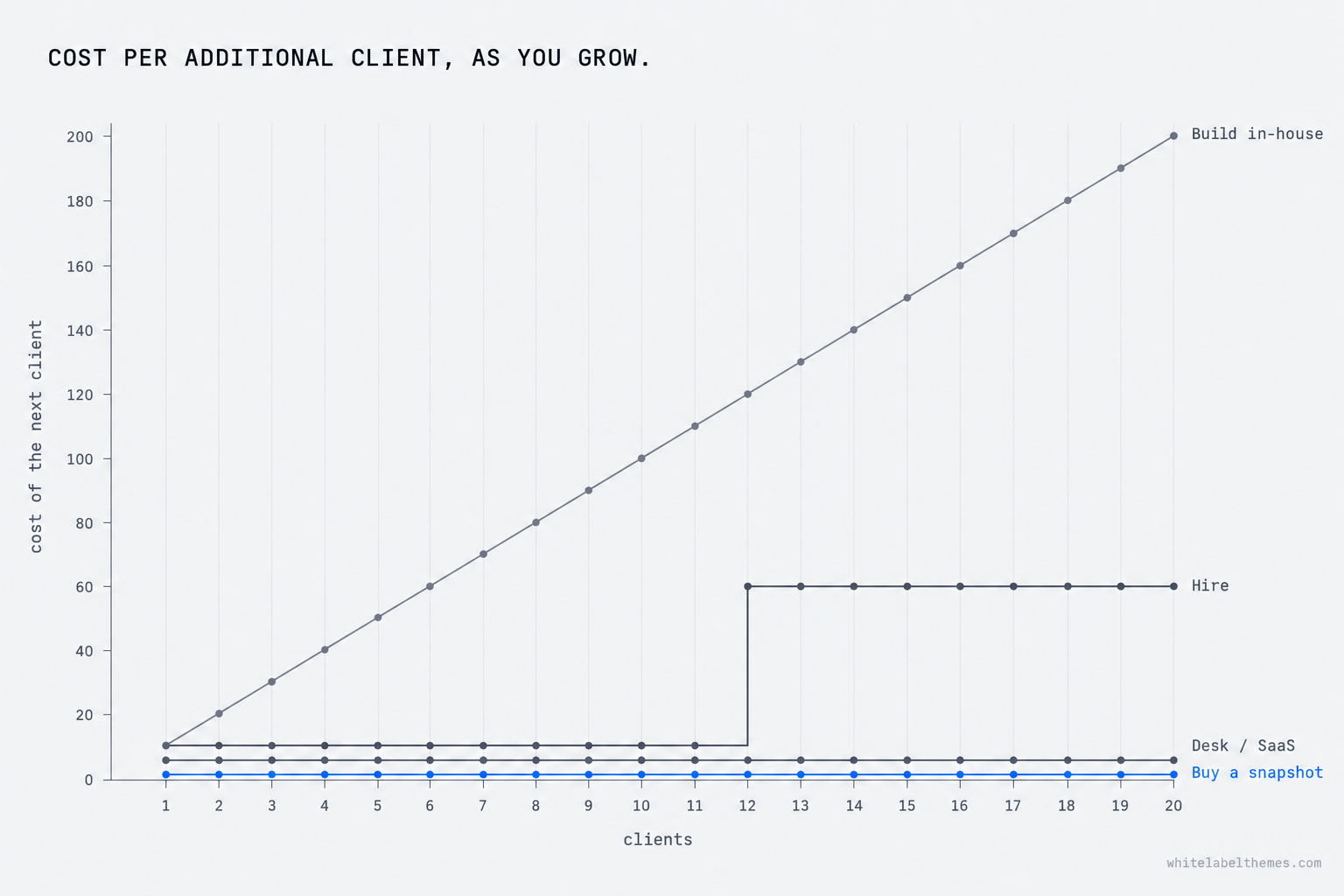
| Build in-house | Platform only | ~430 hrs | about $32,000 | ~10 hrs, about $750 |
| Buy a snapshot | about $3,600 | ~15 hrs | about $4,700 | ~1.5 hrs, or the $250 add-on |
| Subcontract a desk | about $8,400 | ~15 hrs | about $9,500 | $0 support, plus the install |
| Hire a dedicated VA | about $18,000 | ~60 hrs managing | about $22,500 | $0 until capacity fills, then a step |
| Resell SaaS mode | about $6,000 | ~20 hrs | about $7,500 | near $0, the client operates it |
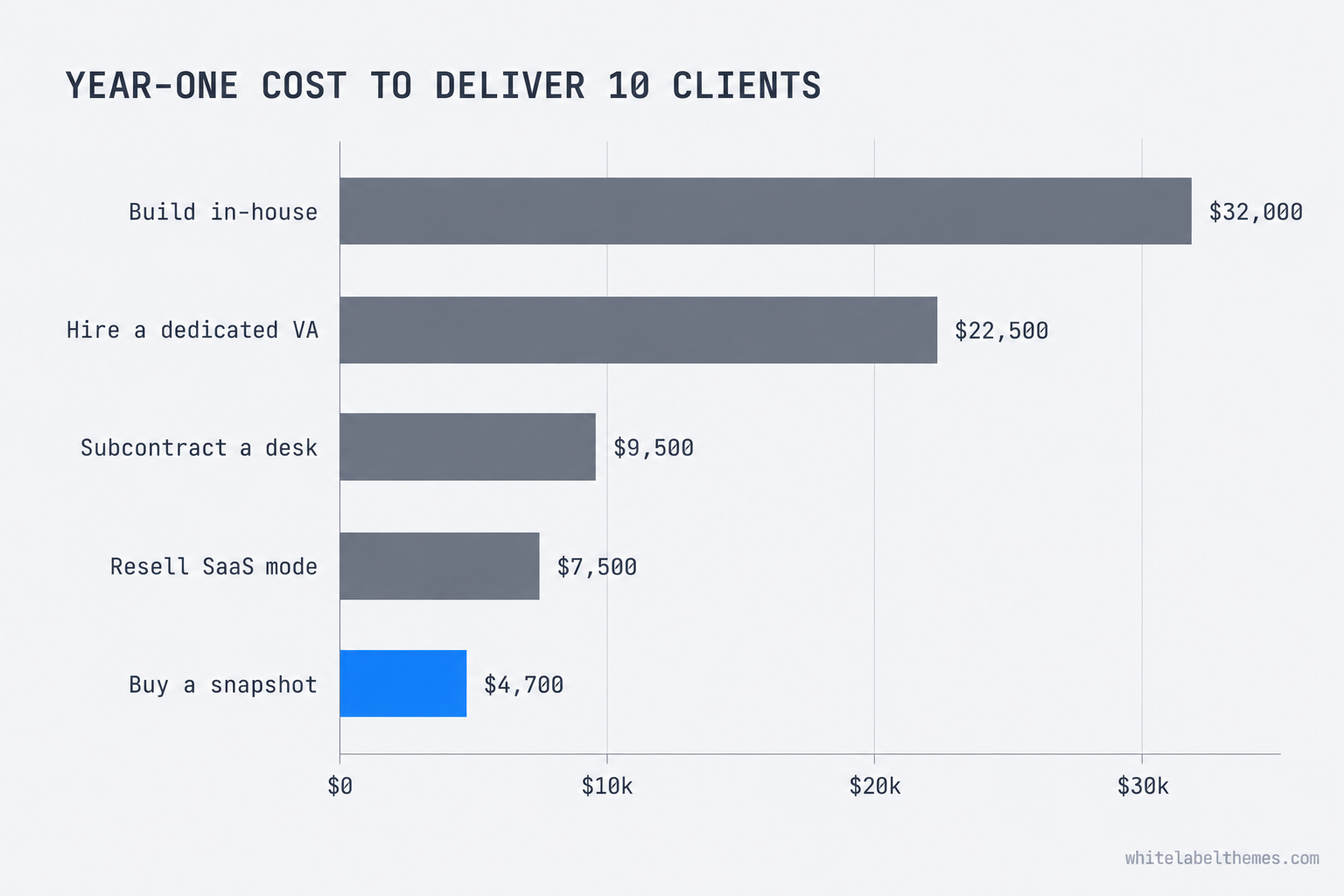
Read the total column and building looks like a disaster; read the cash column and it looks free. Both readings are traps. Building spends your own time, and it spends it in year one when you have the least of it. The snapshot and the desk convert that time into a cash line you can plan around. The hire converts it into fixed capacity that only pays off above a utilisation line most agencies do not reach until well past ten clients. SaaS spends the least of everything and asks the client to spend the time instead, which makes it a different product rather than a cheaper version of the same one.
The figure that should worry you is the last column, not the total. A model whose eleventh client costs almost nothing scales. A model where the eleventh client costs another ten hours of your week has a ceiling built into it, and you will meet it, usually as the moment delivery becomes the growth constraint.
The eight criteria, scored
Cost is one axis of five. Here are all eight, scored across the five models, so you can weight the ones that matter to your agency rather than the one that fits on a homepage. Read down the column for the model you are leaning towards, then check the rows you cannot afford to get wrong.
| Criterion | Build | Buy snapshot | Desk | Hire | SaaS |
|---|---|---|---|---|---|
| Upfront cost | High, in time | Low | Medium | High | Low |
| Cost per extra client | Moderate | Very low | Very low | Stepped | Very low |
| Time to first client live | Weeks | Days | Days | Weeks, with ramp | Days |
| Where a name can leak | Yours only | None if built for resale | Desk error risk | Yours only | Platform tier risk |
| Customisation and fit | Total | High, modify the 20% | Limited | High | Limited |
| Delivery ceiling | Your calendar | Very high | High | Fixed capacity | Very high |
| Licence and resale rights | Yours outright | Per licence terms | Not applicable | Yours outright | Platform terms |
| Maintenance burden | Yours forever | Updates included | Shared | Yours, via the hire | Platform plus you |
Which one to pick
The criteria narrow it; your constraint settles it. Match the model to whichever resource is scarcest in your agency right now.
Build in-house if the system is your differentiator, the vertical is genuinely yours, or you need integration-level work no configuration can reach. That decision has its own four clear cases either way.
Buy a snapshot if the vertical is well understood, a client has already paid, and your only real constraint is your own calendar. Modify the twenty per cent that reflects how you sell, which is what the rebranding walkthrough is for, and re-export the result as your own.
- Subcontract a desk if support is your bottleneck and demand is too spiky to justify a hire, or you need coverage outside your own working hours.
- Hire if delivery demand is steady enough to keep one person busy in your worst month, not your best one, and you have a documented process to hire into.
- Resell SaaS mode if your clients want access rather than done-for-you, and you will fund the onboarding and support that stops them churning early.
The five ways this goes wrong
Each model has a characteristic failure, and every one is avoidable once you can see it coming. The symptom shows first, the cause sits underneath, and the fix is usually cheaper than the failure.
Building stalls at sixty per cent
The symptom is a first vertical that never quite finishes: the client is live, but the reactivation sequence is empty and the review follow-ups were going to be a next-week job three months ago. The cause is that a build has no deadline when you are your own client, and the copy is always underestimated. The fix is to stop treating buy and build as opposites: buy the baseline, build the part that reflects how you sell, and where the gap is bigger than a rebrand, a scoped automation build-out closes it without turning it into a project.
The desk answers in a room you cannot enter
The symptom is a client repeating something your own support team supposedly told them, and you having no record of it. The cause is work happening inside the desk environment instead of yours. The fix is ownership: the account is yours, the desk works under a user you created and can revoke, and the ticket history lives where you can read it. A desk that will not work that way is selling you a blindfold.
You hire against your best month
The symptom is a capable builder idling two weeks in four while the wage clears every month regardless. The cause is a hire justified by peak demand rather than average demand, which is the most common way delivery margin quietly evaporates. The fix is sequence: rent capacity until demand reliably fills a full-time load in your quiet quarter, then hire behind proven work. The true cost of delivering one client is the number that tells you whether you are there yet.
SaaS ships without a support layer
The symptom is churn spiking in the second and third month, with cancelling clients who say they never really got going. The cause is treating self-serve as no-serve. SaaS mode removes your build labour; it does not remove the client need to be onboarded and answered. The fix is to pair it with a real client onboarding process and a support desk, and to price the plan for the margin that funds both.
You buy a client account with the logo removed
The symptom is a supplier name surfacing in an email footer, a calendar confirmation or a form six weeks after go-live, in front of the one client who happened to look. The cause is buying somebody old client build rather than a system made to be resold, where the brand lives in custom values instead of being baked into every asset. The fix is to evaluate before you buy: ask, in writing, whether the build was made for resale and how much of the client-facing content sits in custom values. The licence and resale rights matter just as much as the build quality.
Three arguments you are already having
Buying means I will not understand my own system
True, if you treat it as a black box and never open it. False, if you buy the baseline and change the twenty per cent that reflects your offer, because you learn an architecture faster by modifying it than by staring at an empty account. The agencies that get burned are the ones reselling a snapshot they have never once edited. The ones that thrive treat it as a starting point they own.
A desk or a retainer costs more than just hiring
Only above a utilisation line, and most agencies sit below it longer than they admit. A hire is fixed cost with variable output. A desk or a retainer is variable cost you pay for when you use it. Below the line where a full-time person is reliably busy, renting capacity is cheaper and carries less risk, because you are not paying for idle weeks and you are not carrying the concentration risk of one person holding every build in their head.
Isn’t it cheaper to just build everything myself
Sometimes, and we would rather say so than sell you the wrong thing. If you have a single client in a vertical nothing credible exists for, build it, because a system you install once is not worth productising. If your sales process is genuinely unusual, or the build itself is the product you are selling, build it, because the point of your offer is that it is visibly yours. Buying is the right move when the vertical is understood and your constraint is time. When it is not, a snapshot is the wrong purchase, and it being convenient does not change that.
The short version
Pick the spine that matches your scarcest resource. If time is the bottleneck, buy the build and spend your hours selling. If support is the bottleneck, rent a desk over a bought build. If demand is steady and heavy, hire behind it. If your clients want the keys rather than the chauffeur, resell the platform and fund the onboarding. Build from scratch only when the system is the thing you are actually selling. Then run the arithmetic at the top with your own hourly rate, because the moment your time carries a real price, the ranking usually stops being a matter of taste.
If the answer is buy the build and spend your hours selling, the snapshot catalogue holds twenty rebrandable systems priced from $925, each installable into unlimited sub-accounts inside your own agency, and the pricing page shows where installation and the fulfilment retainer sit on top.
Quick answers
Related questions
Keep reading
Next in the series
Decision · 11 min
Buy or Build a GoHighLevel Snapshot: The Decision
Building teaches you the system. Buying gets you a system this week. The right answer depends on one thing, and it is not the price of the snapshot.
Decision · 11 min
White-Label Fulfilment vs Hiring a GHL Builder
A hire is fixed capacity you have to keep busy. A partner is variable capacity you pay for when you use it. The break-even between them is a number you can work out this afternoon.