Pricing teardown · 13 min read
One snapshot per niche, or one you stretch across your book?
You can install a GoHighLevel snapshot into as many of your own sub-accounts as you like, which tempts every agency to buy one and reskin it for every client. For a book that spans several trades, that is usually the expensive mistake. Here is the stocking arithmetic: when one snapshot stretches, when it cannot, and the point where the five-snapshot pack is cheaper than buying singles one at a time.
Marcus Feld
Head of Build
Published
You won a chiropractor on a Thursday. You already owned the dental snapshot you bought in the spring, the one you had installed for two practices and knew inside out, and the thought was obvious: install the dental build into the chiropractor’s sub-account, swap the logo, change a few words, done by lunch. You started. An hour later you were still inside the automation that confirms the six-month hygiene recall, trying to turn it into something a chiropractor’s front desk would recognise, and you admitted the thing you had been avoiding since nine o’clock. You were not rebranding a build. You were rebuilding one, badly, on top of a build that was fighting you the whole way.
That afternoon is the question this piece is about, and it is not the one the blog usually gets asked. It is not whether a snapshot is worth buying at all. It is how you stock for a book that spans several trades without doing one of two expensive things: buying a different snapshot for every client whether you need one or not, or buying one and forcing it onto trades it was never built for. Both feel like the thrifty option in the moment. Both cost you more than the thing you were trying to avoid paying for.
So this is a teardown of the stocking decision, from the only seat that matters to you, the one where you pay for the build once and bill a client for it many times. Every snapshot price below is a live figure read off the catalogue this week, and every other number is a division you can redo with your own book in about a minute. The aim is not to sell you five snapshots. It is to let you work out how many you actually need, which for a lot of agencies reading this is fewer than the pack and more than one.
What a snapshot copies, and what it does not
Start with what the asset actually is, because the whole decision turns on it. A snapshot is a saved copy of one GoHighLevel sub-account’s build, the funnels, workflows, pipelines, calendars, forms and message templates, packaged as a template you load into another sub-account. The part that makes the maths interesting is the licence: you can install your copy into as many of your own sub-accounts as you run. Buy the dental snapshot once and every dental client you ever win can have it, at no extra cost in the licence.
That is the lever the sticker price hides. The number on the catalogue is a one-time cost for an asset you reuse, not a per-client charge, which is the same shape as every other fixed cost in this business. If you have not read the ground-level version of what travels inside one of these and what does not, the explainer on what a white-label snapshot is is the place to start before the stocking question makes sense.
Here is the part that catches people. Half of what is inside a good snapshot is trade-specific, and half is plumbing. The plumbing is the fact that a pipeline exists, that a reminder fires, that a form feeds a workflow. The trade-specific half is the wording, the timing, the cadence and the order: a dental recall at six months, a roofer confirming the day the crew and the ladder will be on the property, a law firm’s intake that cannot promise an outcome because the compliance will not let it. The plumbing is cheap to build. The trade-specific half is the expensive part, and it is the part you are actually paying for.
The reuse temptation, and the narrow case where it holds
Reusing one snapshot across trades is not always wrong. It is wrong across unrelated trades, and right across a trade family, and the difference is exactly the swap test above. Home-services trades sit close together: the mechanic of booking a job, confirming the day a crew is coming, chasing the review after the work is signed off is nearly identical whether the van says plumbing or electrical or pest control on the side. An HVAC build will carry a long way into plumbing with light edits, because most of the sentences survive the swap. That is genuine reuse, and in that case buying one snapshot for the family and adapting it per client is the right call.
Unrelated trades are the trap. A dental build and a gym build and a law-firm build share only the plumbing, and the plumbing is the half you could have stood up in an afternoon. Strip the dental-specific logic out to fit a gym and you have thrown away the expensive half and kept the cheap half, then paid for the privilege with your own time. You would have been faster starting from an empty sub-account, because at least then you would not be fighting a structure built around somebody else’s trade.
There is a second cost to forcing it, and it lands on the client rather than on you. The sentences that survive a lazy reskin are the generic ones, and generic is exactly what reads as not built for us to the business logging in. That is the gap a client falls into when they notice the funnel talks about a trade that is not quite theirs, and it is the same mechanism that lets a supplier’s fingerprints survive a rebrand. A mismatched snapshot does not look white-labelled. It looks borrowed.
The rule that keeps you honest: reuse one snapshot for a second trade only when the first trade’s copy passes the swap test with light edits. If you are rewriting more than the branding and a handful of lines, you are not reusing a build. You are building one, and you should price and plan it as a build rather than pretending the saved template did the work.
The arithmetic of buying per niche
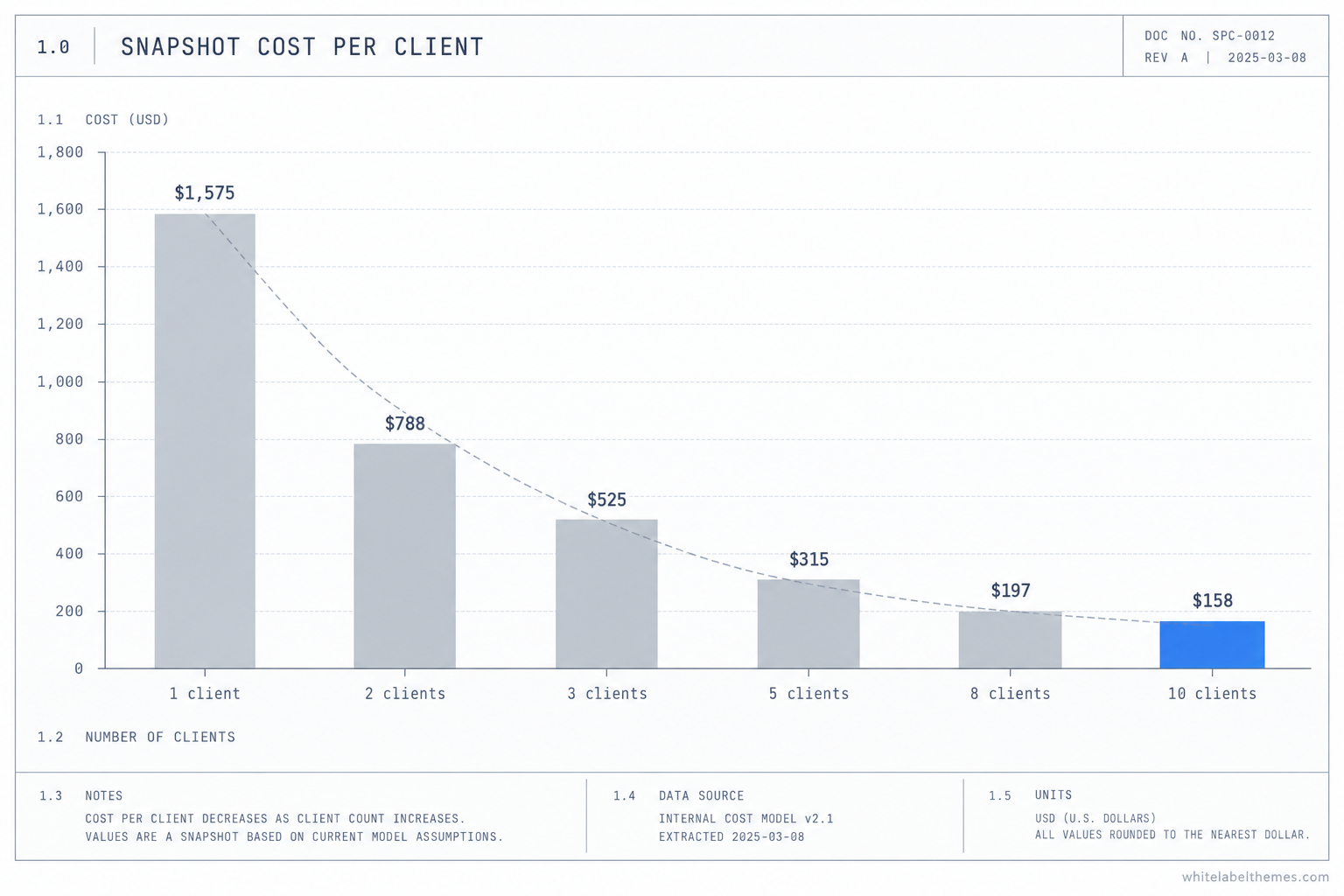
Once you accept that a trade you will sell more than once deserves its own snapshot, the cost stops being the sticker and becomes the sticker divided by the clients you deploy it to. The dental snapshot is $1,575 today. That is the price of the asset, not the price per client, and the per-client figure falls every time you win another dental practice to install it for.
| Dental clients you install it for | Snapshot cost per client | How the figure is reached |
|---|---|---|
| 1 | $1,575 | The whole asset resting on a single client. The most expensive a per-niche snapshot ever is |
| 2 | $787.50 | $1,575 split across two practices |
| 3 | $525 | $1,575 split across three |
| 5 | $315 | $1,575 split across five |
| 8 | $196.88 | $1,575 split across eight |
| 10 | $157.50 | $1,575 split across ten. The build is now a rounding error against what you charge to install it |
Two things sit on top of that figure and must stay on their own lines, or you will double-count and underquote. The first is installation. You can import the snapshot yourself, which an agency doing this for a living usually does, or take the optional $250 install add-on per sub-account. The second is your own rebrand time per client, the logo, the domain, the sender identity and the handful of trade-neutral settings that are account-specific.
Those two are per-client costs. The snapshot is a per-niche cost. Keep them in separate columns, because the whole point of a reused build is that the expensive per-niche line stops repeating while the per-client lines carry on. The rebrand pass itself is a short, repeatable job once you have a checklist, and if you want the full per-client picture rather than just the snapshot slice, what one GoHighLevel client actually costs you to deliver is the ledger that holds all of it together.
The expensive case, the one worth naming before we get to the pack, is the trade you will sell exactly once. A single client in a trade you will never pitch again carries the whole snapshot price on its own, forever, because there is no second client to divide it across. That is not an argument against buying it. A $1,575 build that a client pays you a setup fee and a retainer for is still a good trade. It is an argument for being honest about which column a one-off client sits in, and for reaching for the pack only when the trade is real and repeatable rather than a one-time favour.
When the five-snapshot pack pays
The catalogue sells snapshots singly and in one multi-buy: any five at a pack rate of 20% off, with each line floored at $850, plus one rebrand pass on the vertical you launch first. There is no whole-library bundle and there never can be, because the floor stops the discount before it gets there. The pack is the only place the price moves, and it moves less than the headline suggests, which is the part worth understanding before you reach for it.
The floor is the reason. No snapshot is ever sold below $850, discount included, so the 20% is a ceiling on the cut rather than a flat rate. Run the arithmetic and the break is clean: the full 20% only lands on a snapshot priced at $1,062.50 or above, because that is the point where a fifth off still clears the floor. Below it, the cut is only ever whatever brings the line down to $850 and not a cent further. The salon snapshot at $975 does not come down by $195 in a pack. It comes down by $125, to the floor, and stops.
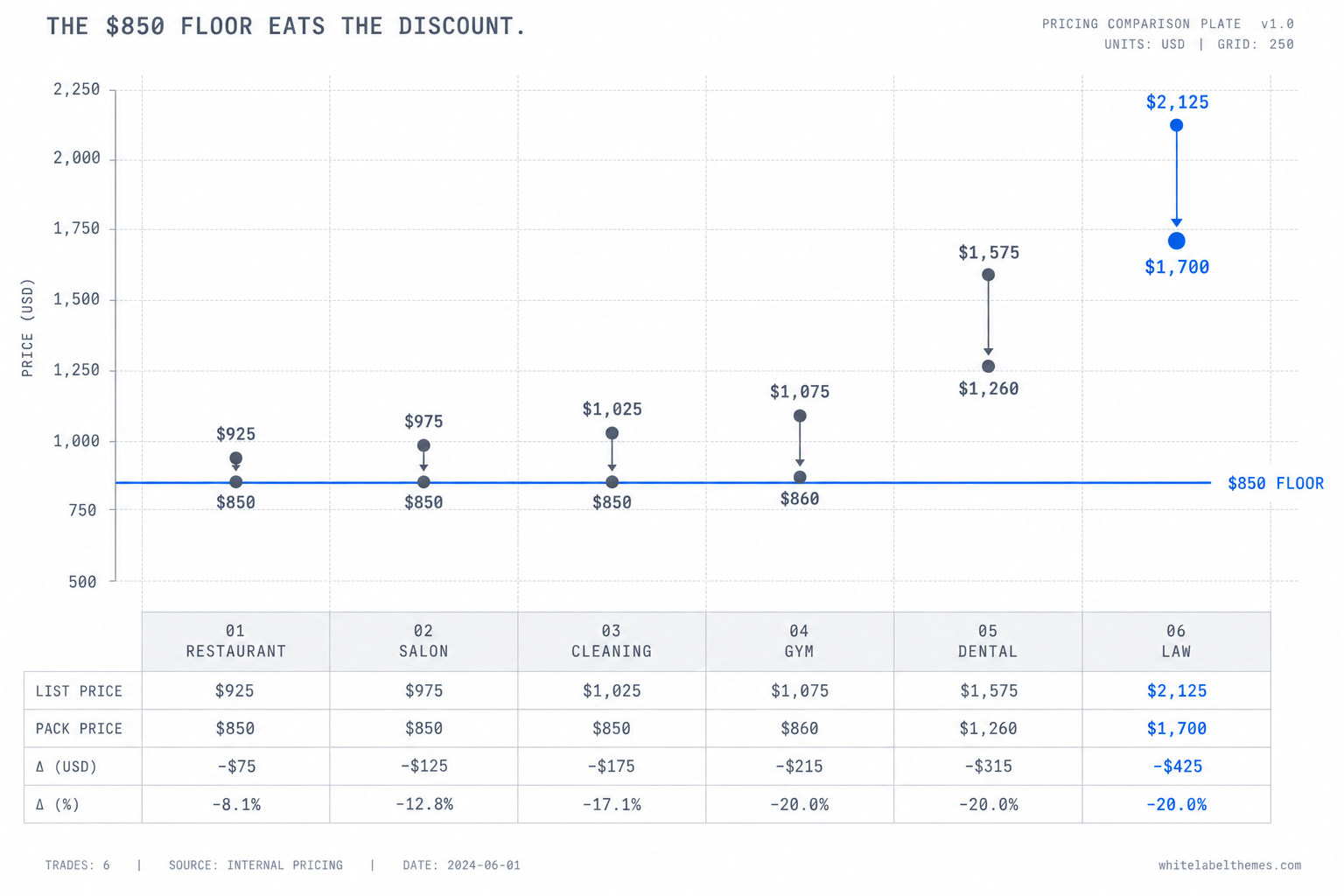
That makes the pack’s real value a function of your niche mix, not a flat rate you can quote yourself. Take a mid-to-high-ticket book first, the kind an agency selling to professional services and trades tends to end up with. Say you stock HVAC at $1,275, med spa at $1,475, dental at $1,575, real estate at $1,825 and a law firm at $2,125. Every one of those is above the floor threshold, so the pack takes a clean fifth off each.
| Five-niche shelf | Buy as singles | Buy as a pack | What the pack saves |
|---|---|---|---|
| HVAC, med spa, dental, real estate, law | $8,275 | $6,620 | $1,655 (a full 20%) |
| Restaurant, salon, cleaning, gym, auto repair | $5,125 | $4,310 | $815 (about 15.9%) |
The high-ticket shelf saves you $1,655, a genuine 20%, because nothing on it is anywhere near the floor. The low-ticket shelf is the honest contrast. Five of the cheapest verticals come to $5,125 as singles and $4,310 as a pack, a saving of $815, which is about sixteen per cent and not the twenty the word on the tin implies. Three of those five lines hit the floor and give back only part of the cut. The pack still pays on a cheap shelf. It just does not pay what you would assume if you multiplied the total by a fifth and called it a day.
So the pack is worth it when two things are both true: you can name five trades you will actually sell this year, and your mix leans towards the dearer verticals where the full discount lands. It is not a reason to buy trades you do not serve, and it is not a flat 20% you can promise yourself on a shelf of budget niches. It is a real saving that you have to read per line to size.
Four ways agencies stock the shelf wrong
None of these feels like a mistake while you are making it. Each is a reasonable-looking move that the licence terms or the floor quietly punish a month or two later.
One: forcing one snapshot onto an unrelated trade
The symptom is the Thursday afternoon in the opening, an hour lost inside a build that fights every edit. The cause is reading the unlimited-install licence as permission to treat any snapshot as a blank base, when a good one is the opposite of blank. The fix is the swap test, run before you install rather than after: read three lines of the build as the new trade, and if more than the branding fails, start from empty or buy the right trade. The licence lets you install a snapshot anywhere. It does not make a dental build a chiropractic one.
Two: buying five for the pack when you sell two
The symptom is two or three snapshots you have never installed sitting in your account because they came with the pack. The cause is chasing the headline 20% and buying trades to fill the five rather than trades you sell. The fix is to let the shelf follow the book: buy singles for the trades you have now, and reach for the pack only when the fourth and fifth trades are real clients you are pitching, not niches you hope to enter. A discount on something you never deploy is not a discount. It is money spent to feel like you saved some.
Three: buying singles piecemeal when the book is plainly multi-trade
The symptom is five separate single purchases over a year, at full price each, for a shelf you could see coming by the second one. The cause is treating every snapshot as a one-off reaction to a won client rather than planning the shelf you already know you need. The fix is the mirror of the last one: if you can honestly name five trades you will sell inside the year, the pack is cheaper than five singles bought one at a time, and the earlier you commit the sooner the rebrand pass and the pack rate start working for you. The test is whether the fifth trade is a plan or a wish.
Four: quoting yourself a flat 20% on a low-ticket pack
The symptom is a saving that looked like a fifth on the spreadsheet and came in nearer a sixth once the order went through. The cause is multiplying the singles total by 0.8 and forgetting the floor, which eats most of the discount on the cheap lines. The fix is to price the pack per line, not in aggregate: run each vertical through the floor and add up the real cuts. On a shelf of budget trades the true rate is closer to sixteen per cent, and knowing that before you quote a client or model your own costs keeps a phantom few hundred dollars out of your plan.
Five: buying the cheapest snapshot as a reskin-everything base
The symptom is the $925 restaurant snapshot bought not to sell to restaurants but to strip and reuse as a starting point for everything. The cause is reading the cheapest line as a blank template with a discount. It is not. It is cheap because it is a specific, finished trade build, and a finished build in the wrong trade is slower to repurpose than an empty sub-account, not faster. The fix is to stop looking for a base and buy the trade. If what you actually want is a blank to build on, that is a build decision, and it belongs in the build-versus-buy column rather than the stocking one.
The decision, by your book
Strip out the edge cases and the whole thing collapses to the shape of your book rather than the size of the discount. Buy for the clients you have and the trades you will genuinely sell, and let the shelf grow as the book does.
| Where your book is | What to buy | Why |
|---|---|---|
| One client in a trade you will not sell again | The single for that trade | The pack would be four dead lines. One snapshot a client pays a setup fee and retainer for still clears, even unamortised |
| Two or three trades you keep selling | Singles per trade | Amortise each across its clients. Revisit the pack only when the fourth and fifth trades are real |
| Five or more trades you can name and will sell this year | The pack | Cheaper than five singles bought piecemeal, and the full 20% lands if your mix is mid-to-high ticket |
| A shelf of budget trades (restaurant, salon, cleaning) | Singles or pack, on cashflow not the headline | The floor holds most lines near $850 either way, so the pack saves less. Decide on cash, not the word discount |
| A trade not in the catalogue, or a genuinely bespoke client | Neither, yet | This is a build-versus-buy call, not a stocking one |
That last row is its own decision, and it is the one to get right before you spend anything, because a build you make yourself and a build you buy have different costs that do not show up on a price tag. The question that settles buy or build is the companion to this piece: that one tells you whether to acquire a snapshot at all, this one tells you how to stock once you have decided to buy.
Three things you are already arguing back
I will just buy one and reskin it for everyone
Within a trade family you can, and you should, because the sentences survive the swap and the reuse is real. Across unrelated trades you cannot, and the reason is not a licence restriction, it is the work. A reskin that touches more than the branding is a rebuild wearing a rebrand’s clothes, and it is slower than starting clean because you are fighting a structure built for a different trade. The install licence lets you put a snapshot into any of your sub-accounts. It does not change what the words inside it say, and the words are what the client reads.
The pack is a waste, I only have three niches
Then do not buy it. Buy three singles for the three trades, amortise them across your clients, and keep the cash. The pack is not a goal to reach, it is a saving that exists only when the fifth trade is real. The point it flips is specific and you will know it when you hit it: the moment you are pitching a fourth and a fifth trade to live prospects rather than imagining them, the pack is cheaper than buying those five singly, and you buy it then. Not before, to qualify for a discount, and not in pieces afterwards at full price.
I will wait until I have actually won the clients
Often the right instinct, and worth keeping for trades you are unsure about. The honest cost of waiting all the way to the signed contract is that you then buy and build under a deadline, with a client expecting a start date, which is the most expensive moment to be acquiring an asset. The middle path is cheaper and calmer: buy the snapshot for a trade when you start pitching it seriously, not after the yes, so the build is ready and rebranded when the deadline arrives rather than being bought into one. You are not speculating on a trade you might enter. You are stocking the one you are actively selling.
The through-line is that the shelf is a stocking decision, not a shopping spree. Buy the trades you sell, divide each build across the clients you win in it, and reach for the five-snapshot pack only when the fifth trade is a real client rather than a line to fill. The full catalogue of twenty verticals shows which trades are built and ready, and the pricing page carries the pack rate, the $850 floor and the all-sales-final terms in full, so you can see the real number per line before you commit to any of it. One more read will save you a bad purchase: what your snapshot licence actually lets you install and resell, because the unlimited-install right is the whole reason the per-client maths works.
Quick answers
Related questions
Keep reading
Next in the series
Decision · 11 min
Buy or Build a GoHighLevel Snapshot: The Decision
Building teaches you the system. Buying gets you a system this week. The right answer depends on one thing, and it is not the price of the snapshot.
Terms · 11 min
GHL Snapshot Licensing and What You May Resell
Installing a snapshot for a client and selling that snapshot to another agency are two completely different rights. Most agencies assume they bought both. Almost none of them did.
Margin maths · 11 min
What One GoHighLevel Client Actually Costs You to Deliver
Most agencies know their revenue per client to the dollar and their cost per client to the nearest guess. Here is the ledger that closes the gap, and the line that is almost always missing from it.