White-label model · 13 min read
The white-label footprint: when a client finds your supplier
The whole business runs on one promise: your client never sees who built the work. It does not hold by luck. It holds because somebody went looking for a name that is not yours, and found none. Here is where that name survives a rebrand, what to say when a client finds it, and how to make sure the question never comes up.
Marcus Feld
Head of Build
Published
The message is always a screenshot. A client forwards a reminder text their own customer received and asks, in a tone that is still friendly but no longer relaxed, why it came from a domain they have never heard of. Or a new marketing hire on the client side opens the account you gave them, reads a workflow called "HL Onboarding v3", and asks who HL is. Or a competitor agency pitching your client mentions, casually and on purpose, that the whole build looks like a snapshot they have seen before. Three different openings, one question underneath all of them: who actually made this, and why is their name in my account.
That question is the one your entire positioning is built to never provoke. You sold a system under your own brand. You charge a retainer that assumes the client believes your team built and runs it. The moment a foreign name surfaces, the client is not just confused, they are recalculating. This piece is about the thing that makes that moment survivable, and better than survivable, avoidable. It is the footprint your supplier leaves in a GoHighLevel account, exactly where it hides, how clients find it, what to say in the hour after they do, and the one-hour discipline at install that means they never do.
The promise, and the single fact it rests on
The line this network sells against is "we build it, you brand it, your client never sees us", and when you resell a build you inherit that promise whole. It is a strong promise and a simple one, but it does not hold because you believe it. It holds because of a single checkable fact: that an account handed to a client carries no name except yours, in any field a human will ever read. A rebrandable white-label GoHighLevel snapshot is built to make that fact easy to achieve, with the business name, booking link and sending identity pulled into custom values so a rebrand is a short list of edits rather than a tour of the whole account. Easy to achieve is not the same as achieved. The gap between the two is the footprint.
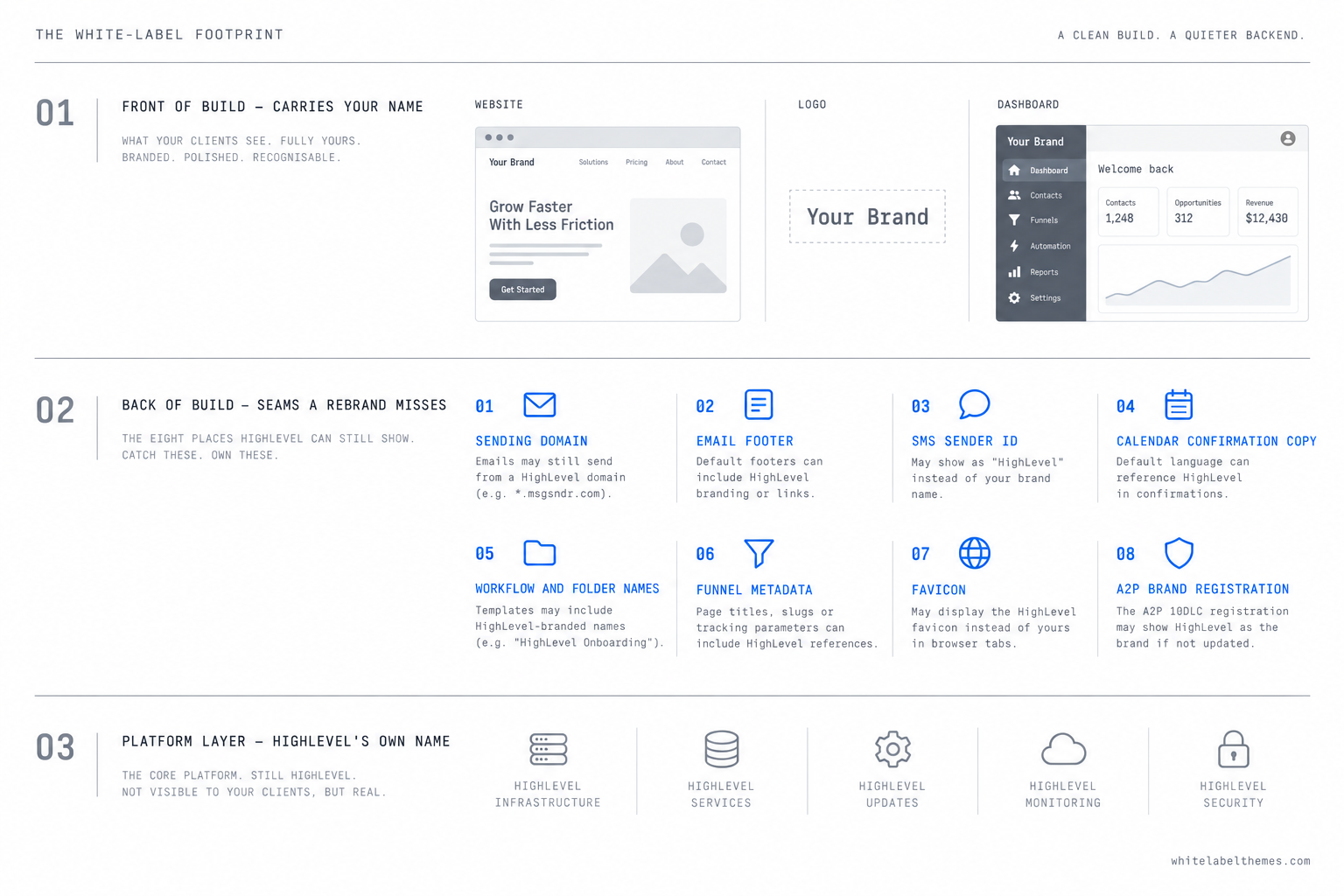
It helps to separate what a client sees from what a client can find, because they are not the same surface. What a client sees is the front of the build: the website, the logo on the login screen, the dashboard they open in the morning. That part gets rebranded first because it is visible, and most agencies do it well. What a client can find is everything behind that front, and behind it is where a name you did not put there tends to survive. Knowing the difference between the two is most of what you can actually white-label in GoHighLevel, and it is the difference between a rebrand that looks complete and one that is.
Where the name survives a rebrand
The front of the build is the easy part, and it is not where the footprint lives. The footprint lives in the back, in the fields a client never looks at until they have a reason to, and the trouble is that the reason usually arrives with someone who knows exactly where to look. Walk the seams in order, because they are the same ones at exit as at install, and the account that survives a competitor reading it is the account that was swept here first.
- The sending domain. Outbound email can still leave from a shared platform domain rather than one the client owns, and an email header is the most public thing in the whole build. A customer who taps "view original" sees it, a spam filter sees it, and a competitor reading the account sees it first. This is the seam that leaks to the widest audience with the least effort.
- Email footers and reply addresses. The compliance footer, the unsubscribe line and the reply-to can all carry a brand or a domain that is not the client’s, and they ride on every single message the account sends. One missed footer is on ten thousand emails.
- SMS sender identity. The number, the sender ID and the "reply STOP" boilerplate are all places a platform or builder name hides inside a text the end customer reads on a locked screen within a minute of it arriving.
- Calendar confirmation copy. The automated confirmation and the reminder sequence are written once and reused everywhere, so a default line that names the wrong brand repeats on every booking the client takes.
- Workflow and folder names. These are internal, which is exactly why they get missed, and exactly why they are the first thing a technical person browsing the account reads. "HL Onboarding" in a folder tree is a confession.
- Funnel metadata. Page titles, URL slugs and tracking parameters outlive a visual rebrand, because they live in the plumbing rather than on the page, and a slug that still reads like a template is a two-second find for anyone who views source.
- The favicon. The small square in the browser tab is the most overlooked asset in GoHighLevel and one of the most visible, because it sits next to the page title on every tab the client keeps open.
- The messaging brand registration. The A2P and 10DLC registration that makes text messaging deliverable is tied to a registered brand, and if the account was registered under the builder rather than the client, that name is sitting in a compliance record the client can request.
None of these is hard to fix. All of them are easy to miss, because a rebrand that checks the website and the logo feels finished long before it is, and the fields above do not announce themselves. The fix is not talent, it is a list run end to end every time, and the full sequence for rebranding a GHL snapshot is that list. Run it as a sweep, not as a glance, and run it before the client ever logs in rather than after they ask a question.
There is one more layer underneath all of these, and it behaves differently. The platform itself is HighLevel, and that is a fact you cannot rebrand your way out of entirely on every plan. Third-party setup guides (ghlexperts.com, ecosire.com), confirmed via search snippet this run rather than independently fetched, describe full removal of HighLevel’s own branding as a SaaS Mode feature, which sits on the Agency Pro plan that HighLevel publishes at $497 a month (gohighlevel.com/pricing); a standard agency plan, by those same guides, leaves some HighLevel branding in place. Platform branding settings move, so check your own plan’s current terms rather than trusting any summary, this one included. The practical point stands regardless of the exact plan tier: the platform layer is a deliberate decision about how far down the rebrand goes, and it is a decision worth making on purpose rather than discovering when a client does.
The three ways a client actually finds out
A footprint only matters when someone reads it, and in practice there are three readers, in rising order of how much damage the reading does. Knowing which one you are dealing with decides how you respond, so name it before you reply to anything.
- The client stumbles on it themselves. They forward their own reminder text, or notice a tab favicon that is not their logo, or a customer replies asking about an unfamiliar sender. This is the gentlest version, because the client is confused rather than suspicious, and confusion is a thing you can clear up in one honest message if you move fast.
- A professional the client hired reads the account. A new marketing manager, a fractional operations lead, or a consultant brought in to "review the stack" opens the account and audits it the way their job trains them to. They are not hostile, but they are thorough, and thoroughness is exactly what finds workflow names and sending domains. The risk here is that their finding reaches the client as a flag in a report, not as a question to you.
- A competitor agency pitches your client. Now the person reading the account is looking for seams on purpose, because every seam is ammunition for their pitch. They will find the template slug, the shared snapshot DNA, the builder name in a footer, and they will present all of it to your client as evidence that you are a middleman rather than a maker. This is the version that loses accounts.
The first case you handle with a quick, calm, truthful reply. The second you handle by having already swept the account, so the audit finds nothing to flag. The third you cannot handle after the fact at all, which is the whole argument for handling it before. A competitor cannot wave a footer at your client if there is no footer to wave, and the only reliable moment to guarantee that is at install, not in the conversation that follows a pitch you were not in the room for.
What a discovered leak actually costs
Agencies underprice this risk because the cost is invisible right up until it is enormous. A missed footer costs nothing for months and then, in one bad week, costs an account. Put real numbers against it and the hour of prevention stops being a chore and starts being the cheapest insurance in the business. Keep every input visible so you can swap in your own.
Take a single mid-book client paying a $1,400 monthly retainer, and walk the exposure forward from the moment a competitor hands them a screenshot of a builder name in their account. The retainer itself is now at risk, because the client is reconsidering the relationship, not a line item. If they stay but renegotiate, a renewal discount of ten to twenty per cent is a realistic ask from a client who now feels they overpaid for a middleman. Even if nothing changes commercially, you spend unbilled hours re-pitching your own value and reassuring a client who should never have needed reassuring. And if the account churns, you pay the most expensive money in the agency a second time, the cost of acquiring a replacement.
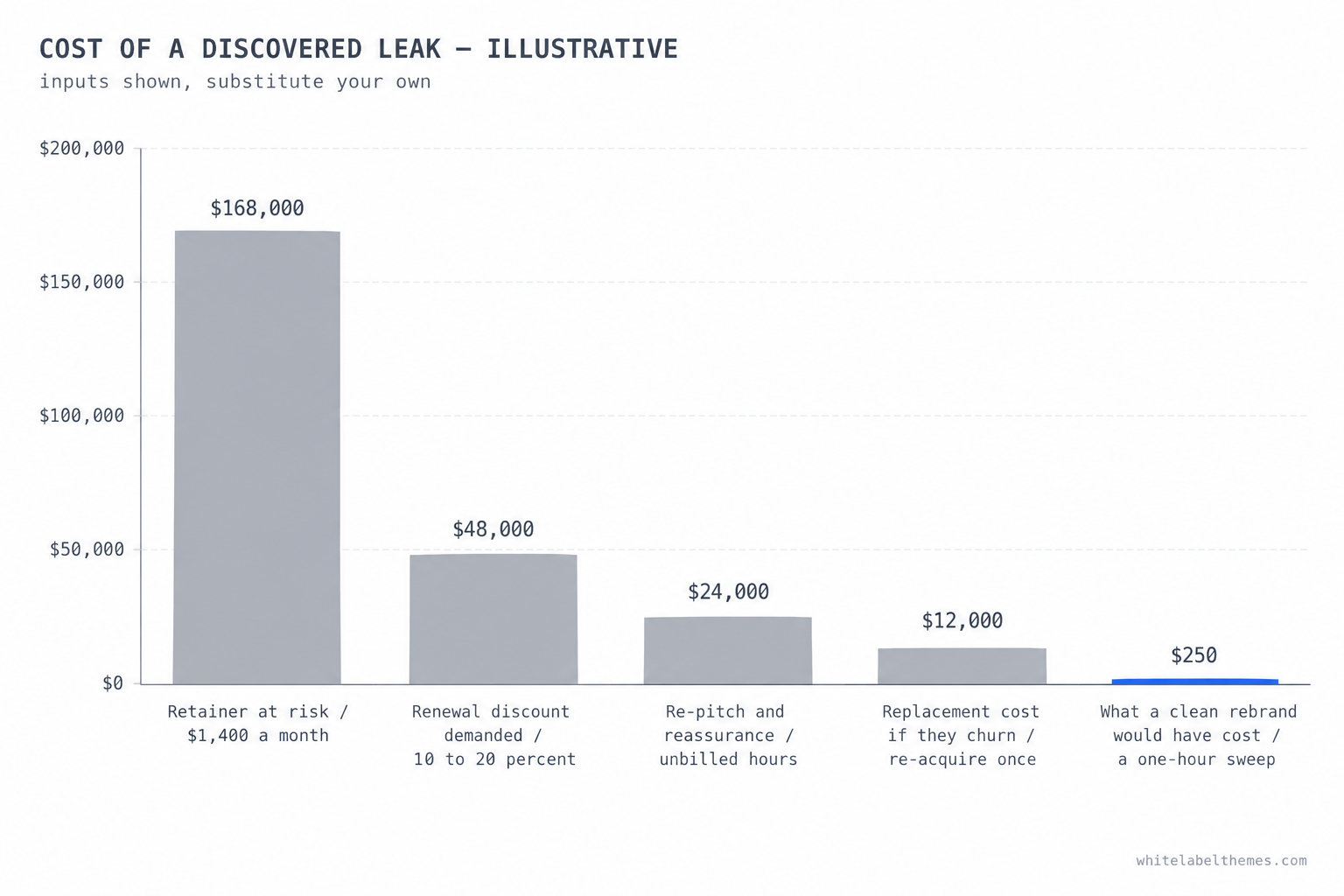
The number that makes the case is not any single bar, it is the last one. A full rebrand sweep is an hour of work the first time you build the muscle and less once it is a habit. Set that hour against a retainer you might renegotiate down, re-pitch for free, or lose entirely, and the trade is not close. If you have never costed your own hour honestly, the true cost to deliver a GoHighLevel client is the figure to drop into the prevention column, and it is almost always smaller than the renegotiation it prevents.
Four ways it goes wrong, and how to fix each
The seams explain where the footprint lives. These four are how the leak actually reaches a client in practice, written the way they happen rather than the way a checklist lists them, because every agency that has run more than a handful of installs has been bitten by at least two.
The sending domain gives it away on a phone
The symptom is a client forwarding an email their customer received, pointing at the sender address or the "via" line that names a domain they do not recognise. The cause is that email was never moved onto a domain the client owns, usually because using a shared sending domain was faster at setup. The fix is a client-owned sending domain authenticated at install, with the footer and reply-to set to match. It is slower on day one and it is the single seam that leaks to the largest audience, because an email header is read by customers, filters and competitors alike, so it earns the extra twenty minutes more than anything else on the list.
The support reply arrives in a stranger’s voice
The symptom is a client getting a reply to a support request that does not sound like you, uses a different signature, or comes from an address that is not on your domain, because you resell a support desk behind your brand and the handoff was not fully white-labelled. The cause is a reseller arrangement wearing white-label clothing, and the tell is in the agreement. The fix is to read your supplier contract for who may contact your client and under whose name, which is exactly the line between white label and reseller for agencies. A supplier who answers your client in their own voice has sold you a reseller deal with a white-label front, and no amount of sweeping the account fixes a person replying in the wrong name.
A consultant runs an audit you were not told about
The symptom is a sudden, specific question about an internal field, a workflow name or a template slug, arriving out of nowhere, because the client quietly hired someone to review the account and that someone did their job. The cause is a back-of-build that was never swept, so the audit found something to flag. The fix is to treat every account as though a professional will read it the week after handover, because sooner or later one will, and the folder names, funnel slugs and metadata that feel safe because they are internal are precisely what a reviewer opens first. Sweep them at install and the audit returns a clean account, which is the best possible outcome of an audit you did not know was happening.
The bookkeeper matches an invoice to the account
The symptom is the client asking why there is a subscription or an invoice in a supplier’s name tied to their service, because a bookkeeper reconciling payments noticed a line that did not match the agency they think they hired. The cause is billing that runs through your supplier directly to the client, or infrastructure invoiced in a name the client can see. The fix is to make sure every pound the client pays goes to you and every pound you pay a supplier is yours to explain, so there is no third name on any document the client’s finance function will ever read. Money leaves a paper trail that outlives any rebrand, and a trail is the one footprint you cannot sweep after the fact.
When the question lands: the hour after
Suppose the sweep was imperfect and the question arrives anyway. The worst response is a defensive one, because defensiveness reads as a confession of something worse than the truth. The truth is usually fine. You are an agency that delivers a system and stands behind it, and almost every agency the client has ever hired subcontracts or licenses something. What the client actually cares about is not whether you personally wrote every workflow, it is whether you are accountable for the result and whether they were misled. Answer those two, in that order, and most versions of this conversation end quietly.
What you do in the next hour depends on which reader found it and on what you promised at the start. The table below is the decision, scored on what you know rather than how the message made you feel.
| If this is true | Then |
|---|---|
| The client stumbled on it and seems confused, not angry | Reply fast and plainly. Name what they found, explain it is platform or build plumbing, confirm you are accountable, and fix the seam the same day. |
| A consultant flagged it in a report | Respond to the substance, not the tone. Fix every seam named, send back a clean account, and treat the audit as a free list of what to harden. |
| A competitor is using it to pitch against you | Compete on outcome and accountability, not on who held the keyboard. Fix the seams immediately so there is nothing left to point at, then have the retention conversation you were overdue. |
| You explicitly told them you build everything in house | This is the hard one, because the exposure is a promise, not a footer. Be honest about what you deliver versus what you assemble, and reset the promise before the gap widens. |
| You never claimed to build every keystroke | You have far more room than you think. Discretion is not deception. Explain that you deliver and stand behind the system, which is true and is what they bought. |
| The seam is a live customer touchpoint, like the sending domain | Fix it first, before any conversation, because a broken or foreign touchpoint reaching their customers is a bigger problem than the one in front of you. |
The through-line under every row is the same. Fix the technical seam immediately and separately from the conversation, because a fixed account changes what the conversation is about. Then answer the human question honestly, lead with accountability, and never let a footer turn into a referendum on whether you are a real agency. You are. The footer was an oversight, not a fraud, and the fastest way to make it look like fraud is to act as though it were one.
Three objections worth answering
These are the arguments an agency principal has with themselves before deciding how to handle any of this. Two are worth talking out of, and one is correct and worth saying plainly.
“I should just tell every client up front that I use white-label”
For some agencies that is exactly right, and for some it is a mistake, so the honest answer is that it depends on what you sell. If your positioning is transparency, partnership and "we assemble the best tools for you", then disclosing the stack is consistent and builds trust. If your positioning is a bespoke, built-for-you system at a bespoke price, then volunteering that it is a rebranded snapshot undercuts the thing the client is paying for. Neither is dishonest. What is dishonest is promising one and delivering the other, so the real decision is not whether to disclose, it is to make sure the promise you make at the sale matches the delivery the client can later inspect.
“Hiding the builder is dishonest either way”
It is not, any more than a restaurant hiding its supplier is dishonest. The client is buying a delivered, maintained, accountable outcome under your name and your guarantee, and that is a real thing you genuinely provide regardless of who exported the snapshot. The honest version of this business is not "I personally typed every automation", it is "I deliver this system, I stand behind it, and I am the one you call when it breaks". That is true, it is valuable, and it is the whole point of buying a white-label fulfilment capacity rather than hiring a team to rebuild the same system from scratch for every client. Discretion about the supply chain is normal commerce. Deception about the deliverable is the only line, and it is one you simply do not cross.
“Then a shared snapshot is the real exposure, not a footer”
This one is partly right, and it is the honest place to say when a product on this site is the wrong fit. If two of your competitors bought the same snapshot and all three of you install it unchanged, a sharp client comparing notes can see the shared DNA, and no footer sweep fixes that. The answer is not to avoid snapshots, it is to treat a snapshot as a foundation you build on rather than a finished product you forward, which is most of the buy-or-build decision on a snapshot. Rework the copy, reshape the funnels to your client’s actual offer, and the shared skeleton stops being visible. But if your entire promise is genuine one-of-a-kind bespoke, and your clients are sophisticated enough to compare builds, then a shared snapshot used as-is really is the wrong tool, and you should either customise heavily or build. Say so to yourself before a competitor says it to your client.
Prevention is an hour, not a policy
Everything above assumes the leak already happened or is about to. The entire problem is cheaper to solve upstream, and it is cheap enough that there is no good reason not to. Two habits remove almost all of the exposure, and both belong at install rather than in a panic later.
- Run the full rebrand sweep every time, as a list, before the client logs in. Not the website and the logo, the whole back of the build: sending domain, footers, SMS identity, calendar copy, workflow and folder names, funnel metadata, favicon and the messaging brand registration. Make it a standing step, not a judgement call you make when you remember.
- Set the client up on their own domain and sending identity from day one. It is the single decision that turns both a leak and an eventual exit from a migration into a non-event, because the most public seam, the one on every email header, is simply never foreign in the first place.
That is the whole defence, and it costs an hour. If you would rather not spend that hour per account building the habit yourself, it is exactly the work the snapshot rebranding service exists to take off your desk: the back-of-build sweep and the client-owned sending setup, done once, under your name, so the account you hand over has no name in it but yours. Whether you run the sweep or hand it off, run it before the client ever logs in, because the cheapest version of this entire piece is the conversation that never has to happen.
The short version
The promise that your client never sees your supplier does not hold by luck, it holds because the account carries no name but yours in any field a human will read. The front of the build gets rebranded because it is seen; the leak is almost always in the back, where a name is found rather than seen, across the sending domain, footers, SMS identity, calendar copy, internal names, funnel metadata, the favicon and the messaging registration. Clients find it three ways, and the one that loses accounts is a competitor looking on purpose, which is why the only reliable moment to fix it is at install and not after. The cost of a discovered leak is a retainer you renegotiate, re-pitch or lose; the cost of preventing it is an hour. Run the sweep as a list every time, put the client on their own domain from day one, and if the question ever does land, fix the seam first and answer the human honestly, because you deliver the system and stand behind it, and that was always the real product.
Quick answers
Related questions
Keep reading
Next in the series
Playbook · 11 min
How to Rebrand a GHL Snapshot Under Your Agency’s Name
The 11 places a builder’s identity hides inside a snapshot, in the order you should hunt them down — and the three that get agencies caught in front of a client.
Field guide · 13 min
What You Can Actually White-Label in GoHighLevel
The platform rebrands the software. It does not rebrand the build. Here is the line between the two, and the six places your name stops travelling and somebody else’s starts.
Operations · 13 min
When a Client Leaves and Wants to Take the Account
You have a thorough onboarding process and nothing at all for the other end. So the first real client exit becomes improvisation, and improvisation under pressure is where you give away work you owned or hold onto data you did not.