Pillar guide · 13 min read
White-label GoHighLevel: the operator’s guide
White-labelling GoHighLevel is a stack, not a switch. Here are the layers you brand, the plan that carries them, the product you hand over, and the margin that makes the whole operation pay.
Marcus Feld
Head of Build
Published
A prospect replied to your proposal with a single line: who is HighLevel, and why is my login taking me to their app. You had spent a fortnight building the account. Your logo was on the funnel, your name was on the invoice, and the mobile app they downloaded still wore somebody else’s brand on the splash screen. The work was yours. The platform was not, and for a second in front of the client it looked like the platform was the one they had hired.
That gap, between owning the work and owning the brand the client sees, is the whole of white-labelling GoHighLevel. Close it and you sell a system that reads as yours. Leave it open and you are quietly advertising the platform your client could have bought direct for two hundred and ninety-seven dollars a month. This is the operator’s guide to closing it: the layers you brand, the plan that carries them, the product you hand over, and the margin that makes the operation worth running. Every figure here is an assumption you should replace with your own, with one exception. HighLevel publishes its plan prices, and those are quoted as read this run rather than estimated.
What white-labelling GoHighLevel actually means
White-labelling is not one switch. It is a stack of separate layers, each of which can carry your brand or leak the platform’s, and an operation is only as white label as its weakest layer. A client who never sees a HighLevel logo on the desktop app will still find it on the mobile app, in an email footer, or in a snapshot link, if you have branded only part of the stack. The discipline is to treat every surface the client touches as a place your name has to be and the platform’s name cannot be.
The surfaces worth branding are a longer list than most agencies check, and what you can white-label in GoHighLevel walks the full inventory of them. This guide sits one level above that: not which surfaces exist, but how to run the whole operation so the brand holds from the first login to the final invoice.
The layers you switch on
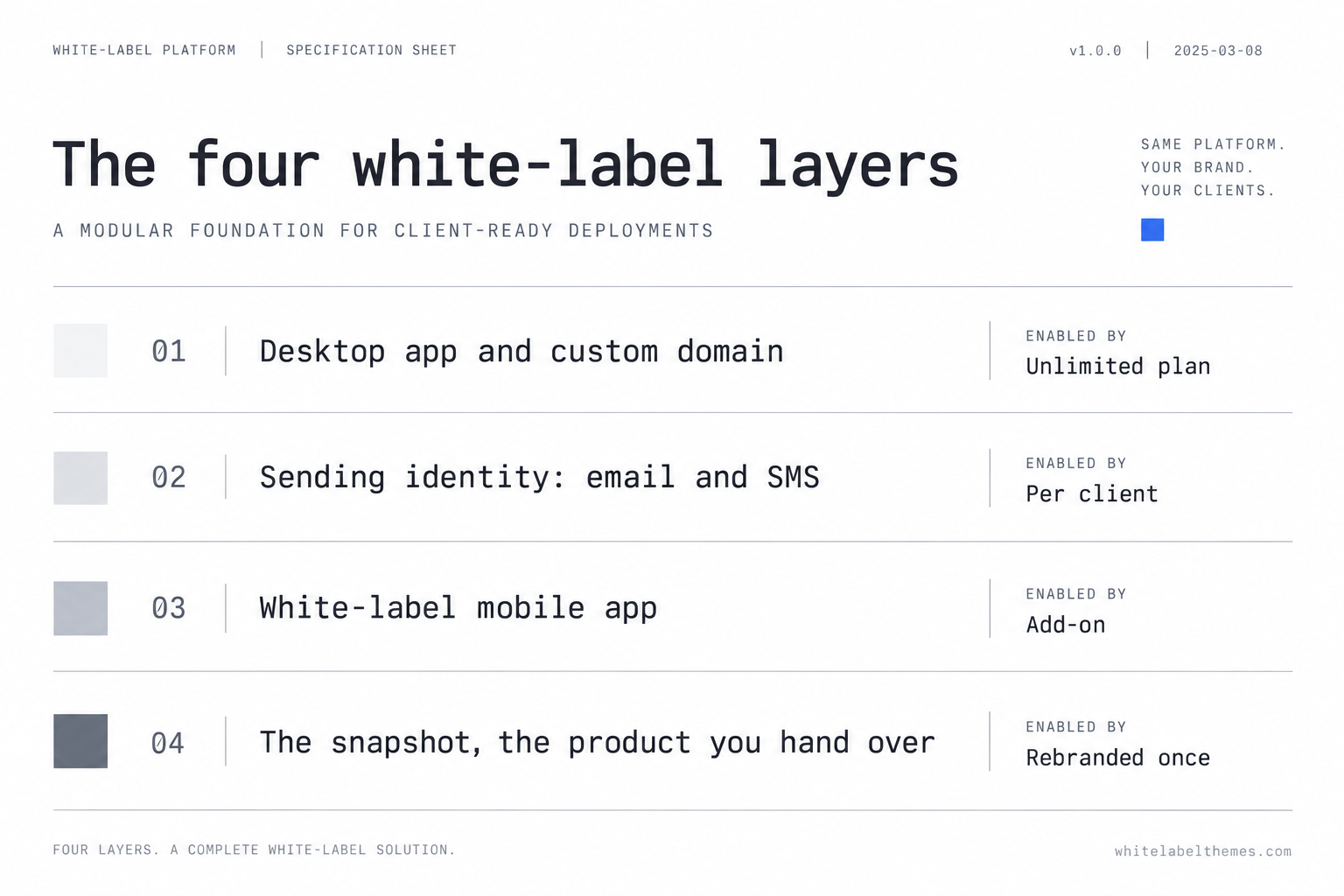
Four layers decide whether the client experiences your agency or the platform underneath it. Switch them on in order, because each is visible to a different person at a different moment, and the one you skip is the one the client happens to look at.
The desktop app and your domain
The first layer is the web app itself. On the Unlimited plan and above, HighLevel lets you serve the whole platform from your own subdomain, app.youragency.com rather than a HighLevel address, with your logo in place of theirs. This is the login the client opens every day, so it is the layer that matters most and the one people get right first. Set the custom domain, upload the mark, and the daily surface is yours.
The sending identity
The second layer is what leaves the account. Every email and SMS the system sends carries a sender, a footer and a set of links, and each of those is a place the builder’s domain hides. A snapshot built by someone else will often send from their sending domain, footer their address, and link to their booking page inside an automation nobody opened. Repoint all of it to your client before a single message goes out, because this is the layer the client’s own customers see, and it is the hardest to audit after the fact.
The mobile app
The third layer is the one that caught you in front of the prospect. HighLevel offers a white-label mobile app as an add-on, so the client installs an app with your name and icon rather than the platform’s. Until you set it up, the client downloads an app branded for a company they have never heard of, which is the single most common place a careful white-label operation still leaks. It is an add-on rather than a plan inclusion, so budget for it on purpose instead of discovering it the day a client asks why the app is not yours.
The product itself
The fourth layer is the system you hand over: the funnels, workflows, pipelines and templates that make the account worth paying for. This is the snapshot, and it is the layer this whole site is about. A snapshot rebuilt against your brand kit is the difference between handing a client a finished operation with your name on it and handing them a construction site with somebody else’s tools left on the floor.
The plan that carries it
None of the branding layers exist on the cheapest plan, so the plan decision is really a branding decision. HighLevel sells three tiers, and the jump that matters is the one from Starter to Unlimited, because that is where white-labelling begins at all. As read on the public pricing page this run:
| Plan | Monthly | Annual | What it gives a white-label operation |
|---|---|---|---|
| Starter | $97 | $970 | No white-labelling. Three sub-accounts, for building and testing only. |
| Unlimited | $297 | $2,970 | White-label desktop app, custom domain, unlimited sub-accounts. The floor for delivering under your own name. |
| Agency Pro | $497 | $4,970 | Everything in Unlimited, plus SaaS mode: resell the platform itself under your brand with your own markup. |
Those figures are from gohighlevel.com/pricing, confirmed via search snippet this run rather than independently fetched, with a fourteen-day trial on every tier and annual billing running roughly seventeen per cent below twelve monthly payments. Contacts and users are uncapped on all three. Starter cannot white-label at all, so for an operation that means anything the real choice is Unlimited at $297 or Agency Pro at $497, and the difference between those two is whether you are also reselling the platform as your own software.
The $297 line is the platform cost your whole margin sits on top of, and it is smaller than the cost that actually decides whether an agency makes money. What it really costs to run a GoHighLevel agency tears down the full base, usage wallet included, and it is worth reading before you price anything, because the platform bill is the number you already know and the one that matters least.
The product you actually hand over
The branding layers are plumbing. The product is the snapshot, and it is what the client is paying for whether they name it or not. A snapshot is a saved copy of an entire sub-account, funnels and workflows and pipelines and templates, that imports into a fresh account in minutes. Rebrand it once against your kit and it becomes the repeatable thing you sell, the same build every time, with a known install path and a known place every bug already got found.
You can build that product yourself over a run of evenings, or buy one already built for a trade and rebrand it. A rebrandable white-label snapshot is priced once and installs into every sub-account you run, so the cost per client falls with each client it serves. A single niche build such as the dental practice snapshot arrives as a snapshot link and a PDF with the full installation instructions, ready to rebrand rather than build from nothing.
The mechanic that makes rebranding fast is custom values. A well-built snapshot puts the business name, offer, price, address and booking link into a handful of custom values and references those everywhere, so rebranding is editing a dozen fields rather than opening ninety assets. A snapshot that hard-codes those details instead is a snapshot you will rebrand by hand, forever, once per client, and that hidden labour is where a cheap build turns out to be the expensive one.
Doing the sweep properly, so no asset still points at the builder, is its own discipline, and how to rebrand a GHL snapshot is the checklist for it. Skip it and you are back to the mobile-app problem: a brand that holds on the surface the client checks and leaks on the one they do not.
The numbers, on one worked example
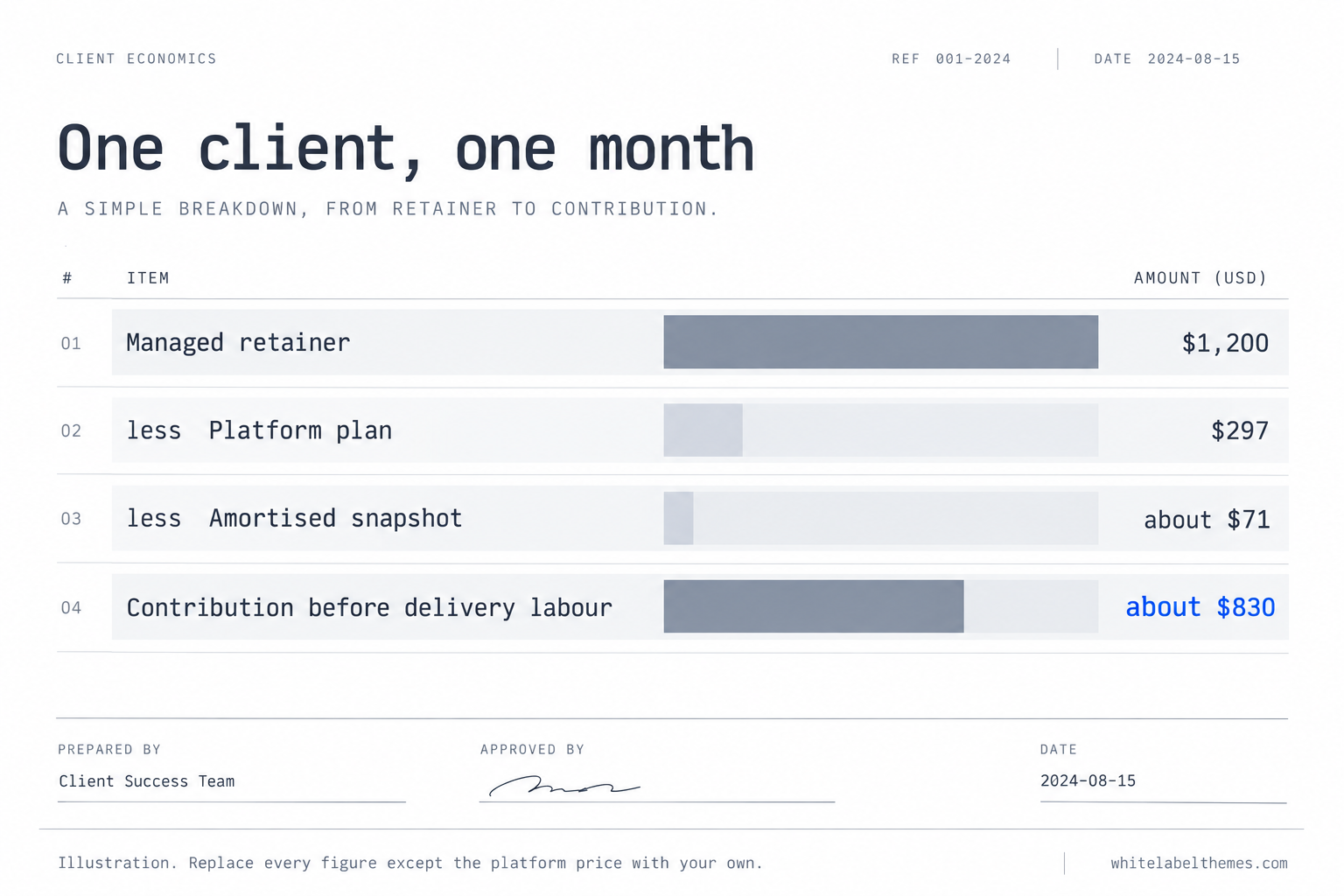
Put the plan and the product together and the operation has a shape you can price. Here is a worked example for an agency on Unlimited, reselling a rebranded snapshot as a managed system, with client usage rebilled so the platform’s wallet is not eating the margin. Every figure except the platform price is an assumption you should replace with your own. The point is the arithmetic, not the digits in it.
| Line | Amount | What it is |
|---|---|---|
| Platform plan | $297/mo | HighLevel Unlimited, published price, unlimited sub-accounts. |
| Amortised snapshot | about $71/mo | A $1,275 niche snapshot spread across eighteen months of service. |
| Your managed retainer | $1,200/mo | What you charge one client for the system and the work around it. Your number, not ours. |
| Rough contribution, one client | about $830/mo | Retainer less the platform line and the amortised build, before your own delivery hours. |
That is the edge white-labelling gives you. The branding layers and the snapshot are paid once and reused across the book, so the second client is cheaper to serve than the first and the tenth is cheaper still. A bespoke build for a single client can never do that, because it is thrown away the moment that client leaves. A reusable, rebranded asset gets cheaper per client with every account it lands in, which is why the fixed base of a white-label operation stays small even as the book grows.
What you actually charge is the number that decides the whole thing, and it is anchored to the client’s business rather than to your costs. That is where the margin is really set, and it is the difference between a retainer that survives a quiet month and one that does not.
Where the operator’s name leaks
A white-label operation fails at the seams, not in the middle. Each of these is a real leak with the same shape: a surface nobody rebranded, found by the one client who happened to look. Here are the five that account for most of the damage, with the symptom that shows first, the cause underneath, and the fix.
The mobile app still wears the platform
The symptom is a client texting you a screenshot of an app store listing for a company they have never heard of, asking if they downloaded the wrong thing. The cause is treating the desktop branding as the finish line and never budgeting the mobile app add-on. The fix is to decide up front whether the client will ever use the app, and if the answer is yes, to set up the white-label app before onboarding rather than after the awkward question. If the answer is genuinely no, say so to the client, so the platform brand on an app they never open is a known choice and not a discovery.
Email and SMS sending from the builder’s domain
The symptom is a reply-to address or an unsubscribe footer carrying a domain that is not yours or the client’s, spotted by a customer rather than by you. The cause is a snapshot imported and switched on without repointing its sending identity, so it keeps sending as whoever built it. The fix is to make sending identity a checklist item in every install: sender name, from-address, footer, and every link inside a workflow body, checked and repointed before the first message fires. This is the layer the client’s customers see, so a leak here is public in a way a login leak never is.
The snapshot that carries somebody else’s links
The symptom is a workflow that quietly books meetings onto the builder’s calendar, or a funnel reporting its traffic to the builder’s pixel, discovered months later when the numbers do not add up. The cause is a rebrand done by opening the obvious assets and skipping the buried ones: hard-coded links in SMS bodies, tracking IDs, favicons, Open Graph images. The fix is the full rebrand sweep rather than a find-and-replace, and, where you can, buying a snapshot built on custom values so the buried links were never hard-coded in the first place.
The platform cost, marked up where the client can see it
The symptom is a client forwarding you HighLevel’s public pricing page and asking why the platform line on their invoice is triple what they can see it costs. The cause is marking up a number anyone can look up in thirty seconds. The fix is to keep the visible platform line modest and recover your margin on the managed-system and growth work instead, where the value is your labour and not a subscription the client can price themselves. A markup they can catch does not just lose you that line, it makes them audit the whole invoice.
SaaS mode priced as a flat fee that ignores usage
The symptom is a SaaS plan that looked profitable at signup and goes underwater the month a client sends in earnest. The cause is a flat monthly fee set without the usage that flows through your wallet underneath it, so one heavy client eats the margin on several light ones. The fix is to price against usage from the start, on Agency Pro so you can rebill it with a markup rather than absorb it.
That last one is its own exercise, and pricing a GoHighLevel SaaS mode plan that survives usage walks the arithmetic of a fee that does not sink the first time a client actually uses what they are paying for.
Which white-label route to run
White-labelling GoHighLevel is not one business. It is at least four, and they differ in what you sell, what you carry, and where the margin comes from. Score your own situation against the routes below and one of them fits the constraint you actually have, which is almost always either time or capital.
| Route | What you sell | Best when | Watch out for |
|---|---|---|---|
| Build your own snapshot | A system you built, rebranded to each client | You have one or two clients, real slack in your week, and you enjoy the build | The maintenance and copy pass cost more than the week you counted |
| Resell a bought snapshot | A rebranded niche system, installed per client | You want a repeatable product without building it, and delivery is the constraint | A thin snapshot that hard-codes details and rebrands by hand |
| SaaS-mode resale | Access to the platform under your brand, on a recurring fee | Clients will pay for software they run themselves rather than for your hours | A flat fee a heavy client’s usage sinks; it needs Agency Pro |
| Done-for-you fulfilment | The outcome, with the build subcontracted under your name | You have sales but not delivery capacity, and want a fixed delivery line | A partner whose own brand leaks into the work; vet the seam hard |
The two routes most agencies actually pick are reselling a snapshot and subcontracting delivery, and they are not exclusive. A white-label fulfilment retainer turns variable delivery labour into a fixed monthly line, and snapshot rebranding hands you a build already carrying your brand rather than one you rebrand yourself. If you are still deciding between owning the build and buying it, white-label vs reseller for agencies draws the line between the two models before you commit to either.
Three things you are already arguing back
"I can just find-and-replace the builder’s name"
You can, and it will get the ninety per cent that was never the problem. Find-and-replace catches the logo and the obvious text. It misses the hard-coded booking link buried in an SMS step, the pixel ID reporting your client’s traffic to a stranger, the Open Graph image that shows the builder’s brand when a page is shared, and the internal notification that still emails the builder’s team. A rebrand is a sweep with a checklist, not a search box, and the assets it misses are exactly the ones a client finds first.
"White-labelling is vanity, the client does not care whose logo it is"
They do not care, right up until they can price the platform themselves. The moment a client sees a HighLevel logo, they can find HighLevel’s pricing in one search, and then the question is not whose logo it is but why they are paying you a multiple of a number they can now read. White-labelling is not vanity, it is what keeps the conversation on the system you built rather than on the subscription anyone can buy. The logo is the least of it. The pricing power is the point.
"Buying a snapshot just adds a cost I do not need"
Sometimes it does, and here is the honest case where buying anything from us is the wrong move. If you have one client, time in your week and you genuinely enjoy building, build it yourself, keep the whole margin, and learn the platform in your hands. You do not need a bought snapshot to serve a single account. The buy decision earns its keep the moment the build is repeated, because the licence installs it into every sub-account you run and the cost per client falls with each one. When capacity, rather than curiosity, is the constraint, a bought build is the cheaper answer.
Run the stack on purpose
White-labelling GoHighLevel is a stack, not a switch. Brand the desktop, the sending identity, the mobile app and the product; put the platform cost where the client cannot resent it; and price the system against the client’s business rather than your bill. Do that and the platform disappears behind your name, which is the whole promise this site is built on: you build it, you brand it, your client never sees us. Start from a build that already carries your brand and see what the margin looks like on your own numbers with the fulfilment calculator on the pricing page.
Quick answers
Related questions
Keep reading
Next in the series
Field guide · 13 min
What You Can Actually White-Label in GoHighLevel
The platform rebrands the software. It does not rebrand the build. Here is the line between the two, and the six places your name stops travelling and somebody else’s starts.
Positioning · 11 min
White Label vs Reseller: Which One Are You Selling?
The two models look identical on an invoice and behave completely differently at renewal. One of them leaves you owning the client. The other leaves you introducing them to your supplier.
Pricing teardown · 13 min
What It Costs to Run a GoHighLevel Agency Each Month
The platform invoice is the number every agency knows. It is also the small one. This is the fixed monthly cost base torn down line by line, the usage wallet nobody budgets for, the build spend spread across the months it serves, and the reason the fixed nut is almost never what actually caps your growth.