Margin and pricing · 13 min read
Why your agency is profitable and still broke
Profit is what you earned. Cash is what cleared. They are not the same month, and the gap between them is the thing that quietly ends agencies that were making money the whole time.
Marcus Feld
Head of Build
Published
The spreadsheet said you made three and a half thousand dollars last month. The card got declined at the petrol station on the thirty-first. Both of those are true at the same time, and the gap between them is the single most common way a profitable agency gets into trouble. Nothing is wrong with the business. The money is real. It is just not in the account yet, and the bills did not wait.
This is the problem nobody warns you about, because it only shows up once you are winning. A struggling agency does not have a cashflow problem, it has a revenue problem, and those feel different. Cashflow trouble arrives when the pipeline is full, the clients are happy and the P&L is green. You are growing, and growth is exactly what is eating the bank balance.
Profit is an opinion, cash is a fact
These are two different measurements and most agency owners only watch one of them. Profit is an accounting idea: revenue you have earned, minus costs you have incurred, over a period. It does not care whether the money has moved. The day you send a client their invoice, you have earned the revenue, so it counts as profit, even though the cash is nowhere near your account.
Cash is the opposite. It does not care what you earned. It cares what cleared. A retainer you invoiced on net-30 terms is profit today and cash in five weeks. A setup fee a client has agreed to is profit the moment you book the work and cash whenever their finance department gets round to it. Your accountant looks at the first number. Your bank looks at the second. When they disagree, the bank wins, because you cannot pay a fulfilment invoice with profit.
This is a different question from whether the work makes money at all. An agency can have a healthy profit margin and still miss payroll, because margin is measured over a year and the bank is measured on a Tuesday. A thin-margin agency that collects every invoice up front is in far less danger than a fat-margin one that invoices on net-30 and pays its suppliers on delivery.
The mechanism: where the gap actually comes from
The gap is not one thing. It is four or five timing mismatches that stack on top of each other, and they all point the same way: money leaves before money arrives. Here is each one, because you cannot close a gap you have not named.
Your costs are paid on delivery, your revenue clears later
When you subcontract a build to a fulfilment desk or a VA, that invoice is usually due when the work is handed over, not when your client pays you. So the cost lands in week one and the revenue it produced lands in week five. You funded the difference out of your own balance, whether you noticed it or not.
Even card payments do not clear the day they are charged
People assume a card charge is instant cash. It is not. Stripe pays most US accounts on a rolling two business day basis, so Monday’s payment reaches your bank on Wednesday, and nothing settles over a weekend or a public holiday. Your very first payout is slower still, typically seven to ten days after the first successful charge while the account is verified (stripe.com/payments/payouts, confirmed via published documentation). Two days is survivable. The point is that even your fastest-paying clients are never truly same-day, so every outgoing payment you time against "the money came in" is running a day or two ahead of the money.
The platform bills you monthly whether or not the client has paid
HighLevel publishes $97 a month for its Starter plan, $297 for Unlimited and $497 for the Agency Pro tier that lets you resell (gohighlevel.com/pricing, confirmed via published pricing this week). That subscription rebills on its own date, not yours. On top of it, the messaging is metered: SMS and voice usage is billed per segment and per minute, so a busy client month is a bigger platform bill, and it arrives before that client’s invoice clears. Your fixed costs do not pause while you wait to be paid.
One invoiced client resets the whole clock
Most of this is manageable while every client pays by card on the first of the month. The moment you take on one larger client who insists on being invoiced on net-30, or net-45, you have added a month-long hole to your cycle for a slice of your revenue, and it is usually your biggest slice. Bigger clients negotiate terms. Terms are a cashflow decision dressed up as a procurement formality.
Annual bills do not spread themselves out
Your domain renewals, your email-sending plan, your design tools, your accountant: a handful of these are billed once a year, and they all land in some particular month. On the P&L a $2,400 annual tool is $200 a month. In the bank it is $2,400 on one specific day, and that day does not consult your receivables.
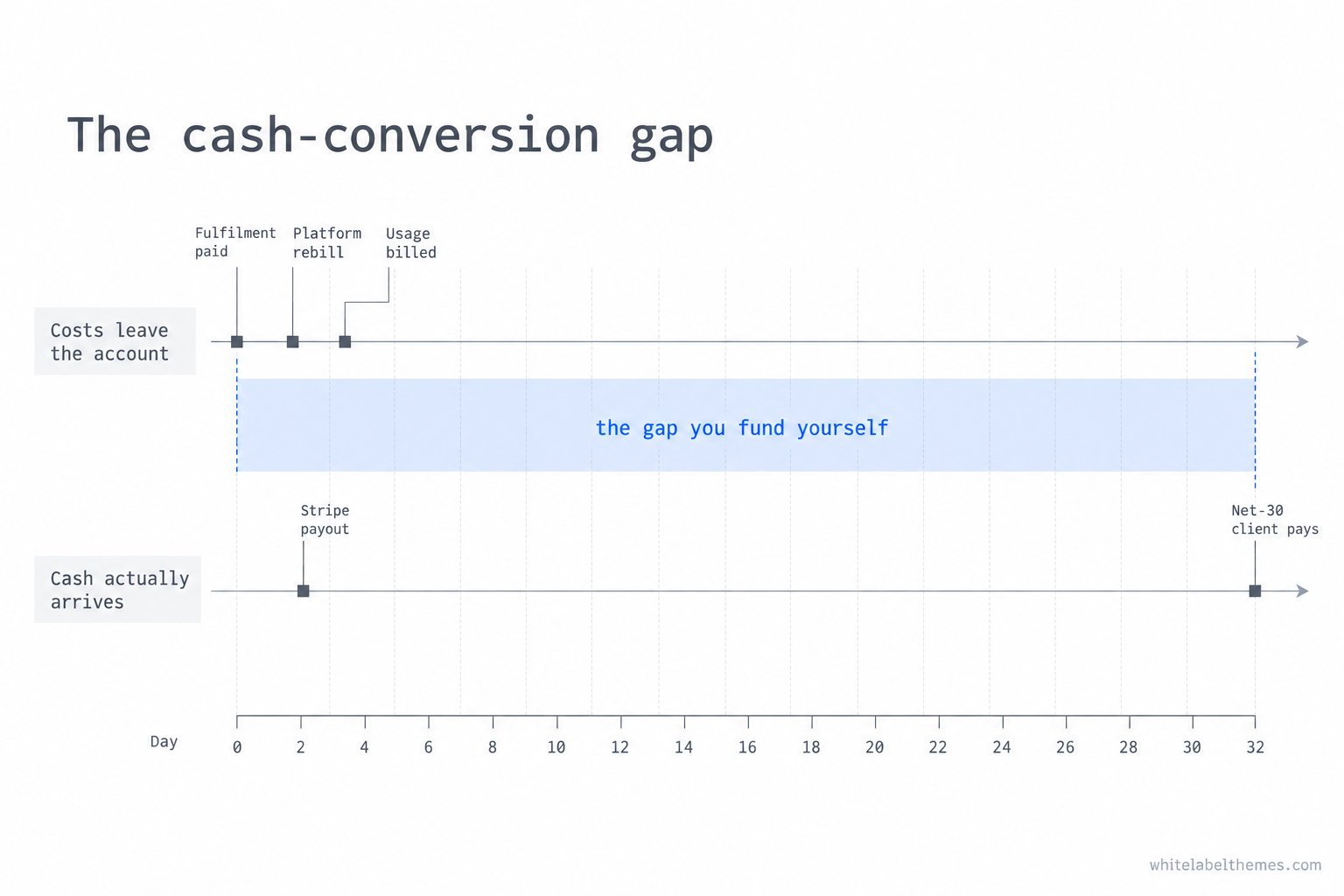
Fig. 01 is the whole problem on one axis. The markers on the left are your costs, which cluster in the first few days. The markers on the right are your money arriving, which is spread across the month and, for anyone on terms, spills into the next one. The band in the middle is not a loss. It is a loan you are making to your own business, interest-free, every single month, and it grows every time you add a client.
The numbers: a month that is profitable and empty
Abstractions do not persuade anyone, so here is a worked month with every input visible so you can swap in your own. These are illustrative figures, not a client’s accounts, and the whole point is that you replace them. Say you run five retainer clients at $2,000 a month and you onboard one new client this month with a $2,400 setup fee.
On the profit and loss, the month looks like this:
| Profit and loss (what you earned) | Amount |
|---|---|
| Five retainers at $2,000 | +$10,000 |
| One new-client setup fee | +$2,400 |
| Delivery (fulfilment desk and support) | −$4,200 |
| Platform and tools (monthly share) | −$1,100 |
| Owner pay | −$3,500 |
| Profit for the month | +$3,600 |
A three thousand six hundred dollar profit on twelve thousand four hundred of revenue. Healthy. Now the same month in the bank, where only what cleared is allowed to count. One of your five retainer clients is the big one, on net-30, so this month’s payment has not arrived. The new client was invoiced for the setup and has not paid yet either. And this is the month your annual email-sending plan renewed, at $2,400 in one go.
| Bank balance (what actually cleared) | Amount |
|---|---|
| Opening balance | $2,800 |
| Profit for the month | +$3,600 |
| Retainer earned but not yet collected (net-30) | −$2,000 |
| Setup fee invoiced, not yet paid | −$2,400 |
| Annual tool paid in full, not just this month’s share | −$2,200 |
| Closing balance | −$200 |
You made three thousand six hundred dollars and you are two hundred dollars overdrawn. Nothing in that is a disaster, a bad client or a mistake. It is three ordinary timing facts stacked in one month: a client on terms, an unpaid setup fee, and an annual bill that happened to fall due. The profit is real and will turn into cash in the next few weeks. The overdraft is also real and is due now.
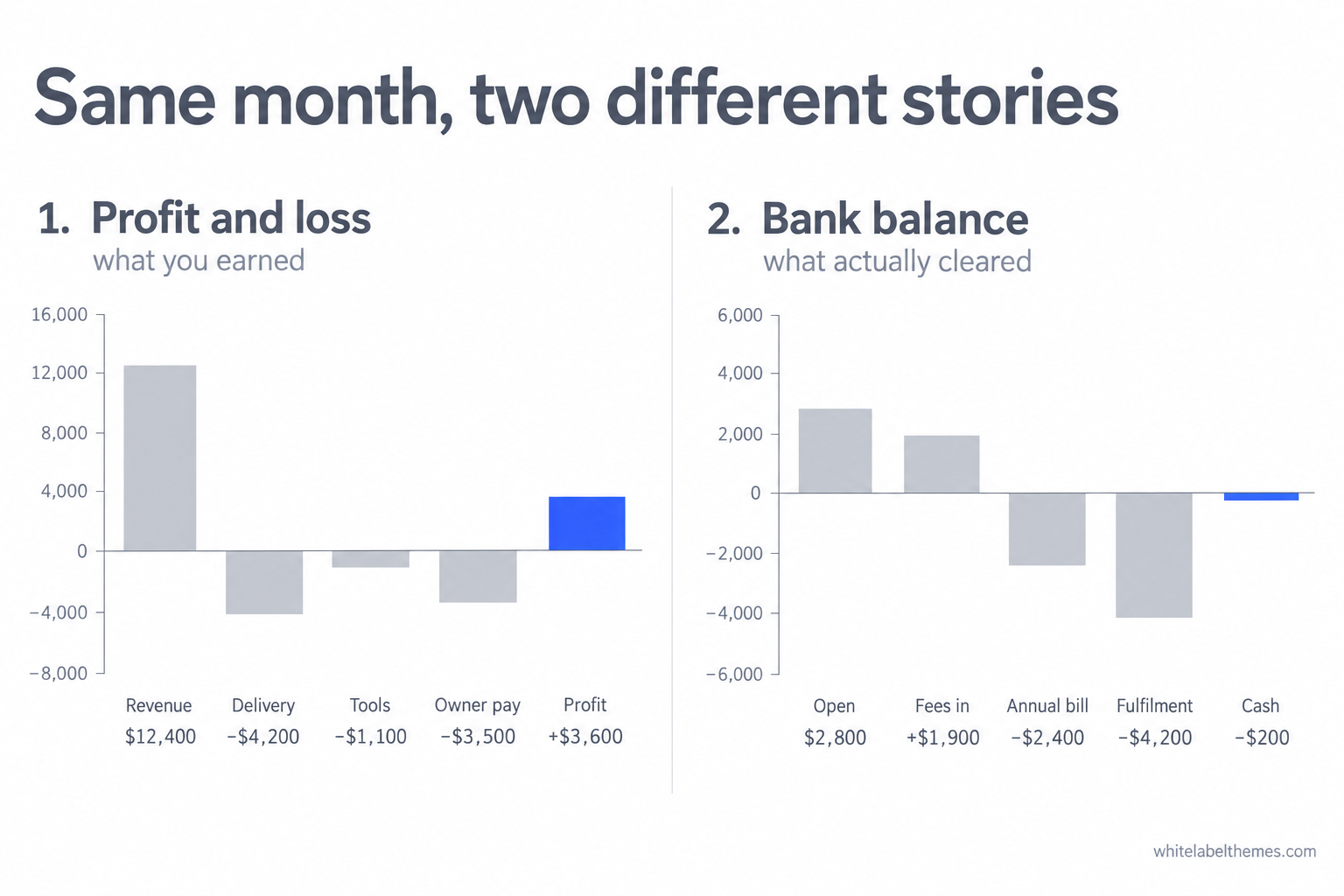
Fig. 02 puts the two side by side. Read left to right, the profit column ends above the line and the cash column ends below it, from the same set of facts. The reconciliation is the useful part: start from the $3,600 profit, subtract the $4,400 of revenue you earned but have not collected, subtract the extra $2,200 of annual bill that cash paid in full but the P&L only charged a twelfth of, and you arrive at the two-hundred-dollar hole. Every line of that is a timing difference, and every one of them is fixable with a term change rather than a price change.
Measure your own gap in days
You do not need accounting software to size this. You need two numbers. The first is how long, on average, from doing the work to the cash landing in your bank. Card clients on the first of the month might be two or three days. A net-30 client is thirty days plus the Stripe settlement on top, so call it thirty-two. Blend them by how much revenue each represents.
The second number is how long you get to hold on to your own cash before your costs are due. If your fulfilment desk invoices on delivery and your platform rebills mid-month, you are paying most things within a week. Subtract the second from the first and you have your cash gap in days.
- Average days to collect, weighted by revenue. Card-on-the-first clients pull it down, net-30 clients pull it up hard.
- Average days before your costs are due. Pay-on-delivery suppliers and a fixed monthly platform bill pull this down to almost nothing.
- The difference is the number of days of your own money you have tied up in the business at any moment. Multiply it by your average daily cost and that is the cash buffer you actually need, before a single thing goes wrong.
The multiplier matters because the buffer is real money sitting idle. If you want to shrink it rather than fund it, there are only two levers: collect sooner, or pay later. Everything below is one of those two. And if the cost side is the problem, the honest fix may be structural rather than procedural, which is where what a single client actually costs you to deliver stops being an accounting curiosity and starts deciding whether you can afford to grow this month.
Four ways the gap turns into a crisis
A cash gap is normal and survivable. It becomes a crisis when one of these four things happens to an agency that was not watching the bank, only the P&L. Each has a symptom, a cause and a fix.
1. The growth trap
The symptom is that your best month ever is also your tightest. The cause is that each new client is a cost paid now against revenue paid later, so a burst of wins is a burst of outflows with the inflows lagging a month behind. The fix is to make new clients cash-positive on day one: a setup fee charged before the build starts, on a card, not invoiced after handover. A build you have not been paid for is a loan you have extended to someone who is not yet a client.
2. The annual-bill ambush
The symptom is a month that is inexplicably tight for no new reason. The cause is one or more annual renewals landing together, invisible on the monthly P&L because they were quietly amortised. The fix is a one-page calendar of every annual and quarterly bill, by month, so you can see the heavy months a year out and hold cash back for them deliberately instead of being surprised four times a year.
3. The one-big-client concentration
The symptom is that your whole month depends on a single payment arriving. The cause is a revenue base where one client, usually the one who negotiated net-30, is a large share of the total. When their finance team is slow, your whole cycle stalls. The fix is partly commercial, a deposit or a shorter term written into that contract, and partly structural, enough smaller card-paying clients that no single late payment can take the month down.
4. The churn-mid-build hole
The symptom is a client who leaves, or pauses, after the expensive part is done but before enough retainer has been collected to cover it. The cause is the mismatch between a heavy front-loaded delivery cost and a thin monthly fee meant to recoup it over many months. The fix is to make the setup fee genuinely cover the build, so the retainer is profit from month one rather than a slow repayment of a debt the client can walk away from.
That last one is why the setup fee is not optional and is not a discount lever. What to charge for a snapshot install works through the number, but the cashflow version of the rule is simpler: the up-front fee should clear your up-front cost before the first retainer is due, so that a client who churns in month two still leaves you square rather than short.
The decision: your delivery model is a cashflow decision
How you produce the work decides how exposed your bank is, and most owners pick a delivery model on margin alone without noticing it is also a financing choice. There are three common ways to deliver a client, and they sit in very different places on cash risk.
| Delivery model | Up-front cash out | Cash out per new client | How well cost matches revenue timing | Pick it when |
|---|---|---|---|---|
| Build in-house with salaried staff | High: payroll runs whether or not you sold anything | Low marginal, but fixed overhead is always there | Poorly: salary is due every month regardless of your pipeline | Demand is steady and high enough to keep staff busy |
| Buy a reusable snapshot, resell it many times | One-time cost per vertical, then near zero to deploy again | Very low: the second install costs almost nothing | Well once bought: the asset is paid for and every sale after is margin | You deliver the same system repeatedly and can fund the one-time buy |
| Rent a white-label fulfilment desk per build | None: you pay only when you have sold a build | Matches the job, due on delivery | Best for a lumpy pipeline: no cost until there is a sale behind it | Demand is uneven and you do not want fixed payroll |
The second row is the one most agencies underuse, because the cash logic runs backwards from the intuition. Buying a white-label snapshot is a cash outflow today, which feels like the opposite of fixing a cash problem. But it converts an open-ended, per-client delivery cost into a one-time purchase you then resell at full margin, which is the single biggest structural improvement you can make to the cost side of the cycle. The third row, a white-label fulfilment retainer, fixes a different half: it makes delivery cost arrive only when a sale is already behind it, which is exactly what a lumpy pipeline needs.
Which of the two you reach for depends on how volatile your demand is, and the break-even between renting fulfilment and hiring a builder does that arithmetic. For cashflow specifically, the ranking is clear: rent when the pipeline is uneven, buy the reusable asset once the same build repeats, and hire salaried capacity last, only once demand is steady enough that fixed payroll is safe rather than brave.
The objections you are already making
Three arguments come back every time this comes up, and all three have a straight answer, including the one where buying anything from us is the wrong move.
- "I will just raise my prices." A higher price is more profit, and profit is not the problem. A client who pays you more on net-45 has made your cash gap larger, not smaller, because the bigger number arrives just as late. Price fixes margin. Only terms fix cash.
- "I will get an overdraft or a line of credit." You can, and it is a legitimate bridge for a genuinely seasonal business. But credit funds the gap, it does not close it, and you pay interest for the privilege of lending your own clients money. Use it to cover a known heavy month, never as the permanent reason the business clears each month.
- "So I should buy a snapshot library to fix my cashflow." Not if you have two clients. A five-snapshot pack is a real cash outflow, and on this site it is floored at $850 each regardless of the twenty per cent multi-buy, so five of even our lowest-priced vertical is $4,250 out of the account today. If you are not yet reselling the same build repeatedly, that outflow makes your cash position worse, not better. Buy the asset when the volume is already there to amortise it, not as a way to escape a gap you can close with a deposit clause this afternoon.
The fixes, in the order that works
Every durable fix is some version of collect sooner or pay later. In rough order of how much they move the needle for the least effort:
- Charge the setup fee up front, on a card, before the build starts. This single change turns every new client from a cash drain into a cash injection, and it is the one with the largest effect.
- Default every retainer to card-on-file on a fixed billing date, and treat net-30 as an exception a client has to ask for and justify, not the standard you offer. The quieter your invoicing, the healthier your bank.
- For any client who genuinely needs terms, take a deposit that covers your delivery cost, so the term applies only to your margin and never to your out-of-pocket.
- Offer annual-up-front with a real discount. A client who pays twelve months in one go has handed you a year of cashflow for the price of one month of margin, and that is a trade worth making almost every time.
- Keep the annual-bill calendar and hold cash back for the heavy months on purpose.
- Only after all of that, size and fund a buffer equal to your cash gap in days times your daily cost, so an ordinary tight month is boring rather than frightening.
None of this requires new revenue, and that is the point. It is the same clients, the same builds and the same retainer you have already priced, collected on a schedule that keeps your bank ahead of your bills instead of behind them.
What this never changes for your client
None of this is visible to the business you are serving or to their customers. The call still gets answered at nine at night, the appointment still gets confirmed and reminded, the no-show still gets a recovery call against a seventy per cent recovery target, the finished job still produces a review request aimed at a steady five to ten reviews a month. Your cashflow discipline is entirely yours. The client experiences a system that works, and never learns that the month you installed it was the month your own card got declined.
That separation is the whole business. You build it, you brand it, your client never sees the machinery behind it, and that machinery includes your bank account as much as your fulfilment.
The short version
Profit is what you earned and cash is what cleared, and they are rarely the same month. The gap comes from costs paid on delivery, card payments that settle a couple of days late, a platform that rebills on its own schedule, clients on terms and annual bills that land all at once. Measure the gap in days, charge setup fees up front, default to card-on-file, take deposits before you extend terms, and keep a buffer the size of your gap. Do that and a profitable month and a solvent bank account finally become the same month.
Quick answers
Related questions
Keep reading
Next in the series
Pricing teardown · 13 min
Profitable on Paper, Broke in the Bank
Your model says the retainer clears fifty-something per cent. The operating account says otherwise. This is the teardown of the gap between the margin you quote yourself and the margin you actually bank, with the arithmetic, the five leaks in the order they cost you, and the fix for each.
Pricing teardown · 13 min
What It Costs to Run a GoHighLevel Agency Each Month
The platform invoice is the number every agency knows. It is also the small one. This is the fixed monthly cost base torn down line by line, the usage wallet nobody budgets for, the build spend spread across the months it serves, and the reason the fixed nut is almost never what actually caps your growth.