Delivery · 12 min read
How to cut GoHighLevel onboarding from three weeks to four days
The build takes a day. Onboarding takes three weeks. The gap is almost never the work, it is the waits running in a line instead of side by side. Here is where the time goes and the four levers that get it back.
Priya Nandan
Delivery Lead
Published
The retainer closed on a Tuesday. You sent the kickoff form that afternoon, felt good about the month, and moved on to the next thing. Sixteen days later the client messages you: are we live yet. The honest answer is no. You are waiting on their logo in a format you can actually use, a DNS record their old web guy has not added, and a text-messaging registration that went in late and still has not cleared. The first retainer payment, meanwhile, landed in your account eleven days ago.
Nothing in that account is broken. The snapshot imported cleanly. The build is good. The onboarding is just slow, the way almost every agency’s onboarding is slow, and slow onboarding is not a service-quality problem you can apologise your way out of. It is a margin problem and a churn problem wearing the costume of a scheduling delay.
Here is the part that costs you. The client is not counting from the day you started building. They are counting from the day their card was charged. Every day between those two points is a day they are paying for something they cannot see, and the first ninety days of a retainer are where a client quietly decides whether they were right to sign. An onboarding that runs three weeks spends most of that goodwill before the system has done one useful thing, and the cash you float on an unbilled build is tied up the whole time.
Where the three weeks actually go
Onboarding feels slow in a diffuse way, as though the whole thing is just heavy and there is nothing to be done about it. That is the wrong picture. The delay lives in a small number of specific waits, and most of them are sitting in a queue behind each other when they could be running at the same time.
The idea worth borrowing here is the critical path: the single longest chain of things that have to happen in order, where each link cannot start until the one before it finishes. Everything off that chain is slack you are not using. The reason a four-day onboarding and a three-week onboarding can contain exactly the same work is that one of them ran the independent steps in parallel and the other ran them in a line.
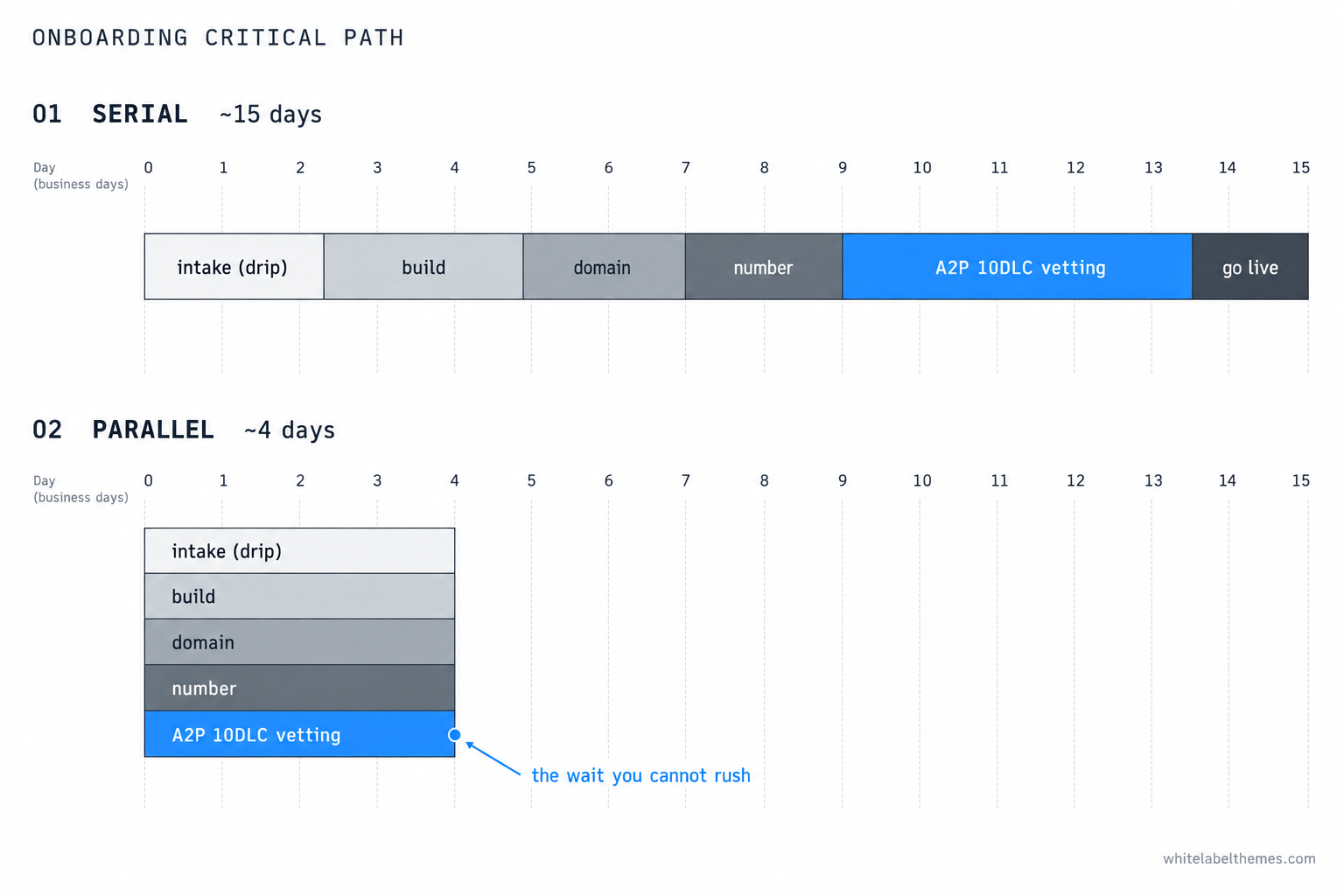
Walk the chain of a normal build. The snapshot import itself is quick, usually under an hour for the mechanics and a focused day for the rebrand sweep, which a good import checklist turns into a known routine rather than a hunt. What stretches is everything that depends on somebody outside your desk: the client sending usable brand assets, a domain being pointed, a dedicated number being provisioned, and above all the text-messaging registration clearing.
That last one is the wait you cannot shorten by working harder. Any GoHighLevel sub-account that sends SMS to United States numbers has to register for A2P 10DLC, and the registration is vetted by a third party on a clock you do not control. Twilio, which runs that vetting for GoHighLevel numbers, puts standard campaign approval at up to five business days and tells you to raise a ticket only if it is still pending after ten (its A2P 10DLC campaign vetting FAQ at support.twilio.com, read via search this run rather than fetched directly). Brand approval takes a couple of business days before the campaign stage even begins. Start the registration on day one and it clears underneath everything else you do. Start it after the build is finished and it becomes the entire second week on its own.
What three weeks of dead time actually costs
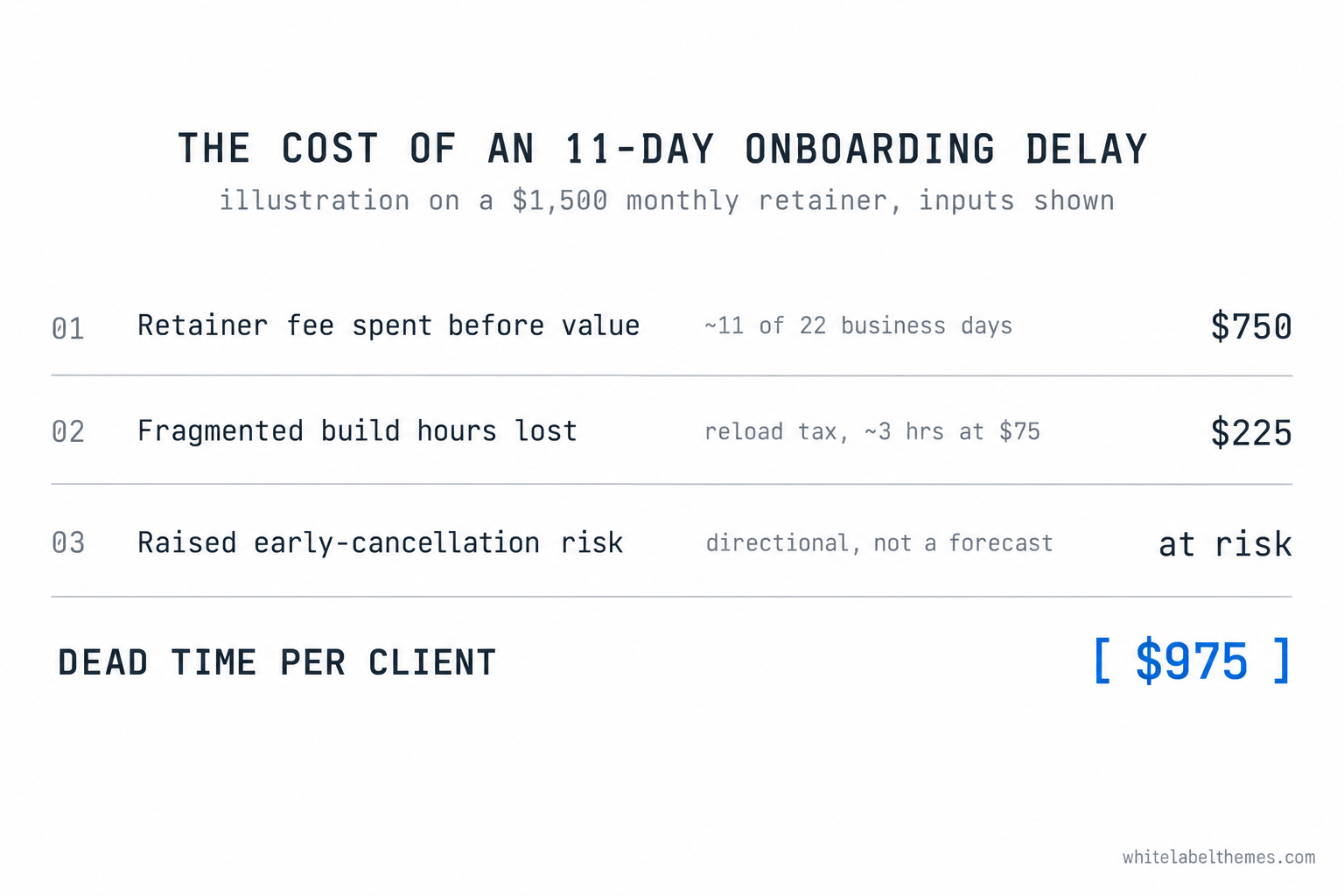
The cost of a slow onboarding is easy to wave away, because no invoice anywhere says the words dead time on it. It shows up in three places instead, and none of them lands on a timesheet.
The first is the retainer you are spending before the client sees value. If you bill fifteen hundred dollars a month and the client goes live eleven business days later than they needed to, you have burned about half a month’s fee delivering nothing they can point to. That is not cash out of your pocket, but it is goodwill out of the account, and goodwill is what renewals are made of. The second is your own time, fragmented: a build that would take one focused day gets smeared across three weeks because you keep setting it down to wait for the client, and picking a job back up costs you the time to remember where you were, every single time. That reload tax is pure waste, and it is a large slice of what one client actually costs you to deliver.
The third is the cancellation you never attribute to this. A client who waited three weeks to go live and then has a quiet first month is a client doing the sums on whether to stay. On your dashboard the onboarding delay and the early cancellation look unrelated, because sixty days separate them. They are the same event. The slow start set the mood, the quiet month confirmed it, and the churn report filed it under results when it belonged under delivery.
Four failure modes that stretch an onboarding
Slow onboardings are not slow for mysterious reasons. They are slow for four, and every one of them has a symptom you can recognise this afternoon and a fix you can apply this week.
The drip-fed intake
The symptom is that you are always waiting on one more thing from the client, and the things arrive one at a time across a fortnight. The cause is that you asked for information as you discovered you needed it, so every gap you hit started a fresh round trip and a fresh day of waiting. The fix is to ask for everything once, in a single structured intake, before the clock starts. The agencies with the fastest onboardings are not faster builders; they are the ones who never have to ask the client a second question. A complete onboarding intake, sent once, is worth more to your delivery time than any amount of build speed.
The late telecom clock
The symptom is a build that is finished, polished and signed off, sitting idle because the client still cannot send a text. The cause is that the A2P registration felt like a finishing task, so it was done at the end, after the funnels and the workflows were pretty. The fix is to submit the brand and campaign registration on day one, alongside pointing the domain and provisioning the number, before you open a single funnel. The vetting then runs beneath the work rather than after it, and the week you would have spent watching a status bar disappears entirely.
Approval ping-pong
The symptom is that every deliverable sits in an open loop waiting for the client to say yes, and the client takes three days to reply to each one. The cause is that you sent open-ended messages asking them to let you know their thoughts, with no deadline and no default, so replying carried no urgency and no consequence. The fix is to send each approval with a specific question, a preview they can look at in ten seconds, and a date after which you proceed as built. Silence should advance the project, not freeze it. The difference between those two behaviours is a sentence at the bottom of the message.
The fragmented build
The symptom is that the work itself is small but it never gets a clean run at it. The cause is that you scheduled the build around the client’s drip of assets and your own other clients, so it happened in twenty-minute slivers between other jobs. The fix is to refuse to start the build until the intake is complete and the telecom clock is already running, then build it in one or two blocks rather than fifteen. A snapshot exists precisely so the build is a short, repeatable install; fragmenting it across three weeks throws away the one advantage you paid for, and turns a productised install back into a custom project.
Four ways to compress it, compared
There are only four real levers, and most agencies reach for one of them while leaving the other three on the table. Here is what each one buys you, scored across the eight things you would weigh before spending money or effort on anything.
| Front-load the intake | Telecom on day one | Template the approvals | Buy the install | |
|---|---|---|---|---|
| Days it removes | 4 to 7 | 5 to 8 | 2 to 4 | your whole build week |
| Upfront effort | Build one intake once | Change your work order | Write five messages once | None; you hand it off |
| Cash cost | Nothing | Nothing | Nothing | $250 per account |
| Risk to build quality | Lower; fewer guesses | None | None if the asks are sharp | Low; same QA path |
| Holds across your book | Yes; reuse the form | Yes; it becomes a habit | Yes; reuse the messages | Yes, at $250 each |
| What the client feels | Asked once, never chased | Live the day the build ends | A project that keeps moving | Fastest; live in days |
| How reversible | Fully | Fully | Fully | Per order; take it or not |
| Best when | Always; it is free | Any US client sending SMS | You run three-plus at once | Your week is the bottleneck |
The first three cost you nothing but a few hours of setup you do once and reuse forever, so the honest answer is to do all three regardless. They are not alternatives to one another; they stack. Front-loading the intake removes the round trips, starting the telecom clock early moves the one unshortenable wait off the critical path, and templated approvals stop the project freezing between deliverables. Together they turn three weeks into roughly four days on their own, without a dollar spent.
The fourth lever is the one that changes the shape of the problem rather than tightening the existing one. If the constraint is not the client’s assets but your own capacity, no amount of intake design fixes it, because the bottleneck is the hours you do not have this month. That is the delivery ceiling every growing agency hits, and it is a different problem from a badly ordered week. When your own build week is the long pole, you can take it out of the critical path by buying the install: the snapshot arrives built and rebranded, and the account goes live under your client’s brand without a day of your time in the middle. We deliver the snapshot itself inside 24 business hours, and the install and onboarding handled for you is an optional add-on priced at $250, which sits deliberately apart from the build you pay for.
Objections you are already making
My clients are the bottleneck, not me
Often true, and it still does not let you off. You designed the intake that let the client drip assets to you across a fortnight. You wrote the approval messages that invited a three-day silence. You chose to start the telecom registration at the end. The client’s pace is largely a product of the structure you put them inside, and the structure is the half you control completely. A client who is genuinely slow despite a single clean intake and deadlined approvals is rare, and that one you schedule around on purpose, with your eyes open, rather than discovering in week two that you have lost a fortnight.
Four days feels rushed, and rushed reads as cheap
Compressed is not rushed. Rushed means skipping steps in the QA path; compressed means running the independent steps at the same time instead of in a queue. The build is identical. The checklist you run before handover is identical. The only thing that changed is that the domain, the number and the A2P registration were moving while you rebranded, rather than waiting politely for their turn. A client cannot see your calendar. What they see is a system that was live the week they paid for it, and that reads as competence, not haste. The agency that took three weeks did not look more thorough to anyone but itself.
Buying the install just admits I cannot do it, and it eats the margin
Sometimes buying the install is the wrong move, and it is worth saying so plainly rather than selling past it. If you have the hours this month, the install is a known, repeatable job you already know how to run, and the $250 is margin you get to keep. Do it yourself. The add-on earns its place in the month when your own time is the thing in short supply, which is a capacity question and not a competence one, the same distinction that decides whether to buy fulfilment or hire a builder. Spending $250 to protect a fifteen-hundred-dollar-a-month retainer that is wobbling because the client waited three weeks is not an admission of anything. It is arithmetic, and the arithmetic is not close.
The four-day onboarding, in order
Put together, the compressed version is not clever. It is the same work with the waits overlapped and the client asked only once.
- Day zero, the hour the retainer clears: send one structured intake that asks for every asset, access and decision you will need, with a short recorded walkthrough showing exactly where the client finds each one.
- Day one: submit the A2P brand and campaign registration, point the domain, and provision the dedicated number, before you open the build. The vetting clock now runs underneath everything that follows.
- Day one to two: import and rebrand the snapshot in one or two focused blocks, not around the edges of other work. A well-built snapshot keeps the client’s name in custom values, so the rebrand is a handful of fields rather than a sweep through every asset.
- Day two to three: send every deliverable for approval in a single pass, each with a preview, a specific question and a date after which you proceed as built.
- Day four onward: the registration clears somewhere in this window, and because the account is already built, rebranded, approved and pointed, going live is a switch you flip rather than a week you start.
Nothing in that sequence is faster building. It is the identical build, begun only once the waits were already running. The three-week version does exactly the same work and spends two of its three weeks watching a queue it chose to stand in.
If you want to take your own build week out of that critical path for good, the white-label snapshots on this site arrive inside 24 business hours, and the optional install puts the account live under your brand without a day of your time in the middle. Point your real client count and build hours at the fulfilment calculator on the pricing page and let it tell you whether your onboarding is a scheduling problem or a capacity one before you decide which lever to pull. Your client never learns either one existed.
Quick answers
Related questions
Keep reading
Next in the series
Checklist · 12 min
The GoHighLevel Client Onboarding Checklist
The account being ready is not the same as the client being onboarded. This is the fourteen-day sequence that happens around the build, under your brand, and it is what the client actually judges you on.
Seasonal playbook · 13 min
The January Delivery Backlog: Planning Intake Capacity
The last build went out before Christmas and the office closed for eleven days. Then four new clients, two renewal deliverables and a full existing book all wanted the first fortnight of January. Nobody oversold. Everything was promised into the same two weeks. Here is how to count that collision in hours before it lands, and which lever closes the gap.
Operations · 11 min
Scaling a GoHighLevel Agency: What Breaks and When
Agencies do not stall because they run out of leads. They stall because delivery hits a ceiling at a predictable client count, and the ceiling moves only if you fix the right thing in the right order.
Margin maths · 11 min
What One GoHighLevel Client Actually Costs You to Deliver
Most agencies know their revenue per client to the dollar and their cost per client to the nearest guess. Here is the ledger that closes the gap, and the line that is almost always missing from it.