Expansion revenue · 13 min read
How to increase revenue per GoHighLevel client
The cheapest sale in your agency is to the client already paying you. Four expansion sales, scored on eight things, with the year-one arithmetic on one account.
Priya Nandan
Delivery Lead
Published
It is month nine with a dental client. You installed the snapshot, rebranded it, got the texting registered, and the account runs itself now. Reminders go out. Reviews come in. The pipeline moves without you touching it. So you spend your week where every agency principal spends it, chasing a stranger who has never heard of you, writing a proposal that will take three calls to close, while the person already paying you $1,500 a month gets a quarterly check-in and nothing else.
That is the leak. Not churn, not pricing, not lead flow. The leak is that the easiest revenue in your business is sitting inside accounts you already run, and most agencies never go and get it.
There is a figure from Marketing Metrics, by Farris and his co-authors, that gets quoted so often it has gone slightly stale, and it is still true: you have a 60 to 70 percent chance of selling something to a customer you already have, against 5 to 20 percent for a stranger (the number is repeated across the marketing literature, for instance at socialmediatoday.com/news/5-sexy-rules-of-customer-retention). The money follows the same curve. SaaS survey data from Pacific Crest and KeyBanc, summarised by Paddle at paddle.com, puts the cost of expansion revenue at roughly 27 cents per dollar won, against about a dollar and thirteen cents for a brand new customer. You are leaving the cheapest dollar in the business on the table, and you are leaving it next to the retainer you already price every month.
This is a piece about the opposite habit. Four things you can sell a GoHighLevel client you already deliver for, what each one is worth, what it costs you to put in, and how to tell which one the account in front of you is actually ready for. The numbers here are illustrative and the inputs are printed so you can substitute your own. None of them is a result from a customer. They are the shape of the maths.
The four things you can actually sell a client you already have
There are really only four, and they are different enough that confusing them is where the money goes missing. Sell the wrong one into the wrong account and you either give away margin or you pour delivery hours into a client who was about to leave anyway.
- The reactivation campaign. You mine the dormant half of the client’s own database, the leads and past customers who went quiet, with a timed win-back across text and email. It is revenue they already paid to acquire and then stopped talking to.
- The reputation engine. You switch on, or properly tune, the review-request and no-show-recovery behaviour the account was always capable of. This is the one that most often ships half configured, because the import works and nobody checks whether the asks are actually firing.
- The second location or the second vertical. The client opens another site, buys a competitor, or launches an adjacent service, and needs the whole system again. This is the only lever that adds a second recurring retainer rather than a one-off.
- The build-out. The client wants a capability the base build never had: a referral motion, a reactivation engine for a new service line, a quoting flow, a membership. Something configured on top of what shipped.
Everything an agency ever upsells into a live GoHighLevel account is one of those four or a combination of them. What follows scores them against each other, because the right answer changes with the client.
The mechanism: why the second sale is cheaper than the first
The expansion sale is cheaper for reasons that are mechanical, not motivational, and it is worth being precise about them because the reasons are also the limits.
The account is already live. You are not provisioning a sub-account, registering the texting, warming a domain or running a fourteen-day onboarding. The expensive, slow, unbillable part of delivery is done, and it is done once per client no matter how much you sell them afterwards. Every pound of the first sale paid for infrastructure the second sale rides on for free.
The data is yours to use. A reactivation campaign on a new client means begging them for a list, cleaning it, and guessing at consent. On an account you already run, the list is sitting in the CRM you built, tagged the way you tagged it, with the opt-in history attached. You can scope the campaign in an afternoon because you can see what is in there.
The relationship exists. You are not in a 5 to 20 percent cold conversation. You are the person whose system books their appointments, and when you say the dormant list is worth a campaign, you are believed, because the last thing you built works. That is the whole of the 60 to 70 percent. It is trust you already earned and are not spending.
That is also the ceiling. Expansion revenue is cheap because the relationship and the infrastructure already exist, which means it is worth nothing on an account where the first build is limping, the client is unhappy, or the retainer is already in arrears. The mechanism that makes the second sale cheap is the same mechanism that makes it pointless to attempt on a leaky account. Fix the first thing first.
Lever one: the reactivation campaign
Every service business has a graveyard in its CRM: enquiries that never booked, customers who came once, quotes that were never chased. For a home-services client it is two or three years of missed-call leads. For a med spa it is everyone who had one treatment and drifted. The list is already paid for. Nobody is talking to it.
You can run this yourself on the client’s own data using the build you already shipped, or you can hand the whole thing to us and keep your weekend: database reactivation, run for you, comes back as a staged win-back under your brand, with the client’s name on it and ours nowhere. Either way the thing you are selling is not a new asset. It is attention on an asset the client forgot they owned.
The honest caveat belongs here, not buried later: a reactivation campaign is a one-off by nature. It adds a spike, not a recurring line, and you can only run the same list so many times before it is genuinely dormant rather than merely neglected. It is the fastest money of the four and the least repeatable. Price it as an event, not a subscription.
Lever two: the reputation engine
This is the quiet one, and it is usually already half built. The snapshot shipped with review requests and no-show recovery in it. The question nobody asks at handover is whether they are firing, firing at the right moment, and firing in the client’s voice. Most are not. The review ask goes out at the wrong time, or only on one channel, or it was switched to draft during testing and never switched back.
Turning it on properly is close to pure margin because the assets exist. You are configuring and timing, not building. And it is the lever that maps directly onto the two outcomes this system is designed to target: a review engine aiming at five to ten reviews a month, and a no-show sequence aiming to recover around 70 percent of appointments that would otherwise have been lost. Both are targets the build is built to hit, not results we can promise on your client’s behalf, and you should sell them exactly that way: as what the system is for, measured against the client’s own before-and-after.
Lever three: the second location or the second vertical
This is the heavy one. When a client opens a second clinic, buys out a competitor, or launches a service line that needs its own funnels and pipeline, they do not need a tweak. They need the whole system again. And because the whole system means a second setup fee and a second monthly retainer, this is the only one of the four that moves the account’s recurring value rather than adding a bump to it.
If the new site is the same trade, you already own the build, so your marginal cost is the install and the rebrand, not the snapshot. If it is an adjacent trade, you buy the right one from the white-label snapshot catalogue and install it clean. What you must not do is stretch the first build to cover a trade it was not written for. The maths on one snapshot per niche is settled: across a trade family the reuse holds, across unrelated trades the generic half carries over and the expensive, trade-specific half does not, and the client notices the half that does not.
This lever is also where delivery capacity bites. A second location is a second onboarding, and if your delivery is already the constraint, selling another one into a full week makes the backlog worse, not the bank balance better. Sell this when you have the hours, or when the margin on it funds the hire that creates them.
Lever four: the build-out
The build-out is the capability the base system never carried: a referral loop, a membership flow, a quoting sequence, a reactivation engine purpose-built for a new offer. It is the most bespoke of the four, which makes it the most dangerous to price, because a build-out that was quoted as a one-off and then quietly turns into unpaid maintenance is how a profitable client becomes a break-even one.
You can build it, or you can hand us the spec and resell the result: workflow and automation build-outs come back tested, documented and under your brand, with a fixed price and a date, so the thing you quote the client is the thing you actually owe. Whichever way you deliver it, quote the maintenance separately from the build, because the build ends and the maintenance does not.
Scored across the eight things that decide which one to sell
Four levers, and the account in front of you can usually only take one this quarter. Here is the eight-point grid that decides it. Score the lever against the client, not in the abstract, because the same lever ranks differently for a single-location dentist with a fat dormant list than it does for a multi-site contractor who has never had a review ask go out.
- Setup fee: what you can charge the client once, up front.
- Monthly uplift: what it adds to the recurring retainer, if anything.
- Cost to deliver: your hours, or what you pay to have it done for you.
- Time to first revenue: how fast it bills after the client says yes.
- Delivery effort: how heavy and how repeatable the work is.
- Churn effect: whether it makes the client harder to lose.
- White-label integrity: whether the new work stays invisibly yours, with no supplier fingerprint reaching the client.
- Who delivers it: whether you, a trained VA, or a bought-in service can do it.
| Criterion | Reactivation | Reputation engine | Second location | Build-out |
|---|---|---|---|---|
| Setup fee | Medium | Low | High | Medium to high |
| Monthly uplift | None | Small | Full second retainer | Small, if any |
| Cost to deliver | Low to medium | Very low | Medium | Medium to high |
| Time to first revenue | Days | Days | Weeks | Weeks |
| Delivery effort | Light, one-off | Very light | Heavy, full onboarding | Variable, scope risk |
| Churn effect | Weak | Strong | Very strong | Moderate |
| White-label integrity | Full, if run right | Full | Full | Full, if specced right |
| Who delivers it | You, VA or bought in | You or VA | You or bought in | You or bought in |
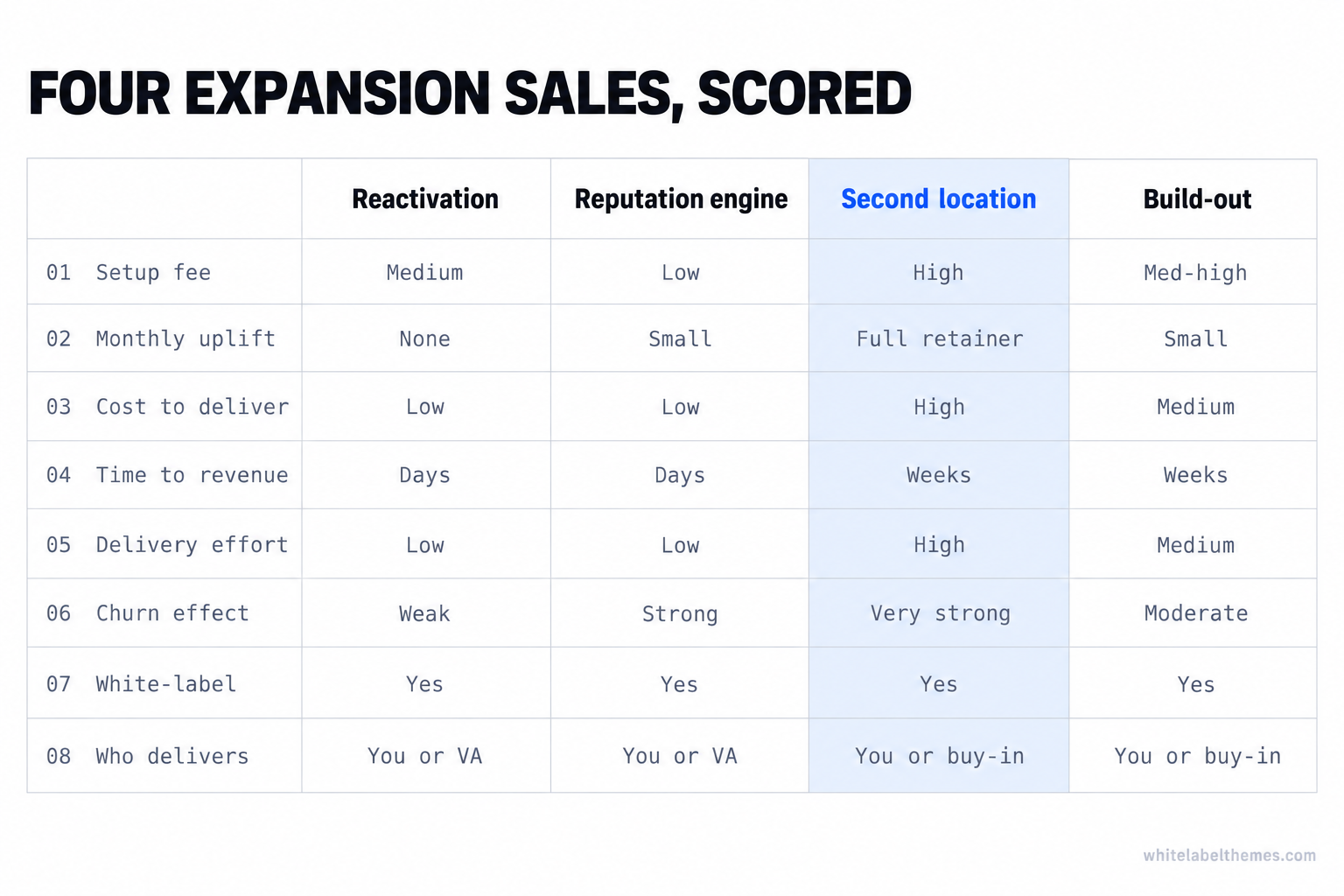
Read down the churn row before you read anything else. The reputation engine and the second location make a client measurably harder to lose, because one of them ties your work to the reviews the client watches every morning and the other ties it to two revenue lines instead of one. The reactivation campaign, for all that it is the fastest cash, does almost nothing for retention. If you only ever sell the fast one, you are taking the cheap money and skipping the money that keeps the account.
The arithmetic, on one client
Take each lever in turn against that client, Year one, margin after what it costs you to deliver.
Reactivation, bought in: you charge the client $2,250 for a staged win-back on their dormant list. You hand the delivery to us at $1,150 and spend perhaps $300 of your own time scoping and reporting. Year-one margin, about $800. No recurring. Fast, clean, and finished.
Reputation engine: you charge $750 to audit and switch on the review and no-show behaviour, then add $150 a month to the retainer to own the ongoing reporting. The delivery is configuration, so your hard cost is a few hours. Year one is $750 plus $1,800 of uplift, call it $2,550 of revenue at close to full margin. Small money, almost no cost, strong on churn.
Second location, same trade: the client opens a second practice. You charge a $1,500 setup fee and a second $1,500 monthly retainer. You already own the dental build, so your marginal cost is the install and rebrand, say $400 of time. Year one is $1,500 plus $18,000, which is $19,500 of new revenue, almost all of it recurring. This single lever is worth more than the other three combined, and it is the one agencies forget to ask about.
Build-out: the client wants a referral engine the base system never had. You charge $2,200, hand the build to us at $1,200, and quote $100 a month to maintain it. Year one is $2,200 plus $1,200 of maintenance, margin after cost around $2,200. Useful, but scope-sensitive, and only as clean as the spec.
| Lever | Client pays, year one | Your cost | Adds to recurring | Year-one margin |
|---|---|---|---|---|
| Reactivation (bought in) | $2,250 | $1,450 | Nothing | about $800 |
| Reputation engine | $2,550 | A few hours | $150 / month | about $2,400 |
| Second location (same trade) | $19,500 | about $400 | $1,500 / month | about $19,100 |
| Build-out (bought in) | $3,400 | $1,200 | $100 / month | about $2,200 |
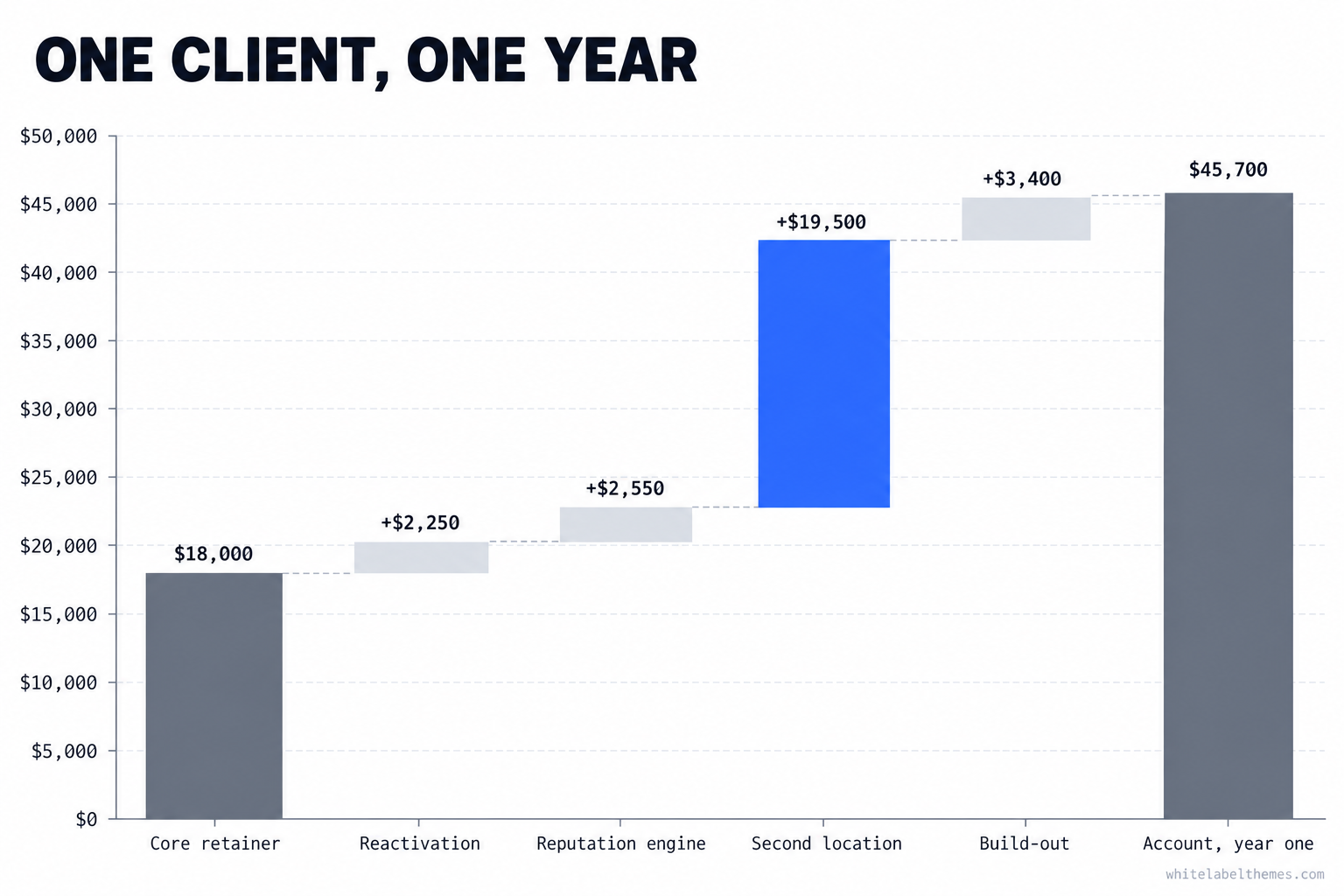
The shape is the point. The lever everyone reaches for first, the reactivation blast, is the smallest bar on the chart. The lever that doubles the account, the second location, is the one that needs you to have asked a single question at the last review: are you opening anything new this year. The reputation engine earns its place on margin and churn rather than size. Stack the three that the client can take and you have turned an $18,000 account into one worth comfortably north of $40,000 in a year, without winning a single new logo.
Four ways the expansion sale goes wrong
You discount it to keep the client comfortable
The symptom is a build-out quoted at $2,200 that goes out at $1,400 because it felt awkward to charge an existing client full rate. The cause is treating expansion as a favour rather than a product. The fix is to price the expansion exactly as you would price it for a stranger, because the client is not comparing it to nothing, they are comparing it to the value of the thing you already deliver, and that comparison is in your favour. If you are not sure the expansion clears its own cost, that is a reason to check what the work actually costs you to deliver, not a reason to discount. A discount here does not buy loyalty. It teaches the client that your prices are soft.
The build-out becomes unpaid maintenance
The symptom is a one-off that still generates support tickets eight months later, none of them billed. The cause is quoting the build and the upkeep as one number, so the upkeep has no price and therefore no end. The fix is to separate them at quote time: a fixed price for the build, a named monthly line for maintenance, and an explicit boundary in writing on what the monthly covers. The build ends. The maintenance is a subscription, and subscriptions are how you survive the gap between projects, so charge for it.
You expand an account that is about to churn
The symptom is pouring a second location into a client who stops paying two months later. The cause is reading the easy yes as health when it was really a client being polite on the way out. The fix is to check the account before you pitch: is the retainer current, is the first build actually being used, has the client logged in this month. Expansion revenue is cheap because the relationship exists. On a dying account the relationship does not exist, so the cheapness evaporates and you are just doing free work for someone who is leaving.
You stretch the first build instead of installing the right one
The symptom is selling a second vertical by find-and-replacing the business name in the first snapshot, because it is faster than installing a fresh one. The cause is treating the build as branding sitting on top of generic plumbing, when the trade-specific logic is most of what the client paid for. The fix is to install the correct trade from the catalogue and rebrand that, cleanly, under your name. A stretched build reads wrong to the client’s customers in exactly the places that matter, and the person who signed off on it is you.
Three things you are already arguing back
“My clients are on fixed retainers. I cannot just add charges.”
You are not adding charges to the retainer. You are selling a new, named deliverable that sits beside it, with its own scope and its own price, which the client can say yes or no to. A reactivation campaign is not a retainer increase, it is a project. A second location is not a renegotiation, it is a second contract. The retainer is for the work the retainer covers. Everything in this piece is work the retainer never covered, which is exactly why you can price it.
“I would rather win new clients than upsell the ones I have.”
Sometimes that is the right call, and it is worth naming when. If your delivery has spare capacity, your accounts are already fully expanded, and your acquisition is cheap and working, then new logos are the better use of the next hour, and you should go and win them. But most agencies are not in that position. Most are delivery-constrained, with accounts that have never been offered a second thing, and a close rate on strangers that sits in the low teens. If that is you, the expansion sale is not a consolation prize. It is the higher-margin, faster-closing, lower-risk half of the business you have been ignoring because it does not feel like growth. It is growth. It just does not come with a new logo to post about.
“Buying the delivery from you eats the margin I am trying to protect.”
Sometimes, and sometimes not. The arithmetic above shows real margin even after our cost, because the client pays for outcome and you pay for labour, and the gap between those two is the whole business. But if you have a skilled builder sitting idle on a slow week, doing it in-house is plainly cheaper, and you should. The honest rule is capacity: buy the delivery when buying it is faster than the revenue it brings in, do it in-house when you have hours going spare anyway. We would rather you bought the snapshot and ran the expansion yourself than bought a service you did not need. The point of the catalogue is that the expensive, repeatable build is already done. What you do on top of it is yours to keep.
The decision, by the client in front of you
Stop scoring the levers against each other in the abstract and score the account. The right expansion is the one the account is actually ready for, and it is usually obvious once you have looked.
- Big dormant list, one location, happy client: run the reactivation first for the fast cash, then book the reputation engine for the retention.
- Reviews thin, no-shows high, behaviour never switched on: the reputation engine is the cheapest win in your whole book, and it makes the client harder to lose. Do it before anything else.
- Client growing, opening sites, buying competitors: the second location is the entire game, and the only question that surfaces it is one you ask at every review.
- Client asking for something the build never did: scope the build-out, price the build and the maintenance separately, and buy in the delivery if the calendar is full.
- Retainer in arrears, build unused, client quiet: sell nothing. Fix the account or let it go. Expansion on a leaky account is free work for someone who is leaving.
If you want to see which expansion your accounts are ready for before you price anything, the fastest route is to map the services that sit on top of a live build against the clients you already run, set each one beside what the product and the labour actually cost, and work out which ones you buy in and which you keep in-house. The build underneath is done and carries your name; the revenue on top of it is the part nobody can take from you.
Quick answers
Related questions
Keep reading
Next in the series
Operations · 10 min
White-Label GHL Fulfilment: How to Price Agency Retainers
Cost-plus pricing caps your agency at the size of your delivery team. Here is the maths behind value-based retainers, with the four numbers that decide whether a retainer survives month four.
Pricing teardown · 13 min
One Snapshot Per Niche, or One You Stretch?
You can install a GoHighLevel snapshot into as many of your own sub-accounts as you like, which tempts every agency to buy one and reskin it for every client. For a book that spans several trades, that is usually the expensive mistake. Here is the stocking arithmetic: when one snapshot stretches, when it cannot, and the point where the five-snapshot pack is cheaper than buying singles one at a time.
Pricing teardown · 13 min
Profitable on Paper, Broke in the Bank
Your model says the retainer clears fifty-something per cent. The operating account says otherwise. This is the teardown of the gap between the margin you quote yourself and the margin you actually bank, with the arithmetic, the five leaks in the order they cost you, and the fix for each.